
introduction
- 格式:ppt
- 大小:879.50 KB
- 文档页数:27


好的introduction的标准一个好的介绍是一篇能够引起读者兴趣,概括主题,并以有趣、独特和令人印象深刻的方式展示内容的写作。
它应该具有吸引力,清晰明了地传达目的,并激发读者继续阅读下去的欲望。
在撰写一个好的介绍时,以下几个要素是需要考虑的:1. 引起读者兴趣:通过启发性的问题、有趣的事实或独特的观点,引起读者的好奇心。
一个引人入胜的开头可以让读者觉得这篇文章值得花时间阅读。
例如,"你曾经想过这个世界上有多少种不同的语言吗?从中文到英语,从西班牙语到阿拉伯语,这个星球上有数千种语言。
每一种语言都是一个独立的现象,背后有着丰富的文化和历史。
本文将带你深入了解语言的奇妙之处。
"2. 概括主题:在引人入胜的开头之后,明确介绍文章的主题,并简要概括内容。
这样读者可以对接下来的内容有一个清晰的预期。
例如,"本文将探索语言的起源、发展和影响。
我们将深入了解语言的重要性,以及它如何连接和影响不同的文化和社区。
同时,我们还将介绍一些有趣的语言事实和故事。
"3. 引用故事或实例:通过引用一个真实的故事、突出的事件或个人经历等,以一个生动的例子来支持主题。
这种引用可以帮助读者更加深入地理解主题,并与之产生共鸣。
例如,"在19世纪末的美国,亚裔移民面临着严重的歧视和排斥。
他们的语言和文化在当时被认为是异质的,而不是与美国主流社会相融合的一部分。
然而,通过他们坚守自己的语言和文化,亚裔移民成功地建立了独特的社区,并在社会经济中发挥了重要的作用。
"4. 提出问题或观点:通过提出一个引人思考的问题或观点,激发读者思考,并为接下来的内容做好铺垫。
例如,"我们是否可以通过语言来打破隔阂和促进理解?你是否曾经遇到过某种语言的挑战,以及如何克服这些挑战?本文将探讨这些问题,并提供一些有用的建议和见解。
"5. 引起读者情感共鸣:通过使用感性语言、描述性细节或讲述动人的故事,引起读者的情感共鸣。

用introduction造句-回复1. As an introduction to the class, I would like to welcome everyone and outline the course objectives.2. The introduction of new technology has greatly improved our productivity in the workplace.3. In his speech, the speaker provided a brief introduction to the topic and then delved deeper into its complexities.4. I will begin my presentation with a brief introduction to the history of the company.5. The book's introduction provides a captivating overview of the plot, enticing readers to delve into the story.6. As an introduction to our vacation destination, let me share some stunning photos of the beaches and landmarks.7. The introduction of renewable energy sources has been instrumental in addressing climate change issues.8. The introduction of stricter security measures has significantly reduced theft in our neighborhood.9. In the introduction of the research paper, the author presents the problem statement and research questions.10. The introduction of a balanced diet and regular exercise can greatly improve one's overall health.11. As an introduction to our new employee, let me give you somebackground information about their qualifications and experience.12. The introduction of a new product line has boosted our company's sales and attracted a wider customer base.13. The introduction of foreign languages as part of the school curriculum enhances students' cultural awareness and communication skills.14. The introduction of an online booking system has streamlined the reservation process and improved customer satisfaction. 15. As an introduction to our project, we will demonstrate a prototype that showcases the key features and functionality.。
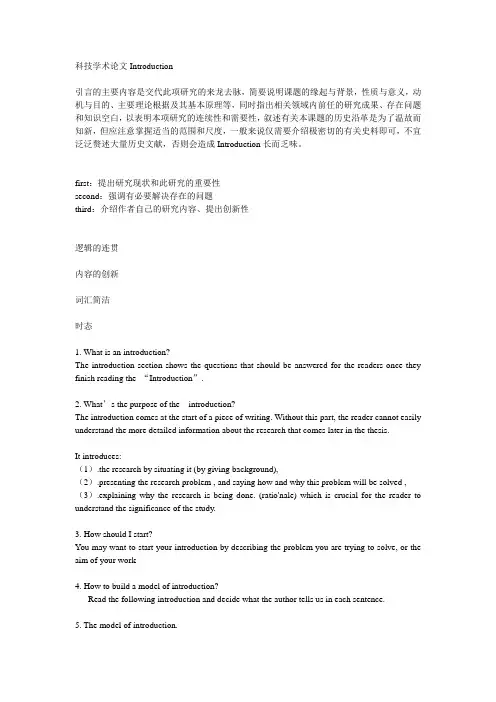
科技学术论文Introduction引言的主要内容是交代此项研究的来龙去脉,简要说明课题的缘起与背景,性质与意义,动机与目的、主要理论根据及其基本原理等,同时指出相关领域内前任的研究成果、存在问题和知识空白,以表明本项研究的连续性和需要性,叙述有关本课题的历史沿革是为了温故而知新,但应注意掌握适当的范围和尺度,一般来说仅需要介绍极密切的有关史料即可,不宜泛泛赘述大量历史文献,否则会造成Introduction长而乏味。
first:提出研究现状和此研究的重要性second:强调有必要解决存在的问题third:介绍作者自己的研究内容、提出创新性逻辑的连贯内容的创新词汇简洁时态1. What is an introduction?The introduction section shows the questions that should be answered for the readers once they finish reading the “Introduction”.2. What’s the purpose of the introduction?The introduction comes at the start of a piece of writing. Without this part, the reader cannot easily understand the more detailed information about the research that comes later in the thesis.It introduces:(1).the research by situating it (by giving background),(2).presenting the research problem , and saying how and why this problem will be solved , (3).explaining why the research is being done. (ratio'nale) which is crucial for the reader to understand the significance of the study.3. How should I start?You may want to start your introduction by describing the problem you are trying to solve, or the aim of your work4. How to build a model of introduction?Read the following introduction and decide what the author tells us in each sentence.5. The model of introduction.(1) establishes the importance of this research topic确立研究主题的重要性(2) provides general background information for the reader.为读者提供总体的背景信息(3) in a more specific/detailed way, using research references to support both the background facts and the claim for significance.与第1、2句的做法一样,但是更具体(4) describes the general problem area or the current research focus of the field.描述了所研究领域的一般性问题或当前的研究焦点(5) provides a transition between the general problem area and the literature review提供了总体问题领域到文献综述之间的一个过渡(6) provides a brief overview of key research projects in this area.概述了此研究领域重要的研究项目(7) describes a gap in the research描述了已有研究的空白(8) describes the paper itself描述了论文本身的工作(9) gives details about the methodology详细描述了论文中所用的方法(10) announces the findings公布了论文的结论6. Four components of a model.(1)Establish the importance of your fieldProvide background/ facts/information (possibly from research)Define the terminology in the title/key wordsPresent the problem area/current research focus确立研究领域的重要性提供背景事实或信息(有可能来自现有文献)定义题目或关键词中的术语给出所研究问题的范畴或目前的研究重点(2)Previous and/or current research and contributions前期的研究或目前的研究及其贡献(3)Locate a gap in the researchDescribe the problem you will addressPresent a prediction to be tested确定已有研究工作的空白;描述你要解决的问题呈现要验证的预测(4)Describe the present paper描述现在的论文7.Grammar and writing skills.语法时态写作技巧8. V ocabulary词汇的简洁举例三篇文章:1.Gene expression profiling and pathway analysis of hepatotoxicity induced by triptolide in Wistar rats在Wistar大鼠中,通过基因表达谱和通路分析由雷公藤甲素诱导的肝毒性引言的主要内容是交代此项研究的来龙去脉,例如本文中,简要说明课题的缘起与背景,TP的性质Triptolide (diterpenoid triepoxide, TP), purified from the shrublike vine Tripterygium wilfondii Hook F (TWHF)与药理学意义possesses anti-inflammatory, anti-fertility, anti-neoplastic and immunosuppressive activities 实验的动机However, clinical use of TWHF or TP has been limited due to severe adverse reactions, such as gastrointestinal upset, diarrhea, reproductive toxicity and problems associated with circulatory systems目的we hypothesized that liver is a major toxic target of TP treatment. Thus, it is essential to elucidate the mechanism of TP-induced hepatotoxicity from a safety point of view.the aim of our study was to identify candidate genes associated with TP treatment and to provide novel insights to better elucidate the mechanisms of toxic effects of TP.主要理论根据及其基本原理Considering that microarray technology is recognized as a reliable toxicologica method to determine mechanisms of drug-induced toxicity, identify biomarkers and to predict chemical toxicity.Therefore, the aim of our study was to identify candidate genes associated with TP treatment and to provide novel insights to better elucidate the mechanisms of toxic effects of TP.同时指出相关领域内前任的研究成果possesses anti-inflammatory, anti-fertility, anti-neoplastic and immunosuppressive activities (Chen, 2001; Huynh et al., 2000; Panichakul et al., 2006).have emerged as treatments of rheumatoid arthritis, systemic lupus erythematosus, nephritis, leprosy and asthma (Lipsky and Tao, 1997; Liu et al., 2005; Zhang et al., 2010).clinical use of TWHF or TP has been limited due to severe adverse reactions, such as gastrointestinal upset, diarrhea, reproductive toxicity and problems associated with circulatory systems (Hikim et al., 2000; Ni et al., 2008; Yang et al., 2012; Zhang et al., 2011).Recently, hepatotoxicity induced by various extracts of TWHF in animals and humans has been reported by many researches (He et al., 2006; Mei et al., 2005; Wang et al., 2007) To date, only mitochondrial respiratory chain inhibition, lipid peroxidation, DNA damage and hepatocyte apoptosis were proposed to be involved in TP-induced liver injury (Fu et al., 2011; Mei et al., 2005; Yao et al., 2008).等存在问题和知识空白Hepatic differential gene expression was analyzed using oligonucleotide microarray analysis for over-represented functions and phenotypically anchored to complementary histopathologic, biochemical, and dosimetry data in the liver. The results indicate that TP affects diverse cellular pathways, including insulin signaling pathway, glucose metabolism, cell cycling, oxidative stress and apoptosis. These data provide a clearer understanding of the molecular mechanisms of TP-induced hepatotoxicity, as well as useful information for predicting drug hepatotoxicity.以表明本项研究的连续性和需要性,叙述有关本课题的历史沿革是为了温故而知新,Triptolide (diterpenoid triepoxide, TP), purified from the shrublike vine Tripterygium wilfondii Hook F (TWHF), possesses anti-inflammatory, anti-fertility, anti-neoplastic and immunosuppressive activities (Chen, 2001; Huynh et al., 2000; Panichakul et al., 2006). Recently, the methanol/chloroform (T2) and ethyl acetate (EA) extracts of TWHF, in which TP was identified as the principal active compound, have emerged as treatments of rheumatoid arthritis, systemic lupus erythematosus, nephritis, leprosy and asthma (Lipsky and Tao, 1997; Liu et al., 2005; Zhang et al., 2010). However, clinical use of TWHF or TP has been limited due to severe adverse reactions, such as gastrointestinal upset, diarrhea, reproductive toxicity and problems associated with circulatory systems (Hikim et al., 2000; Ni et al., 2008; Yang et al., 2012; Zhang et al., 2011).Recently, hepatotoxicity induced by various extracts of TWHF in animals and humans has been reported by many researches (He et al., 2006; Mei et al., 2005; Wang et al., 2007). Besides, Liu et al., (2010) found that potential hepatotoxicity in rats treated with TP for 28 days was associated with increasing levels of serum alanine aminotransferase (ALT) and aspartate aminotransferase (AST) (Liu et al., 2010). Moreover, it was reported that oral administration of TP to rats could lead to liver injury or even death (Fu et al., 2011). In addition to this, our previous investigation showed that the concentration of TP found in liver exceeds those observed in other tissues, such as spleen, lung, heart, and kidney (unpublished data). On account of this, we hypothesized that liver is a major toxic target of TP treatment. Thus, it is essential to elucidate the mechanism of TP-induced hepatotoxicity from a safety point of view.Unfortunately, its underling mechanisms are still insufficiently recognized. To date, only mitochondrial respiratory chain inhibition, lipid peroxidation, DNA damage and hepatocyte apoptosis were proposed to be involved in TP-induced liver injury (Fu et al., 2011; Mei et al.,2005; Yao et al., 2008). Considering that microarray technology is recognized as a reliable toxicologica method to determine mechanisms of drug-induced toxicity, identify biomarkers and to predict chemical toxicity (Lee et al., 2010; Wang et al., 2011). Therefore, the aim of our study was to identify candidate genes associated with TP treatment and to provide novel insights to better elucidate the mechanisms of toxic effects of TP.Here, we describe genome-wide gene expression in the TP-exposed Wistar female rat liver. Differential gene expression was evaluated in 6-week-old female Wistar rat livers following 14 days of continuous exposure to large doses of TP. Hepatic differential gene expression was analyzed using oligonucleotide microarray analysis for over-represented functions and phenotypically anchored to complementary histopathologic, biochemical, and dosimetry data in the liver. The results indicate that TP affects diverse cellular pathways, including insulin signaling pathway, glucose metabolism, cell cycling, oxidative stress and apoptosis. These data provide a clearer understanding of the molecular mechanisms of TP-induced hepatotoxicity, as well as useful information for predicting drug hepatotoxicity.2.综述Blood vessels, a potential therapeutic target in rheumatoid arthritis?血管,类风湿性关节炎潜在的治疗靶标?IntroductionRheumatoid arthritis (RA) can be defined as a disease of the blood vessels, both micro- and macro-vessels. The formation of new micro-vessels is in fact necessary to afford the nutritional supply to proliferating synovial pannus, while macro-vessels are the site where accelerated atherosclerosis driven by disease’s systemic inflammation develops. New vessels formation on one side, and atherosclerotic plaque progression on the other, might seem two different biological phenomena, the first related to the articular involvement of the disease, the second to its main systemic complication. In this context, targeting blood vessels in RA might mean either attempting to reduce synovial vascular supply starving the synovial pannus limiting its proliferation or, in the other case, trying to limit macro-vessels’damage outside the joint. In this review we will analyse the possibility of targeting synovial microvessels to treat rheumatoid arthritis, but we will discuss as well the evidence supporting a link between micro- and macro-vascular involvements in RA.综述的介绍,介绍所提到物质的基本概念,简要说明课题的缘起与背景,RA与血管生成相关,与血管生成的必要性,在这里,说明该文章立题的主要依据与主要原理,并提出在此综述中接下来会说到的内容,如:作者将分析滑膜微血管治疗类风湿关节炎的可能性,且讨论,血管与RA微观和宏观之间联系的证据。

introduction英语解释An introduction is a way to begin a conversation, a presentation, or a written piece. It's like the first handshake that sets the tone for the whole encounter. It gives a glimpse of what's coming next and makes people curious to hear more. In a speech, an introduction might catch your attention with a funny anecdote or a thought-provoking question. In writing, it might draw you in with a vivid description or an intriguing fact. It's that little hook that makes you want to stick around and find out more.When introducing something to a friend, it's like showing them a new toy and saying, "Hey, look at this!Isn't it cool?" You want to share the excitement and make them interested in what you're about to reveal. An introduction in a book or article might be more formal, but it still serves the same purpose to grab the reader's attention and make them want to dive deeper into the subject.Think of an introduction as the appetizer before the main course. It whets your appetite, gives you a taste of what's to come, and makes you eager for the rest. It's that brief moment that sets the stage and prepares you for the journey ahead.And let's not forget, introductions are not just about what's coming next. They're also about who's bringing it to you.。