
状语从句易错点汇总及练习测试题经典
- 格式:doc
- 大小:74.00 KB
- 文档页数:14

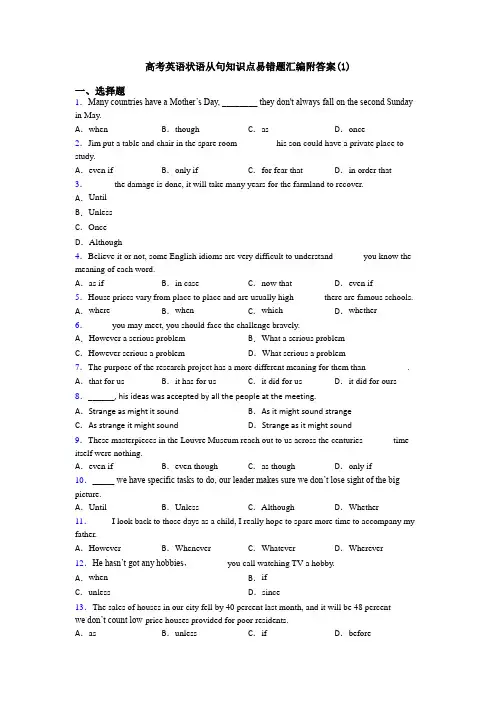
高考英语状语从句知识点易错题汇编附答案(1)
一、选择题
1.Many countries have a Mother’s Day, ________ they don't always fall on the second Sunday
in May.
A.when B.though C.as D.once
2.Jim put a table and chair in the spare room ________ his son could have a private place to
study.
A.even if B.only if C.for fear that D.in order that
3.______the damage is done, it will take many years for the farmland to recover.
A.Until
B.Unless
C.Once
D.Although
4.Believe it or not, some English idioms are very difficult to understand ______ you know the
meaning of each word.
A.as if B.in case C.now that D.even if
5.House prices vary from place to place and are usually high ______ there are famous schools.
A.where B.when C.which D.whether
6._____ you may meet, you should face the challenge bravely.
A.However a serious problem B.What a serious problem

班级 姓名 学号 分数
Unit 10 If you go to the party.
if引导的条件状语从句
(时间:60分钟,满分:100分)
一、单项选择(本大题共40小题,每小题1分,共40分)
1.— Can I play football for some time, Mum?
— You can, if your homework ________.
A.will finish B.will be finished C.is finished D.finished
2.If you ________ to the party, you won’t have enough time to do your homework.
A.go B.goes C.went D.will go
3.I don’t know if it ________ tomorrow. If it ________, I won’t go.
A.will rain; rains B.will rain; will rain C.rains; rains D.rains; will rain
4.—We will go for a picnic if it ________ this Sunday.
—Sounds great.
A.won’t rain B.is rainy C.will be sunny D.doesn’t rain
5.I will go to the party if I ________.
A.will invite B.was invited C.am invited D.will be invited
6.He ________ here if he ________ enough time.
A.will come; will have B.comes; will have C.will come; has D.comes; has

.
. (一)状语从句概述
定义 状语从句用作状语,是起副词作用的句子。
位置 状语从句可以放在主句之前,也可以放在主句之后,时间、条件、原因和让步状语从句放在句首时需要用逗号和主句隔开。
分类 根据其作用可以分为时间、地点、原因、条件、目的、让步、方式和比较等状语从句。
作用 它可以修饰谓语、非谓语动词、定语、状语和整个句子。
(二)状语从句详解
1. 时间状语从句
引导词 用法 示例
when 意为“当…的时候”。When引导从句的谓语动词可以是延续性动词,也可以是瞬间动词。并且when有时表示“就在那时” A liar is not believed when he
speaks the truth.说谎者讲真话时也没有人相信。
When he arrives, I’ll call you.
When you laugh and smile,
your body relaxes.
while 意为“在…的时候,在…的同时”。While引导从句的谓语动词必须是延续性While I was standing at the
window, I saw several boys
running along the street. .
. 的,发生时间较长,并强调主句和从句的动作同时发生(或者相对应)。While有时还可以表示对比。 While John was watching TV,
his wife was cooking.
as 意为“一边…一边…”。As引导的动作是延续性的,发生时间较短,一般用于主句和从句动作同时发生;as也可以强调一前一后。 The writer was angry as he
was travelling on a train to
London because someone
had invaded his “space”.
He smiled as he stood up.

状语从句
(一)状语从句概述
定义 状语从句用作状语,是起副词作用的句子。
位置 状语从句可以放在主句之前,也可以放在主句之后,时间、条件、原因和让步状语从句放在句首时需要用逗号和主句隔开。
分类 根据其作用可以分为时间、地点、原因、条件、目的、让步、方式和比较等状语从句。
作用 它可以修饰谓语、非谓语动词、定语、状语和整个句子。
(二)状语从句详解
1. 时间状语从句
引导词 用法 示例
when 意为“当…的时候”。When引导从句的谓语动词可以是延续性动词,也可以是瞬间动词。并且when有时表示“就在那时” A liar is not believed when he
speaks the truth.说谎者讲真话时也没有人相信。
When he arrives, I’ll call you.
When you laugh and smile,
your body relaxes.
while 意为“在…的时候,在…的同时”。While引导从句的谓语动词必须是延续性的,发生时间较长,并强调主句和从句的动作同时发生(或者相对应)。While有时还可以表示对比。 While I was standing at the
window, I saw several boys
running along the street.
While John was watching TV,
his wife was cooking.
as 意为“一边…一边…”。The writer was angry as he was As引导的动作是延续性的,发生时间较短,一般用于主句和从句动作同时发生;as也可以强调一前一后。 travelling on a train to London
because someone had invaded
his “space”.
He smiled as he stood up.