国际专利分类(ipc)介绍
- 格式:doc
- 大小:16.02 KB
- 文档页数:4
国际专利分类(ipc)介绍
英文回答:
International Patent Classification (IPC) is a system
used to classify patents based on the technical content of
the inventions. It is a hierarchical system that
categorizes inventions into different classes and
subclasses based on their technical features. The IPC is
managed by the World Intellectual Property Organization
(WIPO) and is used by patent offices around the world to
search and retrieve patent documents.
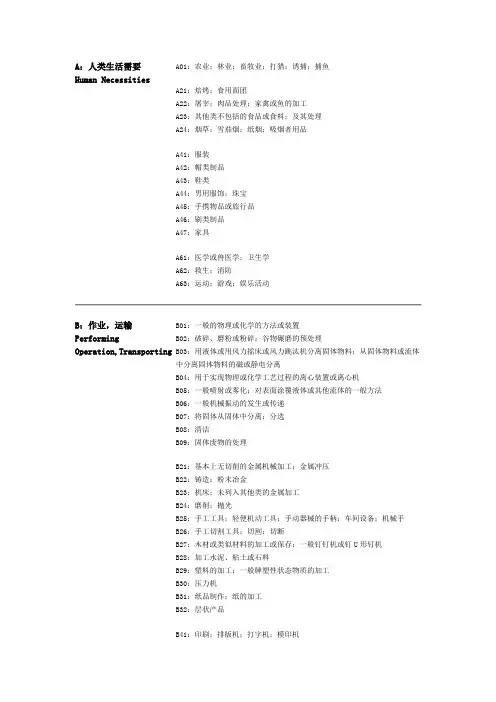
The IPC consists of eight sections, each representing a
different field of technology. These sections are further
divided into classes, subclasses, groups, and subgroups.
Each level of classification provides more specific details
about the technical features of the invention. For example,
in the field of chemistry, the IPC section is divided into
classes such as organic chemistry, inorganic chemistry, and
physical chemistry. Each class is then further divided into subclasses, groups, and subgroups based on more specific
technical features.
The IPC uses a combination of letters and numbers to
represent the different levels of classification. The
letters represent the sections and classes, while the
numbers represent the subclasses, groups, and subgroups.
For example, the IPC code for a patent related to organic
chemistry might be C07D. This code indicates that the
patent belongs to section C (Chemistry) and class 07
(Organic Chemistry), and further specifies the subclass D.
The IPC is an essential tool for patent examiners,
inventors, and researchers. It helps in searching and
retrieving patent documents that are relevant to a
particular technical field. By using the IPC, patent
examiners can efficiently evaluate the novelty and
inventive step of an invention. Inventors can use the IPC
to identify prior art and ensure that their invention is
unique. Researchers can use the IPC to stay updated with
the latest developments in their field of interest.
In conclusion, the International Patent Classification
(IPC) is a hierarchical system used to classify patents
based on their technical content. It is managed by the
World Intellectual Property Organization (WIPO) and is used
by patent offices worldwide. The IPC helps in searching and
retrieving patent documents, evaluating the novelty of
inventions, and staying updated with the latest
developments in various technical fields.
中文回答:
国际专利分类(IPC)是一种根据发明的技术内容对专利进行分类的系统。它是一个层次化的系统,根据技术特征将发明分为不同的类和子类。IPC由世界知识产权组织(WIPO)管理,世界各国的专利局使用IPC来搜索和检索专利文件。
IPC由八个部分组成,每个部分代表不同的技术领域。这些部分进一步分为类、子类、组和子组。每个分类级别提供有关发明的更具体的技术特征。例如,在化学领域,IPC部分分为有机化学、无机化学和物理化学等类。然后,每个类别根据更具体的技术特征进一步分为子类、组和子组。
IPC使用字母和数字的组合来表示不同级别的分类。字母表示部分和类,数字表示子类、组和子组。例如,与有机化学相关的专利的IPC代码可能是C07D。该代码表示该专利属于C部分(化学)和07类(有机化学),并进一步指定了子类D。
IPC是专利审查员、发明家和研究人员的重要工具。它有助于搜索和检索与特定技术领域相关的专利文件。通过使用IPC,专利审查员可以高效地评估发明的新颖性和创造性。发明家可以使用IPC来识别先前技术,并确保他们的发明是独特的。研究人员可以使用IPC来了解他们感兴趣的领域的最新发展。
总之,国际专利分类(IPC)是一个根据技术内容对专利进行分类的层次化系统。它由世界知识产权组织(WIPO)管理,并被世界各国的专利局使用。IPC有助于搜索和检索专利文件,评估发明的新颖性,并了解各种技术领域的最新发展。