(完整版)八下英语期中复习(知识点梳理)
- 格式:docx
- 大小:30.68 KB
- 文档页数:9
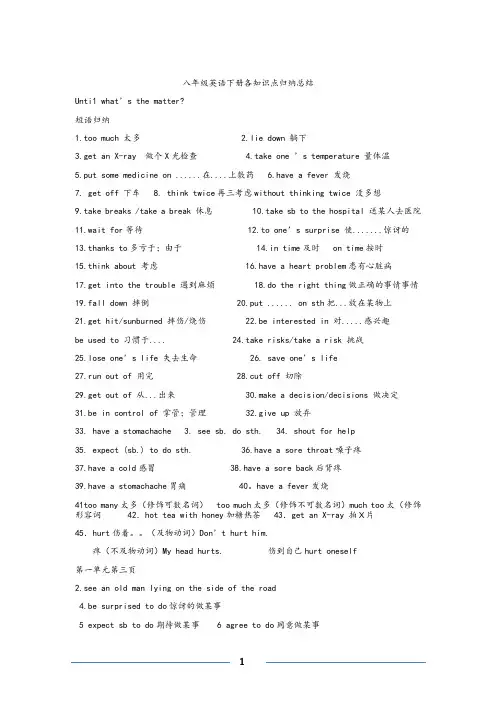
八下中考Unit 1-6知识梳理Unit 1 What's the matter?【语法】同义句问:What' s the matter / trouble/ problem (with sb . )?=What' s your troublematter/ problem?=What ' s up? = What happens to sb.?某人)出什么事了?=What' s wrong (with sb )?(某人)怎么了?=Are you OK?你没事吧?=Is there anything wrong with sb. ?某人有什么事吗?【辨析】trouble【麻烦:make trouble】;matter【事情】;problem 【难度大:solve problem 】;question 【难度小:ask/ answer question】答:①某人+have/has+a+headache/toothache/stomachache/backache/earache.某人+have/has+a+sore+发病部位. He has a sore throat.他喉咙痛。
③某人+hurt(s)+身体部位或反身代词. He hurt his leg.他的腿受伤了。
④某部位+hurt(s). My head hurts badly .我头痛得厉害。
⑤某人+have/has+a pain+in one 身体部位,I have a pain in my chest .我胸口痛。
【语法】should +动原【四个句型】【重点词汇掌握】1. 反身代词:myself, yourself, himself, herself, ourselves, yourselves, themselves, on eself.2. (1)few +可名复,有否定意义。
(2)a few +可名复,几个,数个”,有肯定意义。
(3)little +不可数,有否定意义,“很少,几乎无”(4)a little +不可数,“一些”,有肯定意。
He has _____ friends.他有几个朋友。
He has _______ friends.他几乎没有朋友。
We still have _____ time.我们还有点时间。
There is _______ time left.几乎没剩下什么时间了。
3. much too +adj./ adv. 太..... ”,too much+U 名;too many + C 名,很多,大量There are __________ no ise in the classroom. There are ___________ old books in the library4. Also, too与either 三者都表示也”。
但是用法有区别。
(1) too用于肯定句,句末,有逗号隔开;句中,前后都加逗号。
(2) also句中,be等助动词后,实义动词前。
(3) either用于否定句,句末,并用逗号隔开(4)neither作代词两者都不”He is not there, ______ .他也不在那儿。
She _______ learns English.她也学英语。
He likes English, _____ .她也喜欢英语。
You may use ________ b ook.两本书你可以随便用一本。
____ an swer is wrong.两个答案都不对。
I don 'like him. ________ do I.我不喜欢他。
我也是。
5. Be used to do sth.被用来....Be/ get used to doing sth.习惯于... Used to do sth.过去常常做....I used to ____ (sleep) late, but now I used to ____ (sleep) early. The pen is used to _____ (write)6. Give up going sth.放弃做某事【名】matter, fever, cough, passenger, risk, kilo, rock, knife, spirit【动】躺lie, lying, lay; hit; hurt; break; mean;dieUnit 2 I ' ll help to clean the city parts.【语法】一般将来时复习:will do, be goi ng to do (标志词:will; "-'ll”; won't; tomorrow; next 动词不定式:help to do; need to do; decide to do; want to do; used to do【见附表DD】【重点词汇掌握】1. AIone (—个人的事实 live alone ) , lonely (感觉孤独寂寞 Ionely man )The man live ____ in the coun try, but he n ever feel _____ .2. Raise (筹集,raise money,夕卜力升),rise (自 己升 The sun rises up every day.)3. 短语:Cheer up 使变得高兴,振奋起来 Give away 赠送,分发 Come true 实现Come up with= think of 想出,提出 Put off 推迟 Call up 打电话给某人 Care for 照顾, Make a differenee影响,有作用 Run out of 用尽,耗尽 Give out 分发,散发4. Sou nd (所有声音)/noise (噪音)/voice (人声音)5.care for 照看;照顾;照料 =take care of =look after v.照顾,照料,照看7. Help sb with sth = help sb. do sth.帮助某人做某事8. 1). stop doi ng sth 停止做某事 Please stop speaki ng 请停止讲话2).stop to do sth 停下来去做另外一件事 Please stop to talk .请停下来讲话---Can we stop______ (have ) a rest?——Oh, stop __ (talk ) about this. You 'e rest three times.区别 be like 【人品性格】,such as 常接词或短语,可和 and so on 连用。
【名】 volun teer, sig n, no tice, joy, own er, letter, deaf, door, train, in terest,【动】 volunteer,cheer, notice, feel, raise, repair, fix,miss, open, carry, understand, change Unit 3 Could you please clean your room ?【语法】Could 引导的句子【四项】复习情态动词:can, could (能,可以);must , have to (必须);should, ought to (应该);need (需要,必要);may(可 能);maybe (名,副词:也许,或许 );may be (情态动词:也许可能);had better do (最好做);【重点词汇掌握】1. 短语:Do chores 做家务 Do the dishes 洗餐具 in a mess; Take out 拿走;all the time= always 总是; as soon as;in order to 为了 ; depend on 依靠;take care of= look after=care for 照顾;As a result 结果Make the bed 整理床铺 Ha ng out 闲逛,常去 At l east 至少A waste of time 浪费时间9. Take after, be like, look like, look afterTake after,【人品,品德,性格都像】look like 【外表】,look after 【照顾】10. f or example 常接句子,用逗号隔开。
2. Borrow (借来,进)和lend (借给,出)3. fair n. fairness 公平;公正unfair 不公平4. in front of 指在物体外部的前面in hospital住院和in the hospital在医院in the fro nt of 指在物体内部的前面”注意有the和没the的区别5. 【了解】get, turn, become, go, grow1) . become好、坏两方面的变化He becomes a teacher.现在已经是一位老师)2) . get多用于口语,表示一种变化过程,强调渐渐变得”,后常接形容词的比较级形式。
It ' s getting darker outside.3) . turn指在颜色和性质等方面与以前的完全不同,强调变化的结果。
Leaves turned brown .4) .表示向坏的变化的常用词组中用go (通常不用get)。
vegetables go bad菜变质5) . grow表示逐渐变成新的状态"的含义。
常指生长性的变化。
My youn ger brother is growing tall .我的弟弟渐渐长高了。
【名】rubbish, floor, shirt, fin ger, n eighbor, ill,【动】fold; sweep; throw ;pass; borrow ;lend ; hate; waste; provide ; depend; develop,drop Unit 4 Why don ' t you talk to your parents?【语法】提建议的句子:(1) What about doi ng sth. ?=How about doi ng sth.? ….怎么样?⑵ Why don ' t you do sth.?= Why not do sth= Why do/ does sb. do....?为什么不呢?(3) Let ' s do s让我们一起做....。