
2008 AMC10B Answers
- 格式:doc
- 大小:19.50 KB
- 文档页数:2

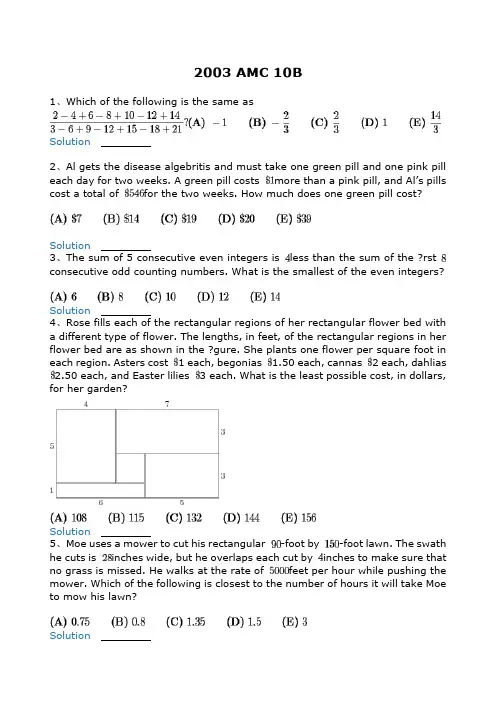
2003 AMC 10B1、Which of the following is the same asSolution2、Al gets the disease algebritis and must take one green pill and one pink pill each day for two weeks. A green pill costs more than a pink pill, and Al’s pillscost a total of for the two weeks. How much does one green pill cost?Solution3、The sum of 5 consecutive even integers is less than the sum of the ?rstconsecutive odd counting numbers. What is the smallest of the even integers?Solution4、Rose fills each of the rectangular regions of her rectangular flower bed witha different type of flower. The lengths, in feet, of the rectangular regions in her flower bed are as shown in the ?gure. She plants one flower per square foot in each region. Asters cost 1 each, begonias 1.50 each, cannas 2 each, dahlias2.50 each, and Easter lilies 3 each. What is the least possible cost, in dollars,for her garden?Solution5、Moe uses a mower to cut his rectangular -foot by -foot lawn. The swathhe cuts is inches wide, but he overlaps each cut by inches to make sure thatno grass is missed. He walks at the rate of feet per hour while pushing themower. Which of the following is closest to the number of hours it will take Moe to mow his lawn?Solution.6、Many television screens are rectangles that are measured by the length of their diagonals. The ratio of the horizontal length to the height in a standard television screen is . The horizontal length of a “-inch” television screen isclosest, in inches, to which of the following?Solution7、The symbolism denotes the largest integer not exceeding . For example., and . ComputeSolution.8、The second and fourth terms of a geometric sequence are and . Which ofthe following is a possible first term?Solution9、Find the value of that satisfies the equationSolution10、Nebraska, the home of the AMC, changed its license plate scheme. Each old license plate consisted of a letter followed by four digits. Each new license plate consists of three letters followed by three digits. By how many times is the number of possible license plates increased?Solution11、A line with slope intersects a line with slope at the point . What isthe distance between the -intercepts of these two lines?Solution12、Al, Betty, and Clare split among them to be invested in different ways.Each begins with a different amount. At the end of one year they have a total of. Betty and Clare have both doubled their money, whereas Al has managedto lose . What was Al’s original portion?Solution.13、Let denote the sum of the digits of the positive integer . For example,and . For how many two-digit values of is?Solution14、Given that , where both and are positive integers, find thesmallest possible value for .Solution15、There are players in a singles tennis tournament. The tournament issingle elimination, meaning that a player who loses a match is eliminated. In the first round, the strongest players are given a bye, and the remainingplayers are paired off to play. After each round, the remaining players play in the next round. The match continues until only one player remains unbeaten. The total number of matches played isSolution16、A restaurant offers three desserts, and exactly twice as many appetizers as main courses. A dinner consists of an appetizer, a main course, and a dessert. What is the least number of main courses that the restaurant should offer so that a customer could have a different dinner each night in the year ?Solution.17、An ice cream cone consists of a sphere of vanilla ice cream and a right circular cone that has the same diameter as the sphere. If the ice cream melts, it will exactly ?ll the cone. Assume that the melted ice cream occupies of thevolume of the frozen ice cream. What is the ratio of the cone’s height to its radius?Solution18、What is the largest integer that is a divisor offor all positive even integers ?Solution19、Three semicircles of radius are constructed on diameter of a semicircleof radius . The centers of the small semicircles divide into four linesegments of equal length, as shown. What is the area of the shaded region that lies within the large semicircle but outside the smaller semicircles?Solution20、In rectangle , and . Points and are on so thatand . Lines and intersect at . Find the area of .Solution21、A bag contains two red beads and two green beads. You reach into the bag and pull out a bead, replacing it with a red bead regardless of the color you pulled out. What is the probability that all beads in the bag are red after three such replacements?Solution22、A clock chimes once at minutes past each hour and chimes on the houraccording to the hour. For example, at 1 PM there is one chime and at noon and midnight there are twelve chimes. Starting at 11:15 AM on February , ,on what date will the chime occur?Solution23、A regular octagon has an area of one square unit. What is thearea of the rectangle ?Solution24、The ?rst four terms in an arithmetic sequence are , , , and ,in that order. What is the ?fth term?Solution25、How many distinct four-digit numbers are divisible by and have as theirlast two digits?Solution。
2008年全国大学生英语竞赛样题及答案(C级)Part II V ocabulary and Structure (10 minutes, 15 marks)Directions: There are 15 incomplete sentences in this part. For each blank there are four choices marked A, B, C and D. Choose the one that best completes the sentence. Then mark the corresponding letter on the Answer Sheet with a single line through the centre.31. So nervous ________ that she didn't know how to start her speech.A. since she becameB. would she becomeC. that she becameD. did she become32. He ________ another career but, at the time, he just wanted to earn money to study abroad.A. might have chosenB. might chooseC. had to chooseD. must have chosen33. The second report was ________ by August 2005, but one year later it was still nowhere in sight.A. submittedB. to have submittedC. to submitD. to have been submitted34. In this experiment, the students studied are stopped several times during the listening test and asked to report what they ________ during the pause before answering the questions.A. had just been thinking aboutB. have just been thinking aboutC. are just thinking aboutD. had just thought about35. I was always taught that it was ________ to interrupt.A. rudeB. coarseC. roughD. crude36. Small boys are ________ questioners. They ask questions all the time.A. originalB. peculiarC. imaginativeD. persistent37. We regret to inform you that the materials you ordered are ________.A. out of workB. out of reachC. out of stockD. out of practice38. The bomb will ________ the moment it is touched.A. go onB. go offC. go outD. go over39. The car won't ________; I've tried it several times, but it won't work.A. beginB. launchC. startD. drive40. Children and old people do not like having their daily ________ upset.A. habitB. routineC. practiceD. custom41. In your first few days at school you'll be given a test to help the teachers to ________ you to a class at your level.A. locateB. assignC. deliverD. place42. China only started its nuclear power industry in recent years, and should ________ no time in catching up.A.loseB.delayC. spareD. relieve43. — You did an excellent job yesterday, Jim! I really enjoyed your presentation.— ________— Oh yeah, it was fabulous. It seems the English program is a great way to practice English.— Yeah. It is fun and motivating.A. Did you really?B. Oh, thank you. You are so kind.C. Really? What about yours?D. Not at all. My pleasure.44. — What kind of music do you like?— Well, I like different kinds.— ________— Er, I especially like punk rock.A. I beg your pardon?B. Are you serious?C. Any in particular?D. Why do you think so?45. — How did you like the fashion show last night?— ________— I didn't see anything wrong with the clothes; they looked pretty nice to me.— Do you really think people can wear that stuff and walk around in streets?A. Impressive. It's a good way to show off women's sense of style and wealth.B. It was cool. The clothes are more beautiful than the people wearing them.C. Nothing serious. It's only a show to attract the eyes of fashion fans.D. It was dumb. I think it's stupid for women to wear clothes like that.Part III Reading Comprehension (20 minutes, 40 marks)Section A (4 marks)Directions: There is one passage in this section with 4 questions. For each question, there are four choices marked A, B, C and D. You should decide on the best choice. Then mark the corresponding letter on the Answer Sheet with a single line through the centre.Questions 46-49 are based on the following passage.The ability to “see” oneself in the future is a remarkable human trait - some would say unique - that is not well understood. That's despite the fact that we probably spend as much time thinking about the future as we do thinking about the present.Now new research from Washington University in St. Louis suggests that it's precisely because we can remember the past that we can visualize the future. “Our findings provide convincing support for t he idea that memory and future thought are highly interrelated and help explain why future thought may be impossible without memories,” says doctoral candidate Karl Szpunar. The findings are consistent with other research showing that persons with little memory of the past, such as young children or individuals suffering from loss of memory, are less able to see themselves in the future.The researchers base their conclusions on brain scans of 21 college students who were cued to think about something in their past, and anticipate the same event in the future, like a birthday or getting lost. The experiment was carried out as each student lay on their stomach in a magnetic resonance imaging machine, a dreadful but very useful piece of equipment that can show which areas of the brain are stimulated during specific thought processes. The students were also asked to picture former President Bill Clinton in a past and future setting. Clinton was chosen because he was easily recognized and familiar to all the students.The researchers found a “surprisingly complete overlap” among regions of the brain used for remembering the student's past and those used for picturing the future. And every region involved in remembering was also used in anticipating the future.In short, the researchers isolated the area of the brain that “lit up” when the students thought about an event in their own past. And more importantly, that same area lit up again when they thought about a similar event in their future. In fact, the rese archers report that the brain activity was so similar in both cases that it was “indistinguishable.” The findings were reinforced when students imagined Bill Clinton. Since none of them knew him personally, their memories were not autobiographical. And th e brain scans showed “significantly less” correlation between memories of having seen pictures of Clinton in the White House and projecting him into the future.So this “time machine,” as the researchers describe it, allows us to use the past to see ourse lves in the future, and both our memories and our anticipation are interdependent.46. A remarkable human trait that is not well understood is the ability ________.A. to think about the pastB. to see the futureC. to remember the pastD. to control the present47. The findings support that ________.A. future goals will greatly influence a person's present performanceB. a person's present performance is determined by his / her past knowledgeC. future thought depends to a great degree on the memory of the pastD. present thought is impossible without the ability to imagine the future48. The conclusion of the experiment on students was that ________.A. the students could picture themselves better than Bill Clinton in a past and future settingB. the students could imagine themselves as well as Bill Clinton in a past and future settingC. the students could anticipate Bill Clinton better than themselves in a past and future settingD. the students could only picture themselves in a past and future setting but not Bill Clinton49. This “time machine” in the last paragraph most probably refers to ________.A. clockB. brain scanningC. magnetic resonance imagingD. memorySection B (14 marks)Directions: There is one passage in this section with 10 questions. Go over the passage quickly and answer the questions on the Answer Sheet. For questions 50-55, mark Y (for YES)if the statement agrees with the information given in the passage; N (for NO)if the statement contradicts the information given in the passage; NG (for NOT GIVEN)if the information is not given in the passage. For questions 56-59, complete the sentences with the information given in the passage.Visiting the White HouseWhite House Tours Public tours of the White House are available for groups of 10 or more people. Requests must be submitted through one's Member of Congress and are accepted up to six months in advance. These self-guided tours are available from 7:30 a.m. to 12:30 p.m. Tuesday through Saturday, and are scheduled on a first come, first served basis approximately one month in advance of the requested date. We encourage you to submit your request as early as possible since a limited number of tours are available. All White House tours are free of charge. For the most current tour information, please call the 24-hour line at 202-456-7041. Please note that White House tours may be subject to last minute cancellation.White House Visitor CenterAll tours are significantly enhanced if visitors stop by the White House Visitor Center located at the southeast corner of 15th and E Streets, before or after their tour. The Center is open seven days a week from 7:30 a.m. until 4:00 p.m. and features many aspects of the White House, including its architecture, furnishings, first families, social events, and relations with the press and world leaders, as well as a thirty-minute video. Allow between 20 minutes to one hour to explore the exhibits. The White House Historical Association also sponsors a sales area. Please note that restrooms are available, but food service is not.Mobility-Impaired / Using a WheelchairGuests requiring the loan of a wheelchair should notify the officer at the Visitors Entrance Building upon arrival. Wheelchairs loans are offered on a first-come, first-served basis. Reservations are not possible.Visitors in wheelchairs, or with other mobility disabilities, on the Congressional guided or self-guided tours, between 8:00 a.m. and 12 noon, use the same Visitor entrance and, with up to four members of their party, are admitted without waiting in line and without tickets.Visitors in wheelchairs are escorted by ramp from the entrance level to the ground floor, and by elevator from the ground to the state floor. Guests generally wait in line with their family or group.Hearing-ImpairedTours for hearing-impaired groups may be arranged in advance by writing to the Visitors Office, White House, Washington, DC 20502. Tours are usually scheduled at 9:30 a.m., between the Congressional and public tour times. Participants enter at the East Appointment gate. A U.S. Secret Service / Uniformed Division Tour Officer conducts the tour in sign language. Signed tours are available to groups of 8 to 20. Groups are also encouraged to bring their own interpreters.Signing interpretation is also available for individual visitors with advance notice. A Congressional office first issues guided tour tickets to a guest who is hearing-impaired and then contacts the Visitors Office at least 2 weeks in advance to request interpreter service.The Visitors Office TDD (telephone device for the deaf) is 202-456-2121. Messages may be left outside normal business hours.Visually-ImpairedTours for visually-impaired groups may be arranged in advance by writing to the Visitors Office, White House, Washington, DC 20502. The tours are usually scheduled at 9:30 a.m., between the Congressional and public tour times. Participants enter at the East Appointment gate. A U.S. Secret Service / Uniformed Division Tour Officer permits visitors to touch specific objects in the House. Touch tours are currently available only to groups of 8 to 20, not to individual visitors. Guide animals are permitted in the White House.General Tour InformationAll White House tours are free. Changes in tour schedules are occasionally made because of official events. Notice may not be given until that morning. The Visitors Office 24-hour Information Line recording at 202-456-7041 provides the most up-to-date information. The TDD is 202-456-2121. Visitors should confirm tour schedules by calling the information line the night before and the morning that they plan to visit. It is occasionally necessary to close individual rooms on the tour; however, notice about closed rooms is not possible.Prohibited ItemsProhibited items include, but are not limited to, the following: handbags, book bags, backpacks, purses, food and beverages of any kind, strollers, cameras, video recorders or any type of recording device, tobacco products, personal grooming items (make-up, hair brush or comb, lip or hand lotions, etc.), any pointed objects (pens, knitting needles, etc.), aerosol containers, guns, ammunition, fireworks, electric stun guns, mace, martial arts weapons / devices, or knives of any size. The U.S. Secret Service reserves the right to prohibit any other personal items. Umbrellas, wallets, cell phones and car keys are permitted.Please note that no storage facilities are available on or around the complex. Individuals who arrive with prohibited items will not be permitted to enter the White House.ParkingThe closest Metrorail stations to the White House are Federal Triangle (blue and orange lines), Metro Center (blue, orange, and red lines) and McPherson Square (blue and orange lines). On-street parking is not available near the White House, and use of public transportation is strongly encouraged.Restrooms / Public TelephonesThe nearest restrooms and public telephones to the White House are in the Ellipse Visitor Pavilion (the park area south of the White House) and in the White House Visitor Center. Restrooms or public telephones are not available at the White House.50. Both Congressional guided and self-guided tours need to be scheduled in advance.51. All White House tours are free of charge except on federal holidays.52. The White House Visitor Center provides free drinks but not food service.53. Wheelchair reservation service is provided by the officer at the Visitors Entrance Building.54. Hearing-impaired visitors can request signing interpretation service from the Visitors Office.55. Touch tours are currently only offered to visually-impaired groups of 8 to 20.56. Sometimes official events make it necessary to close ________________ without notice.57. The personal items permitted to be carried into the White House are ________________.58. The transportation visitors are encouraged to use is ________________.59. Inside the White House, visitors cannot find or use restrooms or ________________.Section C (10 marks)Directions: In this section, there is one passage followed by 5 questions. Read the passage carefully, then answer the questions in as few words as possible (not more than 10 words). Remember to write the answers on the Answer Sheet.Questions 60-64 are based on the following passage.If you were on a distant planet, and if you had instruments that could tell you the composition of Earth's atmosphere, how would you know there was life on this planet?Water in the atmosphere would suggest there could be water on the surface, and as we all know water is considered crucial to life. But water would only suggest that life is possible. It wouldn't prove it's there.Carbon? That basic component of “life as we know it?” Not necessarily. A diamond is pure carbon, and it may be pretty, but it isn't alive.What really sets Earth apart is nitrogen, which makes up 80 percent of the planet's atmosphere. And it's there only because there is abundant life on Earth, say scientists at the University of Southern California.The report grew out of a class discussion two years ago in a course taught by Capone and Kenneth Nealson, professor of earth sciences. Students were asked to come up with different ideas about searching for life on other planets. What is a distinct “signature,” as Capone puts it, that would show there is life on another planet?That's a question that has been kicked around in many quarters in recent decades, especially since all efforts to find some form of life, no matter whether on Mars or in the distant reaches of space, have failed. At least so far.The current effort to search for some evidence of life on Mars focuses primarily on the search for water, because it has long been believed that water, or at least some fluid, is necessary for the chemical processes that lead life to take place. But that's probably the wrong approach, the USC group argues.“It's hard to imagine life without water, but it's easy to imagine water without life,” sa ys Nealson, who was on the Mars team before moving to USC.But nitrogen would be a much clearer signature of life. Only about 2 percent to 3 percent of the Martian atmosphere is nitrogen. That's just a trace, and it probably means there is no life on Mars today, and if there was in the past, it probably ended many, many years ago.But, the USC team adds quickly, that doesn't mean there's no life anywhere else in the universe. They don't know where, of course, but they may have found a way to narrow down the search. Look first for nitrogen, then look for biological activity that should be there.So if life exists elsewhere, and is similar to life as we know it, there should be nitrogen, and that's what we shouldbe looking for first, the researchers say.If they don't find nitrogen on Mars, Capone says, “that will probably bring us to the conclusion that there likely never was life on Mars.”But how about elsewhere? Could this technique be used to search for life in other solar systems?Maybe. It might be possible to detect a nitrogen-rich atmosphere around a planet orbiting another star, but not yet. Current instruments aren't that sensitive.If they ever are, the search for life might be narrowed down to the most promising prospects, chiefly because of the presence of nitrogen. And won't that be fun!Questions:Section D (12 marks)Directions: In this section, there is one passage followed by a summary. Read the passage carefully and complete the summary below by choosing a maximum of three words from the passage to fill in the spaces 65-70. Remember to write the answers on the Answer Sheet.Questions 65-70 are based on the following passage.In August 2008, athletes from the United States and around the world will compete in the Beijing Olympics. But did you know that in September of next year, disabled athletes will compete in the Paralympic Games in Beijing? The Olympics and the Paralympics are separate movements. But they have always been held in the same year, and since 1988, they have also been held in the same city. The International Olympic Committee and the International Paralympic Committee signed an agreement in 2001 to secure this connection. The next winter games will take place in Vancouver, Canada, in 2010.The Paralympic Games grew out of a sports competition held in 1948 in England and a doctor named Ludwig Guttmann organized it for men who suffered spinal cord injuries in World War II. Four years later, it became an international event as competitors from the Netherlands took part. Then, in 1960, the first Paralympics were held in Rome. 400 athletes from 23 countries competed. By 2004, the Paralympic Games in Athens had almost 4000 athletes from 136 countries, who may have physical or mental limitations and may be blind or in wheelchairs. Yet sometimes they perform better than athletes without disabilities.In 1968, Eunice Kennedy Shriver, the sister of former President John F. Kennedy, started the Special Olympics, which are just for children and adults with mental limitations and whose programs currently serve more than two million people in 160 countries. In November 2006, in Mumbai, India, teams competed in the First Special Olympics International Cricket Cup. In addition to India, there were men's teams from Afghanistan, Australia, Bangladesh, Nepal, Pakistan, Sri Lanka and the West Indies. There were also women's cricket teams from India and Pakistan.There are many organizations in the United States that help people with disabilities play sports. Wheelchair tennis is a popular sport. So is basketball. In fact, there are more than one hundred professional teams playing wheelchair basketball thanks to the special wheelchairs for athletes that are lightweight and designed for quick moves. For people who want to go really fast in their chairs, there is a Power Wheelchair Racing Association.In the state of Utah there is a place called the National Ability Center, which teaches all kinds of sports to people with all kinds of physical and mental disabilities and even gives friends and family members a chance to try a sport as if they were disabled.A reporter from the Washington Post wanted to know what it would be like for a blind person to use a climbing wall. So, protected by a safety line, the newspaper reporter closed his eyes and started to feel for places to put his hands and feet. Trainers on the ground urged him on: “Take your time. You can do it.” Finally he reached the top. At the National Ability Center people can learn to ride horses and mountain bikes. They can try winter mountain sports, and learn scuba diving and other water activities. The center also prepares athletes for the Paralympics. These days, the first place many people go when they want to travel is the Internet, where they can get information about hotels, transportation and services like tour companies. The Internet can also help travelers find special services for the disabled. For example, there are groups that help young people with disabilities travel to different countries.Susan Sygall, who uses a wheelchair herself, leads an organization called Mobility International USA, and has traveled to more than twenty-five countries to talk about the rights of people with disabilities. She says people with disabilities are all members of a global family and working together across borders is the most powerful way of making changes.Summary:Part IV Cloze (15 minutes, 15 marks)Section A: There are 5 blanks in the passage. Use the word given on the right side to form a word that fits in each blank. Remember to write the answers on the Answer Sheet.Maria Callas was one of the best-known opera singers in the world, who became famous internationally for her beautiful voice and intense (71)________ during the 1950s, and the recordings of her singing the well-known operas remain very popular today.Maria Callas was born in New York City in 1923 and her real name was Maria Kalogeropoulous. Her parents were Greek and when she was fourteen, she and her mother returned to Greece, where Maria studied singing at the national conservatory in Athens and the well-known opera (72)________ Elvira de Hidalgo chose Maria as her student.In 1941, when she was 17, Maria Callas was paid to sing in a major opera for the first time. She sang the (73)________ role in several operas in Athens during the next three years. In 1943, Callas was invited to perform in Italy, which was the real beginning of her profession as an opera singer. She performed major parts in several of the most (74)________ operas. In 1949, she married an Italian (75)________, Giovanni Battista Meneghini, who was twenty years older and became her adviser and manager. person singlead fame industrySection B: There are 10 blanks in the passage. For each blank, some letters of the word has been given (not exceeding 3 letters). Read the passage below and think of the word which best fits each blank. Use only one word in each blank. Remember to write the answers on the Answer Sheet.Part V Translation (15 minutes, 15 marks)Section A (8 marks)Directions: Translate the underlined sentences of the following passage into Chinese. Remember to write the answers on the Answer Sheet.When you talk about China and India's seemingly unstoppable growth, nobody's surprised. After all, the increasing economic strength of the two countries has dominated the news for the past few years. But both China and India face some substantial demographic hurdles to continued expansion. Despite the billion-plus citizens of each country, both may simply lack sufficient qualified workers.(86) China is a rapidly aging society whose current challenges of unemployment and overpopulation will, within a decade, shift to different problems: labor shortages and an elderly population with too few children. In fact, China may be the first country to go gray before it reaches developed status. The World Bank estimates that by 2020 the mainland will face a lack of even unskilled labor due to aging.China is already facing a shortage of skilled labor. Construction sites lack welders, skilled machine operators, and plumbers. And a recent report said the country is short some 750,000 managers. Despite a 95% literacy rate among all but the oldest citizens, there are not enough well-educated Chinese. (87) This is in part due to a lack of schools that combine basic theory with practical skills and a focus on passing the elite university exams. So despite rising salaries, many of those entering China's workforce cannot learn the skills they need.India seems to have an age advantage, with half its population under 25. In the long run, this gives them the upper hand. But at present, India shares China's problem of an insufficiently educated workforce. Citigroup reports that India's talent pool isn't deep enough to meet demand in industries including textiles, aviation, telecom, retail, and engineering.By some other measures, both countries look pretty good. China graduates about 1.7 million students from 1,500 colleges and universities annually, of whom 350,000 are engineers. India produces about 3 million college and university graduates, including 440,000 engineers. Those numbers, though, don't tell the whole story.(88) Only 10% to 25% of these graduates are employable by multinationals, and this is only partially because of language challenges, which every human resources executive I've met who works in China or India agrees with.The source of the problem is cultural. Young people in these countries are highly motivated to study and learn, but only in theory. There is no tradition of practical application. So engineers don't go into operations, factories, or mines, and don't really know the machines and conditions for which they are designing processes. (89) Chinese and Indian students who have just earned BAs want to pursue MBAs right away, and neither they nor their parents understand the value of practical experience. The degree is seen as a trophy, a traditional ticket to higher status. Section B (7 marks)Directions: Translate the following sentences into English, using the words given in the brackets. Remember to write your answers on the Answer Sheet.90. 如果你告诉他们真相,你就可以获得这次机会而不被他们误解。

T he MATheMATICAL ASSOCIATION Of AMeRICAAmerican Mathematics Competitions9th Annual American Mathematics Contest 10AMC 10Contest BSolutions PamphletWednesday, FEBRUARY 27, 2008This Pamphlet gives at least one solution for each problem on this year’s contest and shows that all problems can be solved without the use of a calculator. When more than one solution is provided, this is done to illustrate a significant contrast in methods, e.g., algebraic vs geometric, computational vs conceptual, elementary vs advanced. These solu-tions are by no means the only ones possible, nor are they superior to others the reader may devise.We hope that teachers will inform their students about these solutions, both as illustrations of the kinds of ingenuity needed to solve nonroutine problems and as examples of good mathematical exposition. However,the publication, reproduction or communication of the problems or solutions of the AMC 10 during the period when students are eligible to participate seriously jeopardizes the integrity of the results. Dissemination via copier, telephone, e-mail, WorldWide Web or media of any type during this period is a violation of the competition rules.After the contest period, permission to make copies of problems in paper or electronic form including posting on web-pages for educational use is granted without fee provided that copies are not made or distributed for profit or commercial advantage and that copies bear the copyright notice.Correspondence about the problems/solutions for this AMC 10 and orders for any publications should be addressed to:American Mathematics CompetitionsUniversity of Nebraska, P.O. Box 81606, Lincoln, NE 68501-1606Phone: 402-472-2257; Fax: 402-472-6087; email: amcinfo@ The problems and solutions for this AMC 10 were prepared by the MAA’s Committee on the AMC 10 and AMC 12 under the direction of AMC 10 Subcommittee Chair:Chair: LeRoy Wenstrom, Columbus, MSCopyright © 2008, The Mathematical Association of America1.Answer (E):The number of points could be any integer between 5·2=10and 5·3=15,inclusive.The number of possibilities is 15−10+1=6.123489101115161718222324252.Answer (B):The two sums are 1+10+17+22=50and4+9+16+25=54,so the positive difference between the sumsis 54−50=4.Query:If a different 4×4block of dates had been chosen,theanswer would be unchanged.Why?3.Answer (D):The properties of exponents imply that3x √x = x ·x 12 13= x 32 13=x 12.4.Answer (C):A single player can receive the largest possible salary only when the other 20players on the team are each receiving the minimum salary of $15,000.Thus the maximum salary for any player is $700,000−20·$15,000=$400,000.5.Answer (A):Note that (y −x )2=(x −y )2,so(x −y )2$(y −x )2=(x −y )2$(x −y )2= (x −y )2−(x −y )2 2=02=0.6.Answer (C):Because AB +BD =AD and AB =4BD ,it follows thatBD =15·AD .By similar reasoning,CD =110·AD .ThusBC =BD −CD =15·AD −110·AD =110·AD.7.Answer (C):The side length of the large triangle is 10times the side length of each small triangle,so the area of the large triangle is 102=100times the area of each small triangle.8.Answer (C):The total cost of the carnations must be an even number of dollars.The total number of dollars spent is the even number 50,so the number of roses purchased must also be even.In addition,the number of roses purchased cannot exceed 503.Therefore the number of roses purchased must be one of theeven integers between 0and 16,inclusive.This gives 9possibilities for the number of roses purchased,and consequently 9possibilities for the number of bouquets.9.Answer (A):The quadratic formula implies that the two solutions arex 1=2a +√4a 2−4ab 2a and x 2=2a −√4a 2−4ab 2a,so the average is 12(x 1+x 2)=122a 2a +2a 2a =1.OR The sum of the solutions of a quadratic equation is the negative of the coefficient of the linear term divided by the coefficient of the quadratic term.In this case the sum of the solution is −(−2a )a=2.Hence the average of the solutions is1.10.Answer (A):Let O be the center of the circle,and let D be the intersection of OC and AB .Be-cause OC bisects minor arc AB ,OD is a perpen-dicular bisector of chord AB .Hence AD =3,andapplying the Pythagorean Theorem to ADO yieldsOD =√52−33=4.Therefore DC =1,and apply-ing the Pythagorean Theorem to ADC yields AC =√32+12=√10.11.Answer (B):Note that u 5=2u 4+9and 128=u 6=2u 5+u 4=5u 4+18.Thus u 4=22,and it follows that u 5=2·22+9=53.12.Answer (A):During the year Pete takes44×105+5×104=44.5×10⁵steps.At 1800steps per mile,the number of miles Pete walks is44.5×10518×10=44.518×10³≈2.5×103=2500.13.Answer (B):Because the mean of the first n terms is n ,their sum is n 2.Therefore the n th term is n 2−(n −1)2=2n −1,and the 2008th term is 2·2008−1=4015.14.Answer (B):Because OAB is a 30–60–90◦triangle,we have BA =5√33.Let A and B be the images of A and B ,respectively,under the rotation.ThenB =(0,5),B A is horizontal,and B A =BA=5√33.Hence A is in thesecond quadrant andA =−53√3,5.15.Answer(A):By the Pythagorean Theorem we have a2+b2=(b+1)2,soa2=(b+1)2−b2=2b+1.Because b is an integer with b<100,a2is an odd perfect square between1and 201,and there are six of these,namely,9,25,49,81,121,and169.Hence a must be3,5,7,9,11,or13,and there are6triangles that satisfy the given conditions.16.Answer(A):If one die is rolled,3of the6possible numbers are odd.If twodice are rolled,18of the36possible outcomes have odd sums.In each of thesecases,the probability of an odd sum is12.If no die is rolled,the sum is0,whichis not odd.The probability that no die is rolled is equal to the probability thatboth coin tosses are tails,which is(12)2=14.Thus the requested probability is1−14·12=38.17.Answer(B):The responses on these three occasions,in order,must beYNN,NYN,or NNY,where Y indicates approval and N indicates disapproval.The probability of each of these is(0.7)(0.3)(0.3)=0.063,so the requested probability is3(0.063)=0.189.18.Answer(B):Let n be the number of bricks in the chimney.Then thenumber of bricks per hour Brenda and Brandon can lay working alone is n9andn 10,respectively.Working together they can lay(n9+n10−10)bricks in an hour,or5 n9+n10−10bricks in5hours to complete the chimney.Thus5 n9+n10−10=n,and the number of bricks in the chimney is n=900.ORSuppose that Brenda can lay x bricks in an hour and Brandon can lay y bricks in an hour.Then the number of bricks in the chimney can be expressed as9x,10y ,or 5(x +y −10).The equality of these expressions leads to the system of equations4x −5y =−50−5x +5y =−50.It follows that x =100,so the number of bricks in the chimney is 9x =900.19.Answer (E):The portion of each end of the tank thatis under water is a circular sector with two right trianglesremoved as shown.The hypotenuse of each triangle is 4,and the vertical leg is 2,so each is a 30–60–90◦triangle.Therefore the sector has a central angle of 120◦,and thearea of the sector is 120360·π(4)2=163π.The area of each triangle is 12(2) 2√3 ,so the portion of each end that is underwater has area 163π−4√3.The length of the cylinder is 9,so the volume of the water is 9 163π−4√3 =48π−36√3.20.Answer (B):Of the 36possible outcomes,the four pairs (1,4),(2,3),(2,3),and (4,1)yield a sum of 5.The six pairs (1,6),(2,5),(2,5),(3,4),(3,4),and (4,3)yield a sum of 7.The four pairs (1,8),(3,6),(3,6),and (4,5)yield a sum of 9.Thus the probability of getting a sum of 5,7,or 9is (4+6+4)/36=7/18.Note:The dice described here are known as Sicherman dice.The probability of obtaining each sum between 2and 12is the same as that on a pair of standard dice.21.Answer (C):Let the women be seated first.The first woman may sit inany of the 10chairs.Because men and women must alternate,the number of choices for the remaining women is 4,3,2,and 1.Thus the number of possible seating arrangements for the women is 10·4!=240.Without loss of generality,suppose that a woman sits in chair 1.Then this woman’s spouse must sit in chair 4or chair 8.If he sits in chair 4then the women sitting in chairs 7,3,9,and 5must have their spouses sitting in chairs 10,6,2,and 8,respectively.If he sits in chair 8then the women sitting in chairs 5,9,3,and 7must have their spouses sitting in chairs 2,6,10,and 4,respectively.So for each possible seating arrangement for the women there are two arrangements for the men.Hence,there are 2·240=480possible seating arrangements.22.Answer (C):There are 6!/(3!2!1!)=60distinguishable orders of the beadson the line.To meet the required condition,the red beads must be placed inone of four configurations:positions 1,3,and 5,positions 2,4,and 6,positions 1,3,and 6,or positions 1,4,and 6.In the first two cases,the blue bead can be placed in any of the three remaining positions.In the last two cases,the blue bead can be placed in either of the two adjacent remaining positions.In each case,the placement of the white beads is then determined.Hence there are 2·3+2·2=10orders that meet the required condition,and the requestedprobability is 1060=16.23.Answer (B):Because the area of the border is half the area of the floor,thesame is true of the painted rectangle.The painted rectangle measures a −2by b −2feet.Hence ab =2(a −2)(b −2),from which 0=ab −4a −4b +8.Add 8to each side of the equation to produce8=ab −4a −4b +16=(a −4)(b −4).Because the only integer factorizations of 8are8=1·8=2·4=(−4)·(−2)=(−8)·(−1),and because b >a >0,the only possible ordered pairs satisfying this equation for (a −4,b −4)are (1,8)and (2,4).Hence (a,b )must be one of the two ordered pairs (5,12),or (6,8).A B CD M AB C D O 24.Answer (C):Let M be on the same side of line BC asA ,such that BMC is equilateral.Then ABM andMCD are isosceles with ∠ABM =10◦and ∠MCD =110◦.Hence ∠AMB =85◦and ∠CMD =35◦.There-fore∠AMD =360◦−∠AMB −∠BMC −∠CMD=360◦−85◦−60◦−35◦=180◦.It follows that M lies on AD and ∠BAD =∠BAM =85◦.ORLet ABO be equilateral as shown.Then∠OBC =∠ABC −∠ABO =70◦−60◦=10◦.Because ∠BCD =170◦and OB =BC =CD ,the quadrilateral BCDO is a parallelogram.ThusOD=BC=AO and AOD is isosceles.Letα=∠ODA=∠OAD.The sum of the interior angles of ABCD is360◦,so we have360=(α+60)+70+170+(α+10)andα=25.Thus∠DAB=60+α=85◦.25.Answer(B):Number the pails consecutively so that Michael is presently atpail0and the garbage truck is at pail1.Michael takes200/5=40seconds to walk between pails,so for n≥0he passes pail n after40n seconds.The truck takes20seconds to travel between pails and stops for30seconds at each pail.Thus for n≥1it leaves pail n after50(n−1)seconds,and for n≥2it arrives at pail n after50(n−1)−30seconds.Michael will meet the truck at pail n if and only if50(n−1)−30≤40n≤50(n−1)or,equivalently,5≤n≤8.50time (sec)distance (ft)200truckMichaelHence Michaelfirst meets the truck at pail5after200seconds,just as the truck leaves the pail.He passes the truck at pail6after240seconds and at pail7 after280seconds.Finally,Michael meets the truck just as it arrives at pail8 after320seconds.These conditions imply that the truck is ahead of Michael between pails5and6and that Michael is ahead of the truck between pails7 and8.However,the truck must pass Michael at some point between pails6and 7,so they meet a total offive times.TheAmerican Mathematics Competitionsare Sponsored byThe Mathematical Association of AmericaThe Akamai FoundationContributorsAmerican Mathematical Association of Two Year CollegesAmerican Mathematical SocietyAmerican Society of Pension ActuariesAmerican Statistical AssociationArt of Problem SolvingAwesome MathCanada/USA MathcampCanada/USA MathpathCasualty Actuarial SocietyClay Mathematics InstituteIDEA MathInstitute for Operations Research and the Management SciencesL. G. Balfour CompanyMu Alpha ThetaNational Assessment & TestingNational Council of Teachers of MathematicsPedagoguery Software Inc.Pi Mu EpsilonSociety of ActuariesU.S.A. Math Talent SearchW. H. Freeman and CompanyWolfram Research Inc.。

2008 MCM A: Take a BathConsider the effects on land from the melting of the north polar ice cap due to the predicted increase in global temperatures. Specifically, model the effects on the coast of Florida every ten years for the next 50 years due to the melting, with particular attention given to large metropolitan areas. Propose appropriate responses to deal with this. A careful discussion of the data used is an important part of the answer.2008 MCM B: Creating Sudoku PuzzlesDevelop an algorithm to construct Sudoku puzzles of varying difficulty. Develop metrics to define a difficulty level. The algorithm and metrics should be extensible to a varying number of difficulty levels. You should illustrate the algorithm with at least 4 difficulty levels. Your algorithm should guarantee a unique solution. Analyze the complexity of your algorithm. Your objective should be to minimize the complexity of the algorithm and meet the above requirements.2008 ICM: Finding the Good in Health Care SystemsNations have systems for providing health care for their residents. Issues that are often of concern to people and are often in the news include which systems are better and whether current systems can be improved. Aspects of these systems vary widely between nations: how they are funded; whether services are delivered through public, private, or non-profit organizations; whether public insurance is universal for all residents; who is eligible for assistance; what care is covered; whether the latest medical procedures are available; and how much is required as user fees. Other factors that are often debated in determining the quality of care include: coverage for complementary care (glasses, dental, prostheses, prescription drugs, etc); which diseases are the most critical in affecting overall health; percentage of GDP spent on health care; percentage of health care costs that goes toward labor/administrative/malpractice insurance; ratio of public to private spending on health care; per capita spending on health care; growth of per capita spending on health care; number of participating physicians;per capita sick days; fairness of care in terms of age, race, gender, socio-economic class; and many more. Adding to the complications are health-related factors such as personal exercise, food availability, climate, occupations of citizens, and smoking habits.The World Health Organization (WHO), an agency of the United Nations, is a source of data on health factors. The annual World Health Report (http://www.who.int/whr/en/index.html) assesses global health factors and World Health Statistics (/wiki/World_Health_Organisation) provides health statistics for the countries in the UN. The production and dissemination of health statistics is a major function of WHO. To many people, these data and the associated analyses are considered unbiased and very valuable to the world community. There are many other sources of reliable health data available.Part I:Describe several different outcomes (metrics) that could be used to evaluate the effectiveness of a country’s health care system, such as average life expectancy of its residents. What metric would you use to make comparisons between existing and potential systems? Can you combine your metrics to make them even more useful in measuring quality?Part II:Identify current sources of data that provide the raw data needed to compute the metrics you have identified above. You may need to modify your list of metrics based on the availability of data. Explain why you have selected those data and demonstrate how they can be used to assess and compare the relative effectiveness of health care systems as they exist in different countries.Part III:Choose at least three of the most important and viable metrics for comparing health care systems. Justify why these are the most useful for this purpose. Can any of these help measure the historical change in an existing health care system? Are they measurable and can the data be easily collected?Part IV: Use your three (or more) metrics to compare the United Stateshealth care system with one other country that is considered to have good health care using the most recent year for which you have data. Which country has the better health care system? Is your answer definitive?Part V:Using your metrics, compare the United States and one other country which is considered to have poor health care using the most recent year for which you have data. Which country has the better health care system?Part VI:Pick a country’s (US or other) health care system and restructure it to improve the system based on your metrics. Build predictive models to test various changes to determine if the changes will improve the overall quality of the system. Suggest major change(s) that can improve the system.。