
专题03 介词及介词短语
- 格式:ppt
- 大小:1.87 MB
- 文档页数:50

专题四介词与介词短语
介 词
(一)方位介词
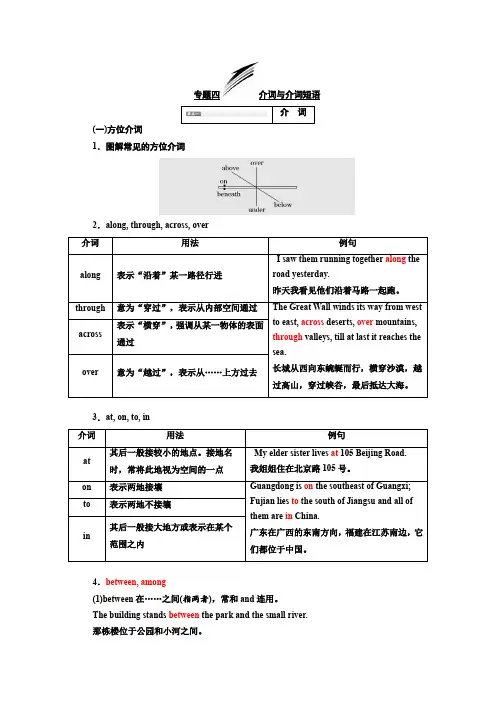
1.图解常见的方位介词
2.along, through, across, over
介词 用法 例句
along 表示“沿着”某一路径行进 I saw them running together along the
road yesterday.
昨天我看见他们沿着马路一起跑。
through 意为“穿过”,表示从内部空间通过 The Great Wall winds its way from west
to east, across deserts, over mountains,
through valleys, till at last it reaches the
sea.
长城从西向东蜿蜒而行,横穿沙漠,越过高山,穿过峡谷,最后抵达大海。 across 表示“横穿”,强调从某一物体的表面通过
over 意为“越过”,表示从……上方过去
3.at, on, to, in
介词 用法 例句
at 其后一般接较小的地点。接地名时,常将此地视为空间的一点 My elder sister lives at 105 Beijing Road.
我姐姐住在北京路105号。
on 表示两地接壤 Guangdong is on the southeast of Guangxi;
Fujian lies to the south of Jiangsu and all of
them are in China.
广东在广西的东南方向,福建在江苏南边,它们都位于中国。 to 表示两地不接壤
in 其后一般接大地方或表示在某个范围之内
4.between, among
(1)between在……之间(指两者),常和and连用。
The building stands between the park and the small river.
那栋楼位于公园和小河之间。 (2)among在……之间(指三者或三者以上)。
- 1 - 专题五 介词、介词短语和连词
一、介词和介词短语
介词是一种虚词,不能单独作句子成分,必须与名词或代词(相当于名词的其他词类短语或从句)构成介词短语,才能在句中充当某一个成分。介词短语在句中可充当状语,表语,定语及补语等成分。
How I wish every family had a large house with a beautiful garden!
Is this the reason he explained at the meeting for his carelessness in his work?
With a lot of difficult problems to settle, the newly-elected president is having a hard time.
二、连词
连词是用来连接词、短语、从句或句子的一种虚词不能独立担任句子成分。
按词义及其句法作用,连词可分为并列连词和从属连词。常见的并列连词有and, but, or, not
only...but also, yet, either...or...等。常见的从属连词有when, because, if, though, as if, now that,
until, unless等。
I saw Bob play the piano at John's party and on that occasion he was simply brilliant.
Not only is the teacher himself interested in football but all his students are beginning to show an
interest in it.
Please follow your supervisor's instructions, or you'll offend him.
1 / 13
介词
一、定义与特征
1. 介词又叫前置词,是一种虚词。
2. 介词是一种用来表示词与词,或者词与句之间的关系的词,在句中不能单独作句子成分。
3. 介词一定要有宾语,充当宾语的一般有名词、代词或相当于名词的其它词、短语或句子。
二、介词的分类
A 表时间的介词 B表地点位置的介词 C表方式的介词 D其他的介词
三、表示方位的介词
1. on, in
on是指在某物的表面上,与物体表面接触。其反义词是beneath。
They are sitting on the grass. 他们正坐在草地上。
A lovely cat is lying on the table. 一只可爱的小猫正躺在桌子上。
The little mouse is beneath the paper, so it is not easy to find.
这只小老鼠在纸下面,所以不容易被发现。
英语中打击人的头、额、鼻、耳、颈、肩、腿等部位时,用on。
The headmaster patted the boy on the head and comforted him.校长拍拍小男孩的头安慰他。
表示植物本身生长出来的枝叶、花果等用on。
There are a lot of pears on the tree. 树上有许多梨。
in 表示“在……之上”时,暗示占去了某物的一部分,强调接触的深度。
There is/are a hole/two windows in the wall. 墙上有个洞/两扇窗户。
英语中打击人的脸、眼、嘴、胸、腹等部位时,用in。
表示植物本身以外的人或动物“在树上”,用in意指枝叶遮掩其中。
2. over, above, under, below
高考英语语法填空之介词及介词短语专项练习
1.I began ________ a calculating machine ________ France ________ 1642.
2.Spielberg is such a famous director that we're all looking forward to ________(see)his new
films.
3.Driving cars instead of taking buses is harmful ________ our environment.
4.As far as I know, the little boy has a strong desire ________ knowledge.
5.On the contrary, most electronic media such ________ television, recordings, and radio make
fewer demands on their audiences.
6.People love to get together to eat, drink and have fun ________each other.
7.________ tradition, Chinese people will have a family reunion, admire the moon and share the
mooncakes.
8.Nanjing is an old city which lies ________ the Yangtze River.
9.Ensure the guard is ________ place before operating the machine.