
人教版七年级英语(下册)-Unit12
- 格式:ppt
- 大小:4.30 MB
- 文档页数:51


七年级下册英语单词表:Unit12附音标人教版七年级下册英语单词表:Unit 12附音标camp扎营;搭帐篷v./ kAmp/lake湖;湖泊n./ leik/beach海滩;沙滩n./ bi:tF/badminton羽毛球运动n./ 'bAdmintEn/sheep羊;绵羊n./ Fi:p/as作为;当作prep.&adv./ Az/natural自然的adj./ 'nAtFErEl/butterfly蝴蝶n./ 'bQtEflai/visitor游客;访问者n./ 'vizitE/tired疲倦的;疲劳的adj./ taiEd/stay停留;待v./ stei/stay up late深夜不留睡;熬夜away离开;远离adv./ E'wei/run away跑开mouse老鼠;耗子/ maus/baby幼小的;婴儿adj.&n./ 'beibi/shout呼叫;喊叫v./ Faut/shout at冲……大声叫嚷woof(狗叫声)汪汪int./ wu:f/language语言n./ 'lANgwidV/fly飞v./ flai/kite风筝n./ kait/fiy a kite放风筝high高的.(地)adj.&adv./ hai/high school中学ago以前adv./ E'gEu/India印度n./ 'indjE/tent帐篷n./ tent/put up搭起;举起moon月亮n./ mu:n/surprise惊奇;惊讶;使吃惊n.&v./ sE'praiz/get a surprise吃惊snake蛇n./ sneik/scared惊慌的;吓坏了的adj.move移动v./ mu:v/shout to对……大声喊叫start开始;着手v./ stB:t/jump跳;跃v./ dVQmp/up and down上上下下;起伏wake 弄醒;醒v./ weik/wake…up把……弄醒into到……里面;进入prep./ 'intu:/forest森林n./ 'fRrist/ear耳朵n./ iE/【人教版七年级下册英语单词表:Unit 12附音标】。

Unit 12 What did you do last weekend?Section A 2a — 2d (P68)* 教师寄语:If you want to understand today, you have to search yesterday.想要懂得今天,就必须研究昨天。
【学习目标】【学习重点】:继续学习谈论过去事件; 学会用疑问词who, what, when。
【体验学习】:预习交流1.根据图片和对话等,预测新课内容;2.根据音标拼读单词并牢记;3.自学课文,勾画出重点和疑惑。
翻译官visit my grandma_______________ 2.备考_____________________3. work as a guide _________________4. over______________________5. How interesting! ________________6. living habit_________________7. kind of _______________________ 8. 熬夜_____________________【课堂导学】:I、新课呈现Step1 Review and Lead-inQuick action: The phrases in 1a or the past forms of the verbs.Step2 PresentationShow some pictures, ask and learn. eg:--What did you/he/ she/they do? --Where did you/he/she/they go?--Who…?Step3 Listening1. Go through the sentences in 2a.2. Listen to 2a and underline the words you hear.3. Listen again. Write C for Carol, J for Jack or B for Becky next to the statements in 2b. Then check the answers.Step4 Pair workStudent A asks questions with who, what or where and Student B answers. Finish 2c. Role-play the conversations in 2d.II、合作交流Group work:模仿2d编写对话,谈论过去事件。

人教版七年级英语下册unit12优秀教案全文共3篇示例,供读者参考篇1Unit 12 of the People's Education Edition Grade Seven English textbook covers the topic of art and creativity. In this unit, students will learn about different forms of art, discuss their favorite types of art, and participate in various creative activities to express themselves.To make the most of this unit, here is an excellent lesson plan that teachers can follow:Lesson 1: Introduction to ArtObjective: To introduce students to the concept of art and its different forms.Activities:1. Show examples of different types of art such as paintings, sculptures, and music.2. Brainstorm with students about what art means to them and what forms of art they enjoy.3. Discuss the importance of art in society and how it can bea form of self-expression.Lesson 2: Famous ArtistsObjective: To learn about famous artists and their works.Activities:1. Introduce students to well-known artists such as Leonardo da Vinci, Vincent van Gogh, and Pablo Picasso.2. Show pictures of their famous works and discuss the style and themes of their art.3. Have students choose a favorite artist and create a poster about their life and works.Lesson 3: Creating ArtObjective: To engage students in creative activities to express themselves.Activities:1. Provide art supplies such as paints, crayons, and paper for students to use.2. Encourage students to create their own artwork inspired by the styles of famous artists or their own imagination.3. Have a mini art exhibition in the classroom to showcase students' works.Lesson 4: Reflecting on ArtObjective: To reflect on the role of art in our lives and society.Activities:1. Have a class discussion about how art can inspire, entertain, and provoke emotions.2. Ask students to write a reflection on what art means to them and how they can incorporate more art into their lives.3. Watch a short video about the impact of art on society and discuss its importance.By following this lesson plan, teachers can effectively cover the content of Unit 12 and engage students in meaningful discussions and activities related to art and creativity. This will not only help students improve their English skills but also develop their appreciation for art and the creative process.篇2Unit 12 of the People's Education Press seventh grade English textbook is focused on the theme of "Life in the future".In this unit, students will learn how to talk about their future plans, aspirations, and predictions. Here is an excellent lesson plan for teaching Unit 12 of the textbook:Lesson Plan:Title: Life in the futureGrade: 7Unit: 12 (People's Education Press)Theme: Future plans, aspirations, and predictionsDuration: 2 lessons (90 minutes each)Objectives:- Students will be able to talk about their future plans using the simple future tense.- Students will be able to express their aspirations for the future.- Students will be able to make predictions about the future using future tense modal verbs.- Students will be able to write a short paragraph describing their future plans.Warm-up (15 minutes):- Begin the lesson by asking students to brainstorm and discuss what they think life will be like in the future. Encourage them to think about technology, education, careers, and daily life.- Play a short video or show pictures of futuristic inventions and ask students to describe what they see.Presentation (30 minutes):- Introduce the simple future tense to students and explain its formation (will + base verb).- Give examples of how to talk about future plans using the simple future tense.- Practice with students by asking them to talk about their own future plans using the simple future tense.- Introduce future tense modal verbs (will, might, may) for making predictions about the future.- Give examples of how to make predictions using future tense modal verbs.Practice (30 minutes):- Divide students into pairs and ask them to discuss and write down their future plans using the simple future tense.- Monitor and provide assistance as needed.- Ask some pairs to share their plans with the class.Production (15 minutes):- Ask students to write a short paragraph (5-7 sentences) describing their future plans using the simple future tense.- Provide a writing prompt to help guide students in their writing.- Allow students to share their paragraphs with the class.Review and Assessment (15 minutes):- Review key concepts and vocabulary from the lesson.- Ask students to complete a short quiz or worksheet to assess their understanding of the simple future tense and future tense modal verbs.- Provide feedback and address any misconceptions.Homework:- Assign students to write a diary entry about a day in their future life using the simple future tense.By following this lesson plan, students will be able to effectively communicate their future plans, aspirations, andpredictions in English. This lesson plan incorporates various activities to engage students and reinforce key language concepts related to the theme of "Life in the future" in Unit 12 of the People's Education Press seventh grade English textbook.篇3Unit 12: You’re supposed to shake handsTeaching Objectives:1. Students will be able to understand the cultural differences in greetings between different countries.2. Students will be able to use the target language for greetings appropriately.3. Students will be able to reflect on the importance of cultural understanding and respect.Teaching Procedures:Step 1: Warm-up (10 minutes)- Begin the class by showing a video clip of people from different cultures greeting each other. Ask the students to share their thoughts on the various greetings they saw.- Discuss the importance of greetings in different cultures and how they can vary from country to country.Step 2: Presentation (15 minutes)- Introduce the target language for greetings and practice pronunciation with the students.- Show a slideshow or video presentation of common greetings in different countries, emphasizing the cultural significance of each greeting.- Have students take notes on the different greetings and their cultural meanings.Step 3: Practice (20 minutes)- Divide the class into pairs or small groups and have them practice the target language greetings with each other.- Encourage students to think about the appropriate greetings for different situations (formal vs. informal, meeting strangers vs. meeting friends).- Monitor and provide feedback as needed.Step 4: Cultural Understanding (15 minutes)- Engage the students in a discussion about the importance of cultural understanding and respect when greeting others.- Ask students to reflect on a time when they may have misunderstood a greeting in a different culture and how they could have handled the situation better.- Encourage students to think about ways they can show respect for other cultures in their daily lives.Step 5: Review and Assessment (10 minutes)- Review the target language greetings with the whole class and assess student understanding through a quick quiz or game.- Encourage students to continue practicing their greetings outside of the classroom and to explore more about different cultures and their greetings.Homework:- Ask students to research a different culture and its traditional greetings, and to write a short reflection on what they learned.By following this detailed lesson plan, students will not only learn the target language for greetings but also gain a deeperunderstanding of the importance of cultural awareness and respect.。
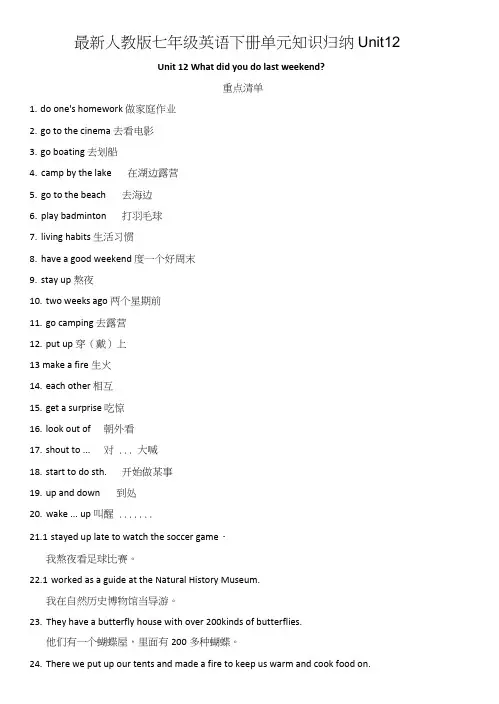
最新人教版七年级英语下册单元知识归纳Unit12Unit 12 What did you do last weekend?重点清单1.do one's homework 做家庭作业2.go to the cinema 去看电影3.go boating 去划船4.camp by the lake 在湖边露营5.go to the beach 去海边6.play badminton 打羽毛球7.living habits 生活习惯8.have a good weekend 度一个好周末9.stay up 熬夜10.two weeks ago 两个星期前11.go camping 去露营12.put up 穿(戴)上13 make a fire 生火14.each other 相互15.get a surprise 吃惊16.look out of 朝外看17.shout to ... 对 ... 大喊18.start to do sth. 开始做某事19.up and down 到处20.wake ... up 叫醒 .......21.1stayed up late to watch the soccer game・我熬夜看足球比赛。
22.1worked as a guide at the Natural History Museum.我在自然历史博物馆当导游。
23.They have a butterfly house with over 200kinds of butterflies.他们有一个蝴蝶屋,里面有200多种蝴蝶。
24.There we put up our tents and made a fire to keep us warm and cook food on.在那我们支起一个帐篷,并生火取暖,在火上烹饪食物。
25.1was so tired that I went to sleep early.我太累了,因此很早就去睡觉了。