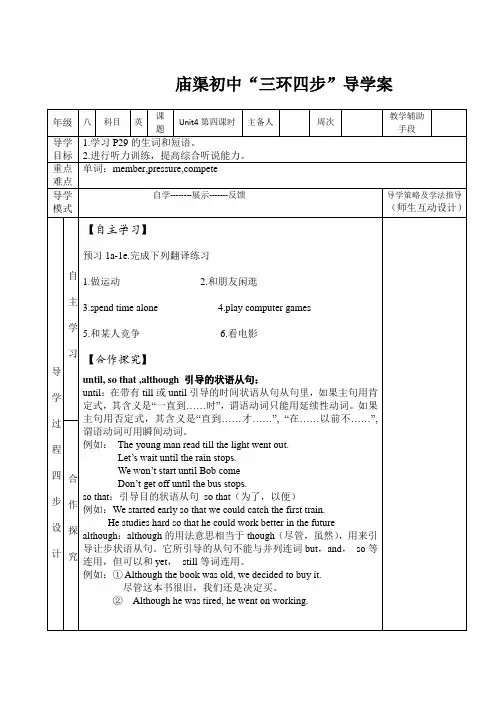
人教版英语八年级下unit4讲解与练习
- 格式:doc
- 大小:291.00 KB
- 文档页数:16
人教版英语八年级下unit4讲解与练习
-CAL-FENGHAI.-(YICAI)-Company One1 Unit 4 Why don’t you talk to your parents?
1. I have to study too much so I don’t get enough sleep.
1) 此处so为连词,意为“因此,所以”,引导结果状语从句。
例:He had a bad cold yesterday so he didn’t go to school.
中考链接
(2012.广东)Ben was busy taking a training class, _____ we had to wait for him for half an
hour.
A. so B. if C. or D. But
2) 此处sleep 为不可数名词,意为“睡觉,睡眠”
例:Do you ever talk in your sleep?
【拓展】sleep (slept, slept) 也可作不及物动词,意为“睡觉”
例:She goes to sleep at nine o’clock every night.
2. I have too much homework so I don’t have any free time to do things I like.
1)词语辨析
Too much:词义____________可修饰_______________举例_______________________________________________
Much too:词义____________可修饰_______________举例_______________________________________________
Too many:词义____________可修饰_______________举例_______________________________________________
2) 此处to do things 为动词不定式作后置定语,修饰名词time.
例:Would you like something ___________你想要吃点什么吗
3. My parents don’t allow me to hang out with my friends.
1) 此处allow作及物动词,意为“允许”
Allow sb. to do sth. 允许某人做某事
例句:I can’t allow you to talk to Mom like that.
【拓展】a. Allow sth. 允许某事
b. Allow doing sth. 允许做某事
2)此处hang out (hung out) 意为“闲逛,溜达”
例:He often hangs out with his friends.
4. I’m really tired because I studied until midnight last night.
此处until为介词,意为“直到......为止”,同义词为till.
It may last until tomorrow.
【拓展】until为连词,意为“直到......为止”,引导时间状语从句。
I will stay with you until your mother comes back.
5. Why don’t you go to sleep earlier this evening?
辨析:go to sleep, go to bed与sleep
Go to sleep: “去睡觉,入睡”,强调动作 Go to bed: “去睡觉”,表示上床去睡这个动作,与get up相对
Slept:“睡觉”,不及物动词,强调睡的全过程,为延续性动词
例:
He often goes to bed at nine.
He went to sleep early, for he was very tired.
She sleeps for just six hours.
6. I am not good at writing letters.
Be good at意为“擅长,在......(方面)做得好”,后面接名词、代词或动名词。其同义短语为do well in.
He is good at maths. = He does well in maths.
辨析:
Be good at: “擅长,善于,在......(方面)做得好”,后面接表示事物的动名词、代词或动名词
Be good for: “对......有益(有用)”,后面接表示人或物的名词或代词
Be good to : “对......好(和善)”,后面接人或人格化的名词或代词
Be good with: “与......相处的好”,后面接表示人的名词或代词
7. I don’t want to talk about it on the phone.
Talk about 意为“谈论”,后面接人或事。
例: He talked about his plan.
8. Well, I found my sister looking through my things yesterday.
Look through 意为“翻阅,浏览,仔细看”,为“动词+介词”短语,后面接物。
例:Look through your notes before the exam.
9. Although she’s wrong, it’s not a big deal.
1) although 作连词,意为“虽然,尽管”,引导让步状语从句。
(2012. 江西)_________ the girl is only nine, she takes care of her brother and cooks meals
every day.
A. If B. Because C. Although D. As
2)big deal为习语,用于口语,意为“什么大不了的事,重要的事,要人”。
例: It’s no big deal! I can find another job any time.
3)deal名词,意为“协议,交易”
例:I would like to make a deal with you.
【拓展】a. Deal作名词,意为“大量”,航用于短语a good/great deal (of sth.)中
例: She reads a good/great deal of books.
b. Deal作不及物动词,常与介词with连用,意为“处理,应付”
How did you deal with the bike?
10. My problem is that I can’t get on with my family. Get on with sb.意为“和某人和睦相处,和某人关系很好”,同义短语为get along
(well)with sb.
例:She can’t get on with her sister.
【拓展】a.get on with sth.(=get along with sth.)意为“取得进展”
例:I am not getting on very fast with this work.
b.get on (=get along) 意为“进展,进步”,后接副词或用于how引导的疑问句中。
例:Linda is getting on well at school.
11. They fight a lot, and I really don’t like it.
A lot此处修饰动词fight,意为“很,非常,常常”。
例: She laughed a lot.
【拓展】a.a lot可与形容词或副词比较级连用,意为“很,非常”
例: I am feeling a lot better today.
b.a lot of (或lots of)作形容词,修饰复数名词或不可数名词,意为“许多,大量”。
例: There are a lot of people in the park.
12. I don’t know if I should say anything to them about this.
If作连词,此处引导宾语从句,意为“是否”,同义词为whether.
例:I don’t know it/whether he will come.
【拓展】if作连词,还常用来引导条件状语从句,意为“如果,假如”
例:We will go to play football if it doesn’t rain tomorrow.
13. When they argue, it’s like a big, black cloud hanging over our home.
1) argue 此处用作不及物动词,意为“争吵,争论”。、
例: The boy argued with his mother about his homework.
2)此处like作介词,意为“像......一样”。
例:I am going to be a pop star like Micheal Jackson.
辨析:like与as
Like:“像......一样”,作介词,用于说明相似关系,指两者在形态上或性质上有相似之处
As:“作为,看作”,作介词,用于说明同一关系,指身份、资格等。
对比:
He works like a worker.
He works as a worker.
3)此处over作介词,意为“在......上方”
例:The sun is shining over our head.
14. Also, my elder brother is not nice to me.
Elder形容词,意为“年纪较长的”,是old的一种比较级形式,主要用于表示家庭成员之间的长幼关系。
例: His elder sister is at school.
辨析:elder与older