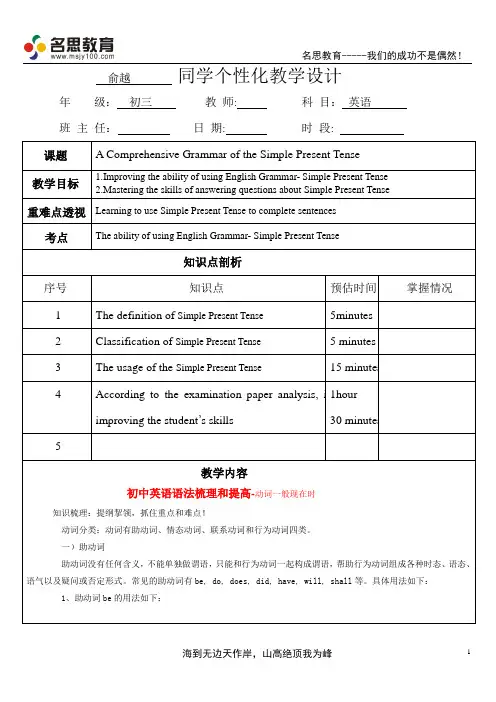
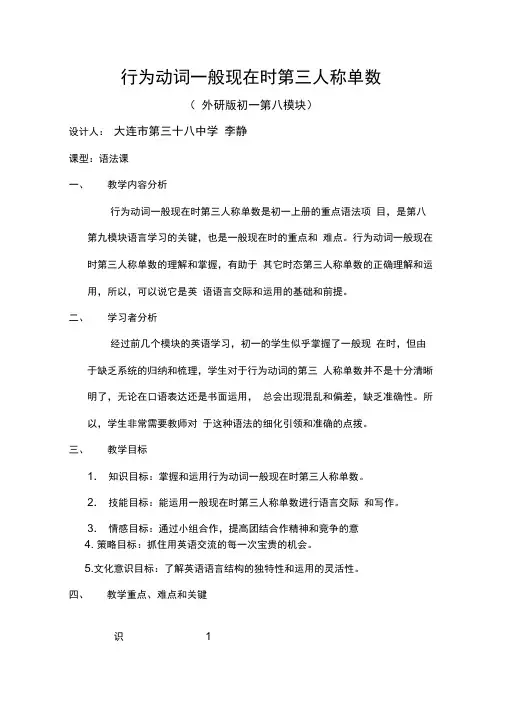
(完整版)一般现在时教案
- 格式:docx
- 大小:55.36 KB
- 文档页数:22
识 1
行为动词一般现在时第三人称单数
( 外研版初一第八模块)
设计人: 大连市第三十八中学 李静
课型:语法课
一、 教学内容分析
行为动词一般现在时第三人称单数是初一上册的重点语法项 目,是第八第九模块语言学习的关键,也是一般现在时的重点和 难点。行为动词一般现在时第三人称单数的理解和掌握,有助于 其它时态第三人称单数的正确理解和运用,所以,可以说它是英 语语言交际和运用的基础和前提。
二、 学习者分析
经过前几个模块的英语学习,初一的学生似乎掌握了一般现 在时,但由于缺乏系统的归纳和梳理,学生对于行为动词的第三 人称单数并不是十分清晰明了,无论在口语表达还是书面运用, 总会出现混乱和偏差,缺乏准确性。所以,学生非常需要教师对 于这种语法的细化引领和准确的点拨。
三、 教学目标
1. 知识目标:掌握和运用行为动词一般现在时第三人称单数。
2. 技能目标:能运用一般现在时第三人称单数进行语言交际 和写作。
3. 情感目标:通过小组合作,提高团结合作精神和竞争的意
4. 策略目标:抓住用英语交流的每一次宝贵的机会。
5.文化意识目标:了解英语语言结构的独特性和运用的灵活性。
四、 教学重点、难点和关键 2
1. 教学重点:行为动词一般现在时第三人称单数的结构体系
和正确运用。
2. 教学难点:行为动词一般现在时第三人称单数运用于交际
和表达。
3. 教学突破的关键: a. 采用多媒体教学,运用形象的图片
和彩色字体的强化 ; b. 采用顺口溜的形式,提高学生的学习 兴趣,强化学生的记忆 ; c. 小组合作,取长补短,共同完成 学习任务。
五、 教学步骤与设计意图
1. Pre-teaching
课前播放大屏幕图片和歌曲 the school day, 让学生在轻 松和愉快的氛围下进入语法的学习。 Students stand up and greet ,Not sitting
down ,the teacher gets the students to talk about“ My school day ”
in pairs ,
设计意图:激情引趣,为上课创造良好的学习氛
2. Homework checking(share )
Get the Volunteers to share “Myschool day” with the class 设计意图:检查作业,为下面的第三人称单数的语言交际打好基础,基础好的学生可以对第三人称单数有少量的使用
3. Presentation
A. Question and answer 3
The teacher:我们以上的交流运用了什么时态?
The students:学生回答:一般现在时.
The teacher:你怎样理解这种时态?
The students: —般的状况或经常发生的动作.
The teacher:我们现在学习了几种动词的一般现在时呢?
The stude nts:系动词,情态动词和行为动词;(学生在 回答时,答案可能有偏差,教师作好引领)
The teacher shows the senten ces on the scree n:
a. Tom is from En gla nd.
b. He can speak English very well.
c. We often get up at six every day.
The students: a. 动词用原形b.主语是第三人称单数时,动
词加s.
The teacher: 什么样的词和短语是第三人称单数?
B. words and phrases The teacher : 我们发现行为动词一般现在时的运用有几种情 She ofte
n gets up at six.
况? 4
细节掌握、快速反映 1:
从下面的单词和短语中找出第三人称单数 (在题号前划 v )
1). my friend 7). the boy 's parents
2). our teacher 8). your teachers
3). your name 9). our class
4).their brother 10). Tom and Lucy
5). her pens 11).the chair
6). Lucy and Lily 's parent 12). DaMing with his parents
与学生研究为什么1 ).2).3).4).6).9).11).12) 是第三人称单数,
而其他的不是第三人称单数。
The teacher: 当主语是第三人称单数时,动词有什么变化?
The students: ...... ( 学生回答,教师补充展示 )
a .直接在动词后加 s. reads
b. 以 s,x,ch,sh 结尾的动词在后面加 es. watches
c. 以辅音字母加 o 结尾的动词,加 es. goes
d. 以辅音字母加 y 结尾的动词,变 y 为 i 加 es. carries
e. 以元音字母加 y 结尾的动词,直接加 s. says
f. 动词的不规则变化。 have 变成 has
细节掌握、快速反映 2:
写出下列动词的第三人称单数形式。
1). study -- 6).go- 11). Pass 5
2). say-- 7).ope n-- 12). do-
3). have-- 8).write-- 13). ride-
4). play-- 9).read-- 14). carry-
5). wash-- 10).teach -- 15). like
Check up and read them together
设计意图:培养质疑,激发思维,快速反映,引导呈现
4. Practise
A. oral practice
学生日常活动表格
where how whe n /what what to do
at school by bus 7:00 go to school
8:00 start less ons
4:00 p.m. play football
by car 5:00 p.m. go home
at home
? get up
7:30 do homework
10:00 ?
10:30 watch TV
in the
supermarket
on Saturday ?
on foot on Sunday go shopp ing
after school play games
6:00 ?
by taxi in the eve ning see a film
at the cin ema
1) 运用表格,用单三形式造句子(one bye one)6
for example: a. He goes to school at seve n.
b. Xiaoh ong goes to school by bus.
The Teacher:这些句子的疑问,特殊疑问,选择疑问和否定有
什么变化?
The students answer and the teacher shows and concludes:
主语是第三人称单数句子的变化:
a. She doesn ' t often get up at six.
b. Does she often get up at six? Yes, she does.
No, she doesn ' t.
c. When does she often get up?
Expla in and read together.
绕口令:Does是个照妖镜,动词见它现原形。
2).运用表格,编一个对话或一段短文(teamwork)
教师与的三个学生合作一个model.
The model: A: She goes home at 5.
B: Does she go home at 5/6?
C: Yes, she does/No, she doesn ' t
How does she go home?
A: She goes home by car. She ofte n gets up at six.
d. Does she often get up at six or at five 7
D: Does she go home by car or on foot?
A: She goes to school by car.
有能力的小组或个人可以脱离表格和 Model,创造自己的对
话或文章。
设计意图: 理清单三句型的变化,利用绕口令,激发兴趣,加深理
解;小组合作,化解语言的难点,知识运用于交际; 口语操练从造
句子过渡到编对话或文段,由易到难,层层深入。
B. written practice
1) 语言运用,习题巩固 (by on eself)
按照要求转换句型,每空一词。
a. They speak English.( 改为一般疑问句)
_______ they ______ English ?
b. She does her homework at home on Sun days.( 变为否定
句)
She _______ ________ her homework at home on
Sundays 。
c. The little girl has a new
book .( 改为一般疑问句)
_____ the little girl ________ a new book?
d. Mike lives in London.( 完成句子)