
subject and predicate agreement
- 格式:ppt
- 大小:897.50 KB
- 文档页数:24




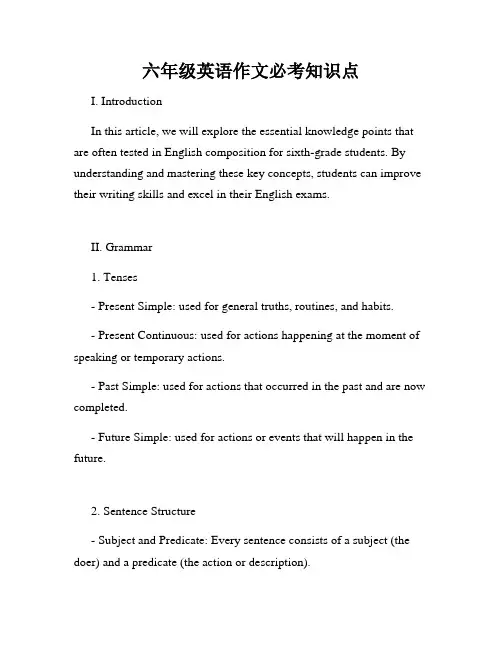
六年级英语作文必考知识点I. IntroductionIn this article, we will explore the essential knowledge points that are often tested in English composition for sixth-grade students. By understanding and mastering these key concepts, students can improve their writing skills and excel in their English exams.II. Grammar1. Tenses- Present Simple: used for general truths, routines, and habits.- Present Continuous: used for actions happening at the moment of speaking or temporary actions.- Past Simple: used for actions that occurred in the past and are now completed.- Future Simple: used for actions or events that will happen in the future.2. Sentence Structure- Subject and Predicate: Every sentence consists of a subject (the doer) and a predicate (the action or description).- Subject-Verb Agreement: The verb must agree with the subject in number (singular or plural).- Sentence Types: Students should be familiar with declarative, interrogative, imperative, and exclamatory sentences.III. Vocabulary1. Synonyms and Antonyms- Synonyms: words that have similar meanings.- Antonyms: words that have opposite meanings.2. Homophones and Homographs- Homophones: words that sound the same but have different meanings.- Homographs: words that are spelled the same but have different meanings.3. Word Forms- Nouns, verbs, adjectives, and adverbs: understanding how words change form to fit different parts of speech.IV. Sentence Connectors1. Coordinating Conjunctions- Examples: and, but, or, so.2. Subordinating Conjunctions- Examples: because, although, if, when.3. Transitions- Examples: first, next, then, finally.V. Writing Techniques1. Introduction and Conclusion- Writing a clear and engaging introduction to grab the reader's attention.- Crafting a strong conclusion that summarizes the main points and leaves a lasting impression.2. Descriptive Language- Using sensory details and vivid language to paint a picture in the reader's mind.3. Dialogue- Incorporating dialogue to make the writing more dynamic and realistic.4. Organization- Structuring the composition logically with proper paragraph breaks and topic sentences.VI. Practice and Preparation1. Regular Writing Practice- Dedicate regular time to write compositions, focusing on incorporating the knowledge points mentioned above.2. Read Widely- Reading various genres, such as novels, short stories, and news articles, can expand vocabulary and provide exposure to different writing styles.3. Seek Feedback- Ask for feedback from teachers, classmates, or family members to identify areas for improvement.VII. ConclusionBy understanding and applying the essential knowledge points mentioned above, sixth-grade students can boost their confidence and excel in English composition. Regular practice, extensive reading, and seeking feedback are vital for continuous improvement. Remember, practice makes perfect!。