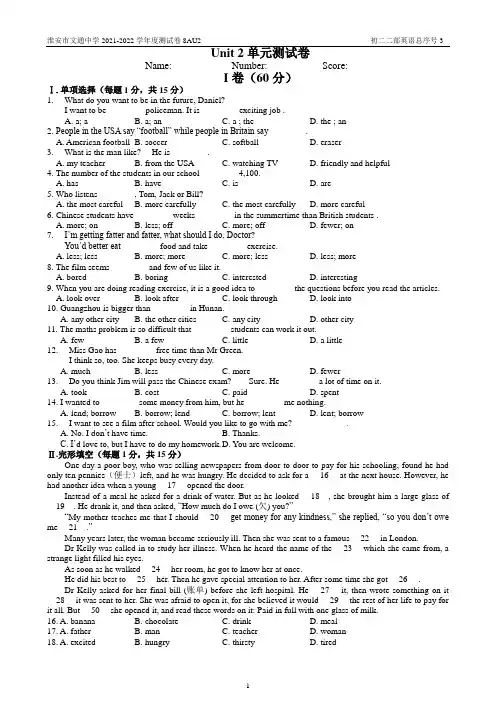
Unit 2单元测试卷Name: ___________ Number: __________ Score: __________I卷(60分)Ⅰ.单项选择(每题1分,共15分)1. ---What do you want to be in the future, Daniel?---I want to be ________ policeman. It is ________ exciting job .A. a; aB. a; anC. a ; theD. the ; an2. People in the USA say “football” while people in Britain say ________.A. American footballB. soccerC. softballD. eraser3. ---What is the man like? ---He is ________.A. my teacherB. from the USAC. watching TVD. friendly and helpful4. The number of the students in our school ________ 4,100.A. hasB. haveC. isD. are5. Who listens ________, Tom, Jack or Bill?A. the most carefulB. more carefullyC. the most carefullyD. more careful6. Chinese students have ________ weeks ________ in the summertime than British students .A. more; onB. less; offC. more; offD. fewer; on7. ---I’m getting fatter and fatter, what should I do, Doctor?---You’d better eat ________ food and take ________ exercise.A. less; lessB. more; moreC. more; lessD. less; more8. The film seems ________ and few of us like it.A. boredB. boringC. interestedD. interesting9. When you are doing reading exercise, it is a good idea to ________ the questions before you read the articles.A. look overB. look afterC. look throughD. look into10. Guangzhou is bigger than ________ in Hunan.A. any other cityB. the other citiesC. any cityD. other city11. The maths problem is so difficult that ________ students can work it out.A. fewB. a fewC. littleD. a little12. ---Miss Gao has ________ free time than Mr Green.---I think so, too. She keeps busy every day.A. muchB. lessC. moreD. fewer13. ---Do you think Jim will pass the Chinese exam? ---Sure. He ________ a lot of time on it.A. tookB. costC. paidD. spent14. I wanted to ________ some money from him, but he ________ me nothing.A. lend; borrowB. borrow; lendC. borrow; lentD. lent; borrow15. ---I want to see a film after school. Would you like to go with me? --- ________.A. No. I don’t have time.B. Thanks.C. I’d love to, but I have to do my homework.D. You are welcome.Ⅱ.完形填空(每题1分,共15分)One day a poor boy, who was selling newspapers from door to door to pay for his schooling, found he had only ten pennies(便士)left, and he was hungry. He decided to ask for a __16__ at the next house. However, he had another idea when a young __17__ opened the door.Instead of a meal he asked for a drink of water. But as he looked __18__, she brought him a large glass of __19__. He drank it, and then asked, “How much do I owe (欠) you?”“My mother teaches me that I should __20__ get money for any kindness,” she replied, “so you don’t owe me __21__.”Many years later, the woman became seriously ill. Then she was sent to a famous __22__ in London.Dr Kelly was called in to study her illness. When he heard the name of the __23__ which she came from, a strange light filled his eyes.As soon as he walked __24__ her room, he got to know her at once.He did his best to __25__ her. Then he gave special attention to her. After some time she got __26__ .Dr Kelly asked for her final bill (账单) before she left hospital. He __27__ it, then wrote something on it __28__ it was sent to her. She was afraid to open it, for she believed it would __29__ the rest of her life to pay for it all. But __50__ she opened it, and read these words on it: Paid in full with one glass of milk.16. A. banana B. chocolate C. drink D. meal17. A. father B. man C. teacher D. woman18. A. excited B. hungry C. thirsty D. tired19. A. coffee B. juice C. milk D. water20. A. always B. never C. often D. sometimes21. A. anything B. everything C. nothing D. something22. A. park B. hospital C. hotel D. university23. A. country B. house C. street D. town24. A. from B. into C. off D. to25. A. examine B. protect C. remember D. save26. A. away B. back C. well D. worse27. A. looked at B. looked after C. looked for D. looked up28. A. after B. because C. before D. when29. A. cost B. pay C. spend D. take30. A. finally B. happily C. quickly D. soonⅢ.阅读理解(每题2分,共30分)AHow much do you know about school life in Singapore?In Singapore, many middle school students spend a lot of time on their studies. People always think that good schooling is the ticket to success (成功). So, many of these students try their best to get good results in their exams. They have a lot of homework every day and exams are usually a big problem to them. Sometimes, a few even have to go to evening classes after school.Schools have many activities outside school hours. The students can join in sports and games, music and dance, swimming and rock-climbing. They also join in community service (社区服务)In their free time, most students like to listen to pop music. Hollywood movies, Hong Kong and Singapore movies are very popular, too. Some of them also spend their free time searching the Internet, e-mailing their friends, playing computer and video games.They sometimes go to cafes, fast-food restaurants, shopping centers and big bookstores.So life for middle school students in Singapore is not easy but rich and colorful.31. ________ go to evening classes after school in Singapore.A. All of the studentsB. Few of the studentsC. A few of the studentsD. Most of the students32. Which of the following is not mentioned(提到) that the students can do outside school hours?A. Doing sports and playing games.B. Listening to music and dancing.C. Going swimming and rock-climbing.D. Visiting the museums.33. The meaning of the last sentence in the passage is that _______.A. the middle school students' life in Singapore is easyB. the middle school students' life in Singapore is amazingC. the middle school students' life in Singapore is boringD. the middle school students' life in Singapore is hard, but it's interesting34. The passage tells us that many students in Singapore would like to _______.A. go swimmingB. write letters to their friendsC. talk to their friendsD. get good results in the exams35. What is the best title of this article?A. Students in SingaporeB. Activities in Singapore’s schoolC. Life in SingaporeD. School life in SingaporeBA few minutes before six o’clock, Mr Smith decided to leave. He was about to start the car when a gunman jumped up from the back seat. He held a gun(枪) to Mr Smi th’s head. “Drive me to Paris.” he shouted.“All right,” Mr Smith answered. He started the engine, pulled away from the side of the street and drove down. Being 81years old, he knew he could not fight the gunman. He knew he needed help. Where were the police? As he drove through each crossing, he looked up and down the side streets, hoping to meet a police car. But he could see nothing. “Just my luck,” he thought. “ If I was driving too fast , there would be a police car on every corner.”Suddenly he pushed his foot down on the accelerator (油门), and the car ran much faster. “What are you doing?” shouted the gunman. “Keeping off the police,” Mr Smith answered. “ I thought I saw a police car back there.”He ran lights, drove the wrong way on one-way streets. On two-way streets he drove on the wrong side of the road. No one policeman saw him. Again Mr Smith’s plan was not working. He had to try a new plan. He turned a corner and saw the police station in front.Then he drove his car as fast as he could towards the police gate. The car hit a police motorbike down and stopped. Mr Smith shouted, “Help! Help!” Then he reached back to grab (夺) the man’s gun. At the same time the policeman heard the noise and quickly caught the gunman.36. Where did the gunman want to go?A. New York.B. Tokyo.C. Paris.D. London.37. What does the underlined word “engine” mean in Chinese?A.发动机B.刹车C.喇叭D.轮胎38. Why does Mr Smith drive much faster suddenly?A. Because he wanted to keep off the police.B. Because he saw a police car behind his.C. Because his plan was working.D. Because he wanted the police to see him.39. Which of the following is NOT true?A. Mr Smith ran lights, drove the wrong way on one-way streets.B. Mr Smith knew h e didn’t need any help.C. Mr Smith drove his car as fast as he could towards the police gate.D. Mr Smith looked up and down the side street, hoping to meet a police car.40. From the passage, we can infer(推断) that ________________.A. Mr Smith is a strong manB. Mr Smith is a shy manC. Mr Smith is a wise manD. Mr Smith is a stupid manCAsk any student which he or she hates most. 9 out of 10 students will answer “math”. No matter which country you visit, no matter which grade you are in, you may not learn art, geography, chemistry or Chinese, but you always learn math. Why is this so? How come so many students hate math, and yet cannot avoid (避免) learning it in school?Jenny Sanders, a high school student in California, asks, “What good do we get from learning math? We can use computers to compute, and we can use computers to store information. I think learning math at school is a waste of time.”However, there is much more to math than just learning to add and subtract (减) numbers. In fact, math is not so much about calculation(计算) as it is about learning to think logically (逻辑) and solving problems. Of course, Jenny was right that we can use computers to do calculations, but how would we even know how to use the computer if we can’t think logically? In short, computers are only tools when solving problems.For example, imagine(想象)you are a cook and must serve dinner to 100 guests. How should you divide(分配) your resources so that you can get the job done most efficiently(高效地)? In situations like this, the ability to think logically will get you to a reasonable answer and solve your problem.41. According to the passage, which subject do students always learn in different grades at school?A. ChineseB. MathC. GeographyD. Art42. What does Jenny Sanders think of learning math?A. Interesting.B. Boring .C. Fun.D. Difficult.43. Which of the following is TRUE according to the passage?A. 90% of the students hate learning math.B. Students can learn math well with computers.C. Math can do calculations and store information.D. Math helps students learn all the other subjects well.44. What does the underlined word “resources” mean in the passage?A.科目B.效率C.信息D.资源45. What does the writer want to tell us?A. Math is just learning to add and subtract numbers.B. Math can be good for both our body and our mind.C. Math helps us think logically and solve problems.D. Math can help students find a good job in the future.II卷(60分)Ⅳ.词汇运用(每题1分,共15分)A.选词填空。