
英语语言学chapter4.ppt
- 格式:ppt
- 大小:340.00 KB
- 文档页数:38

实用标准文案
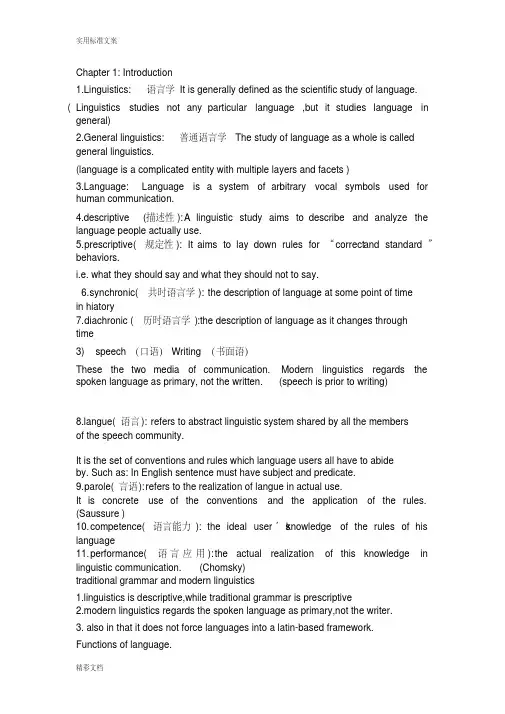
精彩文档Chapter 1: Introduction 1.Linguistics:语言学It is generally defined as the scientific study of language. ( Linguistics studies not any particular language ,but it studies language in general) 2.General linguistics:普通语言学The study of language as a whole is called general linguistics. (language is a complicated entity with multiple layers and facets ) nguage:Language is a system of arbitrary vocal symbols used for human communication. 4.descriptive (描述性):A linguistic study aims to describe and analyze the language people actually use. 5.prescriptive(规定性): It aims to lay down rules for “correct and standard” behaviors. i.e. what they should say and what they should not to say. 6.synchronic(共时语言学): the description of language at some point of time in hiatory 7.diachronic (历时语言学):the description of language as it changes through time 3) speech(口语)Writing(书面语)These the two media of communication. Modern linguistics regards the spoken language as primary, not the written. (speech is prior to writing)
《新编简明英语语言学教程》第二版课后练习题答案
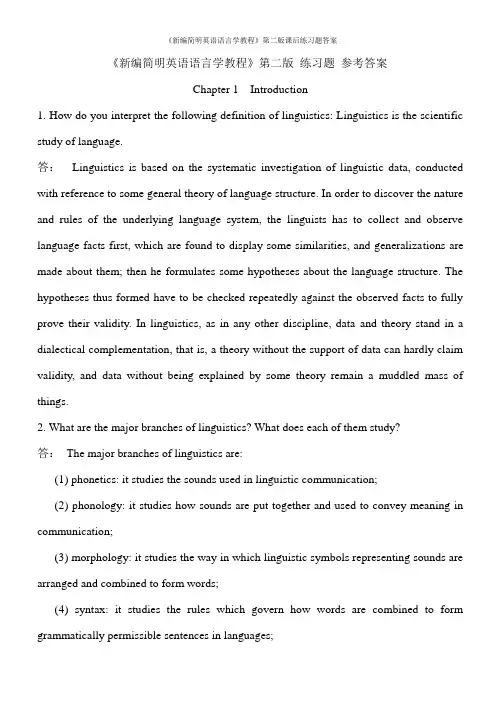
《新编简明英语语言学教程》第二版 练习题 参考答案
Chapter 1 Introduction
1. How do you interpret the following definition of linguistics: Linguistics is the scientific
study of language.
答: Linguistics is based on the systematic investigation of linguistic data, conducted
with reference to some general theory of language structure. In order to discover the nature
and rules of the underlying language system, the linguists has to collect and observe
language facts first, which are found to display some similarities, and generalizations are
made about them; then he formulates some hypotheses about the language structure. The
hypotheses thus formed have to be checked repeatedly against the observed facts to fully
prove their validity. In linguistics, as in any other discipline, data and theory stand in a

百度文库 - 让每个人平等地提升自我
1 英语语言学教程(胡壮麟版)
Chapter one. Invitation to Linguistic.
1. What is language?
“Language is system of arbitrary vocal symbols used for human communication. It is a system, since
linguistic elements are arranged systematically, rather than randomly. Arbitrary, in the sense that there is
usually no intrinsic connection between a work (like “book”) and the object it refers to. This explains and
is explained by the fact that different languages have different “books”: “book” in English, “livre” in
French, “shu” in Chinese. It is symbolic, because words are associated with objects, actions, ideas etc. by
nothing but convention. Namely, people use the sounds or vocal forms to symbolize what they wish to
refer to. It is vocal, because sound or speech is the primary medium for all human languages. Writing

英语语言学试题(9)
语言学试题及参考答案
I. Directions : Read each of the following statements carefully. Decide which one of the four choices best completes the statement and put the letter A, B, C or D in the brackets. (2%×10=20%)
1. Linguistics is the scientific study of __________.
A. a particular language
B. the English language
C. human languages in general
D. the system of a particular language
2. The consonant [f] in English can be correctly described as having
the following phonetic features: __________.
A. voiceless, bilabial, stop
B. voiceless, labiodental, fricative
C. voiced, bilabial, stop D. voiced, labiodental, fricative
3. There are different types of affixes or morphemes. The affix "ed" in the word "learned" is known as a(n) __________.
A. derivational morpheme