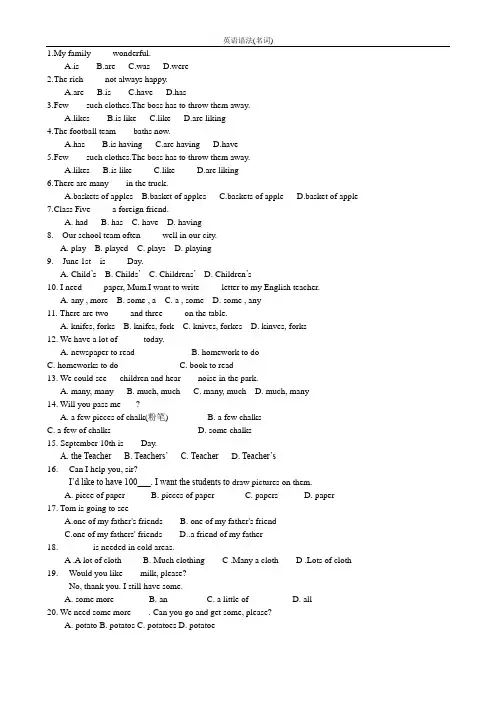
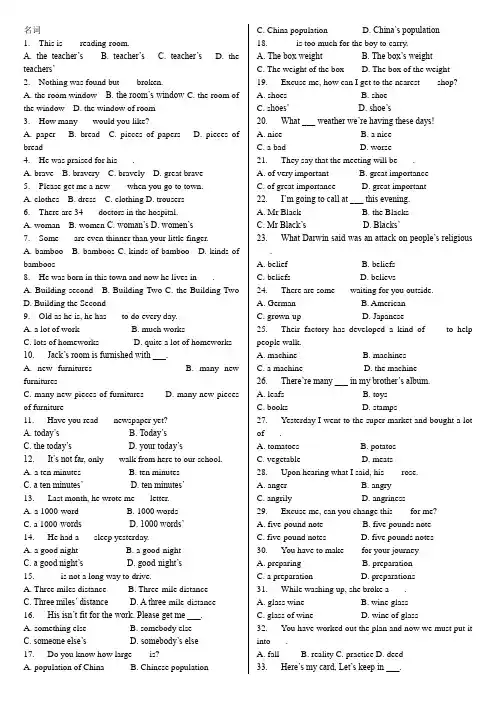
初中英语 名词
- 格式:doc
- 大小:64.00 KB
- 文档页数:10
初中英语名词用法讲与练
在英语中,名词的用法十分广泛,且在历年中考中,―名词‖考点热仍然处于有升无降之趋势,就近几年的中考英语试题来看,对名词考查得较热的还是―名词的数‖、―名词的格‖、―名词作主语时和谓语一致关系‖(名词的其它知识点是必要的基础),下面结合教材和近年来中考试题,从这三个方面谈名词复习的问题,供学习者体会。
名词的数
名词按其所表示的事物的性质可分为可数名词(个体名词和大多数集体名词)和不可数名词(物质名词和抽象名词)两种。表示可以计数的事物的名词叫可数名词,一般有单数和复数两种形式;表示不可以计数的事物的名词叫不可数名词,一般不分单数和复数。
1、可数名词:个体名词都是可数名词。每个可数名词都有其单数和复数形式。
①. 单数 表示"一个"的概念。用名词的单数时,名词前需加 a 或 an。如 a book)、a river、an apple、an orange等。
②. 复数 表示两个或两个以上的物体。如two pens、three days、three cities等。
(1)规则名词复数形式的构成:
①大多数名词 在词尾加-s。(在清辅音后读[s],在浊辅音及元音后读[z]。)
例1:The teacher said we needed to choose three ______ for the school concert.(重庆2006)
A. farmers B. doctors C. drivers D. singers (答案:选D)
②以辅音字母 + y 结尾的名词 把 y 变成 i , 加 -es(读作[iz] city—cities) ,但专有名词例外,直接在 y后加-s(读作[z] Germany—Germanys)。
例2:Many _______? have been built in our city since 1987.
?? A.factorys?? B.factories???C.factoryes???D.factory (答案:选B)
③以 s、x、ch、sh 结尾的名词 在词尾加 –es(读作[iz])。
例3、How many _______? are there in the room ? ??
A.boxes??? B.box????? C.boxs????? D.boxxes (答案:选A) 例4、His mother bought two _______? yesterday. ??
A.brushs??? B.brushse???? C.brushes??? D.brush (答案:选B)
④以辅音字母 + o 结尾的名词 一般直接加 –es(读作[z]), 某些外来词例外,加 -s
(如 zero, kilo, tobacco 等);以元音字母 + o 结尾的名词直接加–s(但读作[z])。
例5、There are lots of _______?in the basket on the table.
?? A.tomatos???B.tomato???C.tomatoss???D.tomatoes (答案:选D)
例6、Whose ______? are these?
?? A.photo????? B.photoes??? C.photos??? D.photoss (答案:选C)
⑤以 f 或 fe 结尾的名词 有的直接加 –s(读作[z]);大多数要将 f 或 fe 变为 v, 再加-es(读作[z]);有些词两种形式都可以 handkerchief--handkerchiefs--handkerchieves。
例7:This tree has green ________ throughout the year.
A. leaf B. leafs C. leave D. leaves (答案:选D)
(2)不规则变化:
①单数、复数形式相同 如:deer—deer,sheep—sheep,fish—fish,Chinese—Chinese,people—people。
例8:Look, five _________ are feeding on the hill.
A. sheeps B. sheep C. sheeps D. the sheep (答案:选B)
②改变单数名词中的元音字母 如:foot—feet,man—men ,tooth—teeth,woman—women。
例9:Several ___ are talking under the tree. And their ___ are swimming in the lake.
A. woman; children B. woman; child
C. women; children D. women; child (答案:选C)
③含有man,woman的复合名词的变化 如:Englishman—Englishmen,policewoman—policewomen, Frenchwoman— Frenchwomem,fisherman—fishermen. ④其他变化 如:child—children ,mouse—mice。
例10:The cat caught two _______? last night.??
A.mouses???? B.mice?????? C.mouse???? D.mices (答案:选B)
⑤有些词只有复数形式
A.某些由两个部分构成的物体的名词。如:trousers等。
B.某些通常以复数形式出现的名词。如:arms,clothes,goods,stairs等。
二、名词的格
英语中有些名词可以加 's来表示所有关系,带这种词尾的名词形式称为该名词的所有格,如:a teacher's book。名词所有格的规则如下:
1) 单数名词词尾加 's,复数名词词尾没有s,也要加's,如the boy's bag 男孩的书包,men's room 男厕所。
例11:—How soon shall we start the bicycle trip? — _________.
A. In five day’s time B. In five days’ time
C. In five days time D. For five days (答案:选B)
2) 若名词已有复数词尾-s ,只加" ' ",如:the workers' struggle 工人的斗争。
例12:—He may be back to the country in a few ______. — I hope the day to come!
A. month’s time B. months time C. months’ time D. month time (答案:选C)
3) 凡不能加 's的名词,都可以用"名词+of +名词"的结构来表示所有关系,如:the
title of the song 歌的名字。
例13:—What do you know about the world’s population? (辽宁2005)
—I know China and India are the countries ______ more than one billion.
A. with a population of B. with populations
C. that have populations of D. which has a population of (答案:选C) 4) 在表示店铺或教堂的名字或某人的家时,名词所有格的后面常常不出现它所修饰的名词,如:the barber's 理发店。
例14:–You needn’t wait for Tom any longer. –He must be having supper at _____.
A. the Tell’s B. the Tells’ C. the Tells D. Tells (答案:选B)
5) 如果两个名词并列,并且分别有's,则表示"分别有";只有一个's,则表示'共有'。复合名词或短语,'s 加在最后一个词的词尾。例如:John's and Mary's rooms(两间) John
and Mary's room(一间)
例15:Yesterday evening we had a lovely praty at ______.
A. Peter and Helen's B. Peter and Helens
C. Peter and Helen D. Peter's and Helen's (答案:选A)
三、名词作主语和谓语的一致
1、复数主语须用复数谓语,单数主语须用单数谓语。
例16:A man of words and not of deeds ______ a garden full of weed.
A.like B. likes C. is like D. are like
解析:选C。因主语是A man(单数),―of words and not of deeds‖是主语的定语。
例17:A number of people in the developed cities______cars of their own.
A. has B. have C. there is D. there are
解析:选B。因主语是people(复数),a number of(许多)是主语的定语。
2、如果名词主语是一个抽象概念,一般都用单数谓语。
例18:Smoking is bad for your health.
例19:―Many years‖ ____a long time, I don’t know how long_____ !
A. are, they are B. are, it is C. is, they are D. is, it is 解析:例1中,smoking指事,谓语用单数;例2选D,因为在英语里,表时间、距离等的名词作主语,和表事件都是抽象概念,其谓语都要用单数。
3、当主语是and连接的两个名词时,在指一样东西时用单数谓语,若指两样东西时则需用复数主语。
例20:Talking about something and doing it are two different things.
例21:I want bread and milk instead of bread and butter because bread and butter
_____not sold well before.
A. are B. is C. were D. was
解析:例1中―说‖和―做‖是两件事;例2中,bread and milk、bread and butter分别是指―牛奶面包‖和―黄油面包‖,and连接的表示一样东西,在because从句中,主语bread and