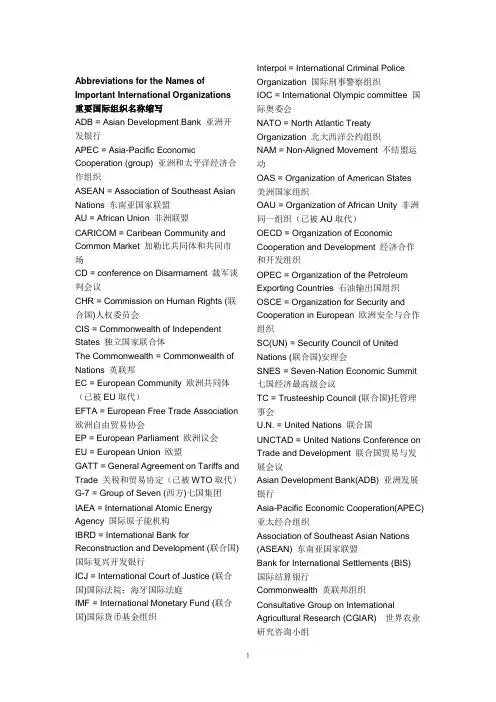
国际奥委会英文介绍
- 格式:pdf
- 大小:74.38 KB
- 文档页数:5
FACTSHEETTHE IOC SESSIONS UPDATE - JANUARY 20151. THE MISSIONThe IOC Session is the general meeting of the members of the IOC. It is the supreme organ of the IOC. The Session adopts, modifies and interprets the Olympic Charter and its decisions are final. While the Session may delegate powers to the Executive Board (EB), all important decisions are taken by the Session, which votes on proposals put forward by the EB. If the EB can be considered the "government" of the IOC, the Session is the "parliament".The Session is held at least once a year, often over a two- or three-day period. In the years when Olympic Games take place, the Session traditionally precedes them. An extraordinary Session can be convened upon the initiative of the IOC President, or on the written request of at least one third of the IOC members.The main prerogatives of the IOC Session are the following:•It elects the host city of the Olympic Games, seven years before they are held.•It elects the IOC President, Vice-Presidents, the other members of the Executive Board and – on the latter’s proposal – IOC members. •It decides upon modifications to the Olympic Charter.•It decides on the inclusion or exclusion of a sport on the programme of the Olympic Games.•It decides on the recognition (or exclusion) of International Federations, National Olympic Committees or any other sports organisation which submits a request.•It decides on the cities which will host forthcoming Sessions (the President decides on the location of Extraordinary Sessions).•It approves the reports and accounts of the IOC.2. PROCEDURESThe following main procedures are applicable for the decisions taken by the IOC Session: •The President, or, in his absence, the longest-serving Vice-President present chairs the Session.•The quorum required for a Session is half the total membership of the IOC, plus one.•Each member has a vote, and voting by proxy is not allowed. Abstentions and spoiled or blank votes are not counted.•In general, an IOC member must abstain from participating in a vote when it concerns a city (Olympic Games, Session, Congress), a person (IOC member) or any other matter from his or her country / NOC.•The decisions are taken by the majority of votes cast. However, a majority of two-thirds of the members present at the Session is required for any modification to the Fundamental Principles and Rules of the Olympic Charter.•The election of a host city must take place in a country not having a candidate for the Olympic Games in question.•A city is declared elected when it obtains the majority of the votes cast. If there is no majority, the city with the fewest votes is eliminated, and IOC members proceed to another round of voting. The procedure is repeated until an absolute majority is obtained.•The President, the Vice-Presidents and the Executive Board members are elected by the Session, in a secret ballot, by the majority of the votes cast. If there is no majority, the candidate with the fewest votes is eliminated, and the IOC members proceed to another round of voting. Abstentions are not taken into account, nor are spoiled or blank votes. The procedure is repeated until an absolute majority is obtained.3. UPCOMING SESSION128th Session, Kuala Lumpur, July 2015Elections of the host cities of the XXII Olympic Winter Games in 2022, and of the third edition of the Winter Youth Olympic Games in 2020.129th Session, Rio de Janeiro, August 2016130th Session, Lima, 2017Election of the host city of the Games of the XXXIII Olympiad in 2024.4. SOME DECISIONS TAKEN BY THE IOC SESSION OVER THE LAST YEARS127th Session, Monaco, December 2014- Unanimous approval of the 40 recommendations that make up Olympic Agenda 2020,the strategic roadmap for the future of the Olympic Movement.- Full recognition granted to the NOC of Kosovo.- Election of the city of Lima (Peru) to host the 130th IOC Session in 2017.- Election of Jean-Claude Killy, Raja Randhir Singh, HRH Prince Nawaf Faisal Fahd Abdulaziz, Leo Wallner and Melitón Sánchez Rivas as IOC honorary member- Approval of the planned consolidation of the IOC headquarters.126th Session, Sochi, February 2014- Election of Zaiqing Yu as Vice-President (position that became available following the election of Thomas Bach as IOC President) and Ugur Erdener to the EB (the mandate of Sam Ramsamy coming to an end).- Election of Poul-Erik Høyer as IOC member.- Re-election of three IOC members - Beatrice Allen, Nicole Hoevertsz and HRH Prince Tunku Imran.125th Session, Buenos Aires, September 2013- Election of Thomas Bach as the new IOC President.- Jacques Rogge nominated as IOC Honorary President.- Election of Tokyo host city of the Games of the XXXII Olympiad in 2020.- John Coates elected as a new Vice-President- Election of Anita L. DeFrantz to the IOC Executive Board.- Election of nine new IOC members: Octavian Morariu, Bernard Rajzman, Mikaela Maria Antonia Cojuangco-Jaworski, Alexander Zhukov, Paul Kibii Tergat, Lawrence Probst III, Dagmawit Girmay Berhane, Camiel Eurlings, Stefan Holm.- Kevan Gosper and Lamine Diack were appointed to become honorary members.- Wrestling was elected in the programme for the Olympic Games of 2020 and 2024. Extraordinary Session, Lausanne July 2013- Election of Buenos Aires as host city of the 3rd Youth Olympic Games in 2018.- Election of four new members: Danka Bartekova, James Tomkins, Kirsty Coventry and Tony Estanguet (members of the IOC Athletes’ Commission).124th Session, London, July 2012- Election of five new IOC members: Aisha Garad Ali, Pierre-Olivier Beckers, Tsunekazu Takeda, Frank Fredericks, and Lingwei Li.- Election of Nawal El Moutawakel and Craig Reedie as IOC Vice-Presidents.- Three new members elected to the EB: Juan Antonio Samaranch Jr., Sergey Bubka and Willi Kaltschmitt Luján.- Ching-Kuo Wu (ASOIF), René Fasel (re-elected, AIOWF), Patrick Hickey (ANOC), Claudia Bokel (Chair of the IOC Athletes’ Commission) were elected or re-elected to the Executive Board due to their functions.- Francisco Elizalde, Alpha Ibrahim Diallo and Carlos Nuzman were appointed as honorary members.123rd Session, Durban, July 2011- Election of PyeongChang as host city of the XXIII Olympic Winter Games in 2018.- Election of Gunilla Lindberg to the EB.- Re-election of Phil Craven as an IOC member. - Election of three new IOC members: Gerardo Werthein, José Perurena López and Barbara Kendall.- Election of Phillip Walter Coles, Chiharu Igaya, Shun-ichiro Okano, Arne Ljungqvist, Antun Vrdoljak and Lassana Palenfo as honorary members.122nd Session, Vancouver, February 2010- Election of two new members: Adam Pengilly and Angela Ruggiero (members of the IOC Athletes’ Commission).- Election of six new members: HRH Prince Faisal bin Al-Hussein of Jordan, Maria de la Soledad Casado Estupiñan, Barry John Maister, Dagmawit Girmay Berhane, Patrick McQuaid, Yang Yang.- Election of Manuela Di Centa and Kipchoge Keino, as honorary members.121st Session, Copenhagen, October 2009- Election of Rio de Janeiro as host city of the Games of the XXXI Olympiad in 2016.- Reelection of Jacques Rogge as the President of the IOC.- Review of the Olympic programme for the Games of the XXXI Olympiad in 2016 Games: inclusion of gold and rugby sevens in the programme of the 2016 Olympic Games.120th Session, Beijing, August 2008- Election of four new IOC members.- Election of a new IOC honorary member. 119th Session, Guatemala City, July 2007- Election of Sochi as host city of the XXII Olympic Winter Games in 2014.- Election of four new IOC members.- Simplified voting process for the Olympic programme.- Approval of the project of the Youth Olympic Games.- Recognition of the National Olympic Committee: Montenegro (MNE) and Tuvalu (TUV).118th Session, Turin, February 2006- Election of five new IOC members.- Election of Copenhagen to organise the XIII Olympic Congress in 2009 and the Executive Board meetings and 121st IOC Session.- Election of a new Vice-President and two new Executive Board members.- Confirmation of 26 sports on the programme of the 2012 Olympic Games in London.- Recognition of a 203rd National Olympic Committee: the Marshall Islands.117th Session, Singapore, July 2005- Election of London as host city of the Games of the XXX Olympiad in 2012.- Review of the Olympic programme for the Games of the XXX Olympiad in London in 2012: two sports (baseball and softball) did not receive the absolute majority required and were eliminated from the programme.- Exclusion of an IOC member.116th Session, Athens, August 2004- Exclusion of an IOC member.- Revision of the Olympic Charter following modifications proposed by the IOC Juridical Commission.115th Session, Prague, July 2003- Election of Vancouver as host city of the XXI Olympic Winter Games in 2010.- Adoption of 117 recommendations presented by the Olympic Games Study Commission,aimed at reducing the size, cost and complexityof the Games.114th Session, Mexico City, November 2002.- Confirmation of the principle of regularly reviewing the Olympic programme.- Decision to limit the number of sports to 28, events to 301 and athletes to 10,500.- Decision to study the means of controlling the size, cost and complexity of the Games.113th Session, Salt Lake City, February 2002- Election of a new IOC vice-president.- Election of two new EB members.- Election of four athletes as IOC members.- Election of ten new IOC members.112th Session, Moscow, July 2001- Election of Beijing as host city of the Games ofthe XXIX Olympiad in 2008.- Election of the new IOC President: Jacques Rogge.- Appointment of President Samaranch as IOC Honorary President for Life.111th Session, Sydney, September 2000- Approval of the EPO detection test for the Sydney Olympic Games.- Election of eight new IOC members.- Election of new Executive Board members.110th Session, Lausanne, December 1999.- Adoption of 50 reforms proposed by the IOC 2000 Commission focussing on the composition, structure, organisation and role of the IOC as well as selecting organisers of the Olympic Games.Among other things:- Lowering the age limit for new IOC membersto 70. - Creation of a Nominations Commission for IOC membership.- Limit on the IOC President’s mandate to eight years, renewable only once for four years.- Introduction of a candidature acceptance phase for the organisation of the Games.- Limit on the number of events and athletes at the Games.- No visit to candidates cities are allowed109th Session, Seoul, June 1999.- Election of Turin as host city of the XX Olympic Winter Games in 2006.- Decision to perform unannounced doping - control tests at the Sydney 2000 Games, under the authority of the IOC.- Suspension of gender testing.- Adoption of the IOC Code of Ethics.- Adoption of the Olympic Movement’s Agenda 21.108th Session, Lausanne, March 1999.- Vote of confidence in IOC President Juan Antonio Samaranch.- Exclusion of six IOC members for inappropriate conduct related to the candidatureof Salt Lake City.- Creation of the IOC 2000 Commission responsible for examining the IOC and its structures and recommending necessary changes.- Creation of the Ethics Commission- Reform of the election procedure for the 2006 host city: creation of a selection college responsible for selecting the two finalist cities to be put to the final vote.- Adoption of the Declaration of Lausanne on doping in sport, which provided for the creation of an anti-doping agency.107th Session, Nagano, February 1998.- Election of Jacques Rogge as a member of the Executive Board.- Admission to the programme of women’s pentathlon and the Star category in sailing for the Sydney 2000 Games.- Grand Duke Jean of Luxembourg, doyen of the IOC, resigned and was appointed honorary doyen of the IOC.106th Session, Lausanne, September 1997.- Re-election for a fourth consecutive term of office of Juan Antonio Samaranch as IOC President.- Election of the first female IOC Vice-President, Anita L. DeFrantz.- Election of Athens as host city of the Games of the XXVIII Olympiad in 2004.105th Session, Atlanta, July 1996- Election of a new Vice-President and two new Executive Board members.- Election of new IOC members and new honorary members.104th Session, Budapest, June 1995.- Election of Salt Lake City as host city of the XIX Olympic Winter Games in 2002.- Increase in the age limit of IOC members (elected after 1965) to 80.103rd Session, Paris, September 1994.- Adoption of a medical code with the objective of unifying the various anti-doping resources.- Triathlon and taekwondo were provisionally admitted to the programme of the Sydney 2000 Games.102nd Session, Lillehammer, February 1994.- Set up of a pre-selection procedure for the candidate cities for the XIX Olympic Winter Games in 2002- The reforms adopted by the 110th IOC Sessionin December 1999 were maintained and the decision not to visit candidate cities was widely supported. IMPRINTTHE SESSIONS 20 January 2015 A publication of the For further information, please contactChâteau de Vidy,1007 Lausanne,SwitzerlandOlympic Studies CentreTel. +41 21 621 66 11Fax +41 21 621 67 18studies.centre@。