
最新东南大学毕业论文设计完整框架优秀漂亮模板汇报
- 格式:ppt
- 大小:2.20 MB
- 文档页数:46

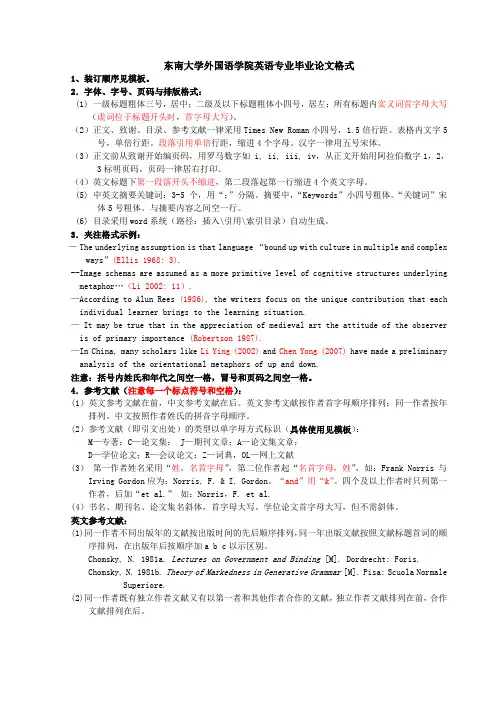
东南大学外国语学院英语专业毕业论文格式1、装订顺序见模板。
2.字体、字号、页码与排版格式:(1) 一级标题粗体三号,居中;二级及以下标题粗体小四号,居左;所有标题内实义词首字母大写(虚词位于标题开头时,首字母大写)。
(2)正文、致谢、目录、参考文献一律采用Times New Roman小四号,1.5倍行距。
表格内文字5号,单倍行距。
段落引用单倍行距,缩进4个字母。
汉字一律用五号宋体。
(3)正文前从致谢开始编页码,用罗马数字如 i, ii, iii, iv,从正文开始用阿拉伯数字1,2,3标明页码。
页码一律居右打印。
(4)英文标题下第一段落开头不缩进,第二段落起第一行缩进4个英文字母。
(5) 中英文摘要关键词:3-5个,用“;”分隔。
摘要中,“Keywords”小四号粗体。
“关键词”宋体5号粗体。
与摘要内容之间空一行。
(6) 目录采用word系统(路径:插入\引用\索引目录)自动生成。
3.夹注格式示例:—The underlying assumption is that language “bound up with culture in multiple and complex w ays”(Ellis 1968: 3).--Image schemas are assumed as a more primitive level of cognitive structures underlying metaphor…(Li 2002: 11).—According to Alun Rees (1986), the writers focus on the unique contribution that each individual learner brings to the learning situation.— It may be true that in the appreciation of medieval art the attitude of the observer is of primary importance (Robertson 1987).—In China, many scholars like Li Ying (2002)and Chen Yong (2007)have made a preliminary analysis of the orientational metaphors of up and down.注意:括号内姓氏和年代之间空一格,冒号和页码之间空一格。

东南大学毕业设计篇一:东南大学毕业设计论文模板题目光伏并网逆变器建模与仿真研究_电气工程_院(系)电气工程及其自动化_专业学号姓名指导教师顾问教师起止日期设计地点 16008307 李文丽黄学良老师 20xx.2.18 – 20xx.5.25 动力楼3楼光伏并网逆变器建模与仿真研究摘要随着全球经济的飞速发展,人类对能源的需求越来越大。
而地球上的不可再生能源,如石油、煤炭等,随着过量开发利用也日趋短缺并造成了较为严重的污染。
太阳能是资源最丰富的可再生能源,具有独特的优势和巨大的开发利用潜力,充分利用太阳能有利于保持人与自然的和谐及能源与环境的协调发展。
而作为光伏并网发电系统关键装置之一的并网逆变器,其运行性能则直接影响光伏并网发电系统的安全、可靠和高效率运行。
最大功率点跟踪(Maximum Power Point Tracking,MPPT)方法是光伏并网发电系统中提高系统效率的重要手段。
本文以光伏并网发电系统为应用背景,在了解光伏并网发电系统及逆变器的工作原理和特点的前提下,建立光伏并网发电系统的仿真模型,研究光伏并网逆变器的控制策略,并利用 Matlab/Simlink,对包括光伏并网逆变器等的单、三相光伏并网发电系统最大功率点跟踪的扰动观察法、电导增量法、恒定电压法、模糊逻辑控制各种控制策略进行建模和仿真,最后对不同的并网逆变控制策略进行定性分析。
1.本模板采用大纲级别和自动目录生成2.本模板中定义了1-8级标题,快捷键分别是Ctrl + 1 至 Ctrl + 8,其中,标题7作为图片说明,标题8作为表格的说明3.更新目录,只需用鼠标点击到目录的任何位置,按下快捷键F9即可。
4.其他快捷键:正文:Ctrl + 0或者Alt + 0;代码:Alt + 1; 图片居中:Alt + 25.页眉已经设定成自动随章节号变化,无需修改关键词:光伏发电;并网;最大功率点跟踪;逆变器;建模与仿真。
THE ESTABLISHMENT OF NANJING PUKOU WATER FACTORYAUTOMATIC CONTROL SYSTEM NETWORK REAL-TIME DATABASEAND BROWSER PROGRAMMINGAbstractThe article is mainly about the foundation of the Internet database system in Nanjing Pukou Waterworks automation control system.The system transfers the data form industry net to a NT Server by serial communication. Then the NT Server analyses the data and stores it in the database. At the same time, the data is published on the Internet. The system is divided into three layers: the database layer, the middle layer and the application layer. The database layer stores the data. The middle layer receives the data, inserts data into database, puts the data in order and offers inquiring interfaces. The application layer displays the running status of the system, displays the current data, and offers an operation plate to inquire data.The application layer is composed of two parts, the local application and the web application.The web site, a part of the application layer, was created in NT Server by IIS. It was developed in ASP. Because of the use of the middle layer, the site was developed rapidly.KEYWORDS: Automation Control System, Serial Communication, Database, SQL Server, Network, Web Application, COM, IIS, ASP, VB, VBScript.目录光伏并网逆变器建模与仿真研究 .................................................................. .................................... I 摘要 .................................................................. ..................................................................... (I)ABSTRACT............................................................. ..................................................................... (II)第1章绪论 .................................................................. (1)1.1 光伏发电的背景与意义 .................................................................. . (1)1.1.1 光伏发电的必要性 .................................................................. .. (1)1.1.2 光伏发电的优缺点 .................................................................. .. (2)1.2 光伏发电发展现状及趋势 .................................................................. . (3)1.2.1 国外光伏发电发展现状及趋势 .................................................................. .. (3)1.2.2 国内光伏发电发展现状及趋势 .................................................................. .. (6)1.3 功能分析 .................................................................. .. (7)1.3.1 功能划分 .................................................................. .. (7)1.3.2 功能描述 .................................................................. .. (7)1.4 性能需求 .................................................................. .. (7)1.4.1 数据精确度 .................................................................. . (7)1.4.2 时间特性 .................................................................. .. (7)1.4.3 适应性 .................................................................. (8)第2章总体设计 .................................................................. . (9)2.1 逻辑结构分析 .................................................................. . (9)2.1.1 数据传输 .................................................................. .. (9)2.1.2 数据存储与查询 .................................................................. (9)2.1.3 WEB服务 .................................................................. . (9)2.2 系统结构设计 .................................................................. .. (10)2.2.1 系统结构图 .................................................................. .. (10)2.2.2 数据库层 .................................................................. (10)2.2.3 中间层 .................................................................. . (10)2.2.4 应用层 .................................................................. . (11)2.2.5 对象和控件 .................................................................. .. (11)2.3 接口设计 .................................................................. (11)第3章数据库设计与访问 .................................................................. (13)3.1 SQL数据库设计 .................................................................. (13)3.1.1 数据表定义 .................................................................. .. (13)参考文献 .................................................................. .....................................................................14致谢 .................................................................. ..................................................................... .. (15)第1章绪论1.1 光伏发电的背景与意义能源是人类活动的物质基础。
