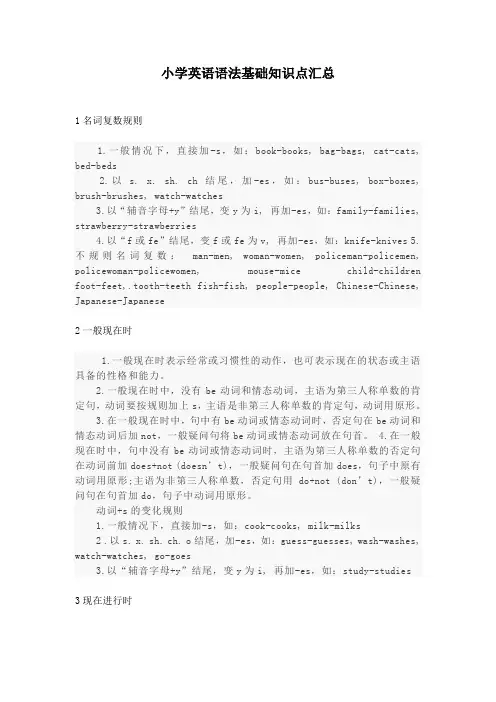
PEP小学英语语法及词汇表
- 格式:doc
- 大小:101.50 KB
- 文档页数:29
字母的大写(1)英语中句子首字母要大写。
(2)人名中的名和姓的首字母要大写。
(3)国名、城市名的首字母要大写。
(4)语言及民族的首字母要大写。
(5)职务或称呼的首字母要大写。
(6)专有名词的首字母要大写。
(7)表示我的字母“I”无论在什么情况下都要大写。
人称代词和物主代词1、人称代词主格和宾格的区别:主格通常位于句中第一个动词之前(有时候位于than 之后),宾格一般位于动词或介词之后。
2、物主代词形容词性与名词性的区别:形容词性用时后面一般要带上名词,名词性则单独使用,后面不带名词。
五:人称代词与物主代词一、人称代词二、物主代词(八)完全、缩略形式:I’m=I am he’s=he is she’s=she isthey’re=they areyou’re=you are there’s=there isthey’re=they are can’t=can notdon’t=do notdoesn’t=does not isn’t=is notaren’t=are not let’s=let uswon’t=will notI’ll=I will wasn’t=was not总结:通常情况下,'m即am,'s即is(但 let’s=let us), 're即are ,n't即not (但can’t=can not)(九)近义词或同义词同义词是指意思相同或相近的词,有时候可以互相换用,以避免重复。
by plane----take a plane by ship----take aship by bike---ride a bikeby train---take a train by subway----take a subway after class----after schoolusually----often near----next to bookstore----book shop find---look forgo straight----go down take----bysour----tart tonight----this eveningwant----be going to must----have to beautiful---pretty draw---paint tell---say little----small big---large tall----high wear---put oneach----every sick----ill between----among watch----look, seewish----hope begin----start learn----study shop----storegift----present dear----expensive bike----bicycle speak---talk love----like eat breakfast----have breakfast eatlunch----have luncheat dinner----have dinner play sports----dosports too----eitherwhat about you?----how about you?----and you? climb mountains----do some climbingread some books----do some reading go shopping----do some shoppinggo hiking---- do some hiking on the weekend----at the weekend fall----autumn(十)反义词或对应词反义词是指单词的意思相反,如:big—small, long—short. 对应词是指单词的意思相对,如 man—woman,teacher—student ,同学们要注意区分。
I – you my—your your—my /our good—badmorning—afternoon this—that us—you white—blackboy—girl teacher—student come—go we—youfather—mother she—he big—small open—closeright—left / wrong yes—no night—day quiet—activein—out here—there long—short tall—shortget up—go to bed these—those warm—cool cold—hotrainy—sunny new—old expensive—cheap young—oldkind—strict strong—thin old—new / young thin—strong / fatactive—quiet in front of—behind village—city usually—sometimessummer—winter always—never up—down why—becausebrother—sister key—lock wake up—sleep always----neverusually----sometimes often----sometimes near----farfast----slow easy----hard geton----get off east----westnorth----south left----right wrong----right out side----in sidebusy----free buy----sell learn----teach with----withoutactor----actress policeman----policewoman taller----shorterstronger----thinner older----younger little----big bigger----smallerhead----tail heavy----light longer----shorter happy----unhappysad----happy last----first below----above same----differentsomebody----nobody forwards ---- back wards after----beforestop----go on sit----stand(十一)同音词。
在英语中,有一部分的单词的读音相同,但意义却有着很大的不同。
如:see看见sea 海 mouse 老鼠mouth嘴write写 right正确where哪里wear穿four四 for为,给two二too也,太to为pear梨pair一对I我eye眼睛no 不,不是 know知道meat肉 meet遇见 bye再见 by坐,乘buy买 son儿子 sun太阳it’s 它的 its 它的 there 那儿,那里their他们的dear 亲爱的 deer小鹿(十二)与所给字母同音的单词。
在英语中,有些单词的读音与某个字母的读音相同。
如:B――bee 蜜蜂C――sea 大海see 看见I—eye 眼睛K—key 钥匙O――oh哦 R—are 是T—tea 茶Y――why为什么(一)学生易错词汇1. a, an的选择: 元音字母开头的单词用an,辅音字母开头的单词用a.2. am , is , are的选择: 单数用is , 复数用are. I 用 am , you 用 are.3. have , has 的选择: 表示某人有某物。
单数用has , 复数用have. I , you 用 have .4. there is, there are 的选择:表示某地有某物,某人。
单数用there is , 复数用there are.5. some, any 的选择:肯定句用some, 疑问句和否定句用any.6.疑问词的选择:what (什么) who (谁) where (哪里) whose (谁的) why(为什么)when(什么时候)which(哪一个)how old (多大) how many(多少)how much(多少钱)(二)名词1、掌握名词变复数的变化规则(1)多数名词变复数时直接在词尾加 s 。
如book--boos (2)以s, sh, x, ch结尾的名词,一般加 es。
如:watch—watches(3)以辅音字母加y结尾的名词,变y为i ,再加es。
如 family—families(4)以f, fe结尾的名词,大多数情况下一般将f, fe变为v, 再加es。
如 leaf—leaves.但也有例外,有些以f 结尾的名词,在构成复数时只加s。
如gulf—gulfs.(5)以字母o结尾的名词变复数,一般说来,有生命的加es,没有生命的加s。
如 piano—pianos photo—photos radio—radiostomato—tomatoes potato—potatoes2、不规则名词的复数要单独记忆。
fish-- fish foot-- feet sheep--sheepit-- they I -- we me—ushe-- they my--our you-- you your—your man--mengoose--geese deer--deer woman--women tooth—teethI –we my—our you—you your—yourit—they he—they she—they his—theirher—their its—their him—them her—them(三)动词1、现在分词的变化规则(1)一般直接在动词的词尾加ing. 如 pick—picking(2)以不发音的字母e结尾的动词,去年e,再加ing.如 bite—biting.(3)以一个辅音结尾的重读闭音节词,且它的前面是一个短元音,一般应该先双写最后一个辅音字母,再加ing.如 dig—digging. swim—swimming3、动词第三人称单数的变化规则(1)一般直接在动词词尾加s.如 run—runs(2)以s, x, o , sh , ch 结尾的动词,加es。
如brush—brushes(3)以辅音字母加y结尾的动词,变y为i再加eses.如 fly—flies.(4)个别不规则变化单词,需要单独记忆。