
Renaissance英国文学文艺复兴时期
- 格式:ppt
- 大小:2.72 MB
- 文档页数:28

英国文艺复兴时期的人文主义思潮与影响
人文主义是一种文化运动,主张将人类的价值超越宗教和政治,强调个体自由、个体创造力和个体意识。在英国文艺复兴时期,人文主义思想得到了广泛传播和推崇。这场思想革命深刻影响了英国文化和社会的发展。
一、文艺复兴时期的背景
文艺复兴时期是一个充满变革的时期。在15世纪初,欧洲经历了黑死病的摧残,随后爆发了一系列的战争和政治动荡。但是,随着贸易的发展和城市的繁荣,欧洲开始迎来了繁荣的时期。这个时期被称为文艺复兴,它的主要特点是人文主义思潮的盛行和艺术的复苏。
二、人文主义思潮的兴起
人文主义思潮的根源可以追溯到古希腊和罗马,但是在文艺复兴时期,它得到了新的发展和充实。人文主义者主张将文化和教育重新回归人类的本质,强调个体的自由和创造力。他们不再满足于传统的神学和经院哲学,而是关注于人类的现实和成功。这样的思潮,反映了人们对于自由、平等和个性的渴求,它掀起了一场思想革命。
三、人文主义思潮的影响
人文主义思潮对于英国文化和社会的影响是深远的。它对哲学、文学、艺术、教育和政治都产生了影响。
1、哲学
人文主义思潮对哲学的影响主要表现在形而上学和人文主义伦理学的转变。人文主义者强调人类本质的自由和创造力,他们反对传统的神学和经院哲学,并提倡以人类的现实和成功为中心的生活哲学。这样的思想深远影响了西方哲学的发展方向。 2、文学
人文主义思潮对于英国文学的影响也是非常大的。在这个时期,英国的文学艺术开始追求复古和古典的风格,强调人物形象的塑造和语言的美感。莎士比亚、培根、马洛、约翰·米尔顿等作家的作品,都受到了人文主义思潮的影响。
3、艺术
文艺复兴时期,艺术得到了重新的发展和繁荣。在绘画、雕塑和建筑等方面,人文主义思潮给了艺术家更多的创作自由和灵感来源。伦勃朗、达芬奇、米开朗基罗等艺术家的杰作,代表着文艺复兴时期的艺术造诣。
4、教育
在文艺复兴时期,教育也得到了重视和改革。人文主义者主张以人类的本质为中心的教育模式,并倡导推崇古典教育。这样的改革思想,推动了欧洲教育的发展和改革。
English Literature
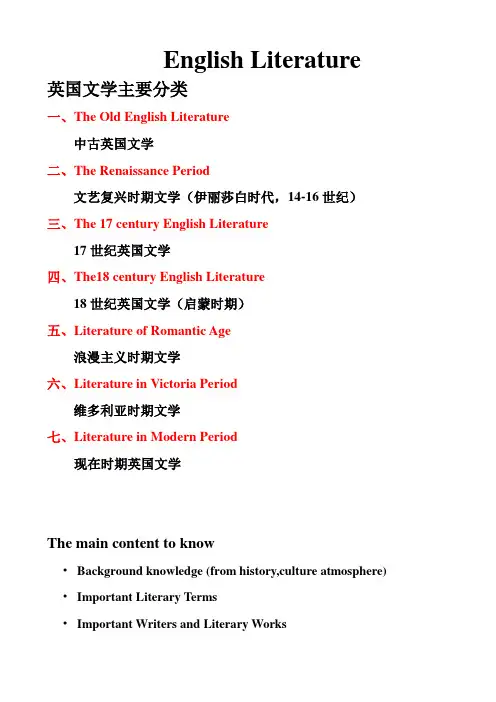
英国文学主要分类
一、The Old English Literature
中古英国文学
二、The Renaissance Period
文艺复兴时期文学(伊丽莎白时代,14-16世纪)
三、The 17 century English Literature
17世纪英国文学
四、The18 century English Literature
18世纪英国文学(启蒙时期)
五、Literature of Romantic Age
浪漫主义时期文学
六、Literature in Victoria Period
维多利亚时期文学
七、Literature in Modern Period
现在时期英国文学
The main content to know
• Background knowledge (from history,culture atmosphere)
• Important Literary Terms
• Important Writers and Literary Works
The Old English Literature
(一)General Introduction(总体介绍)
The Old English literature(which lasted from 499 to 1066)isexclusively a verse(诗篇) literature in oral
form.There were two groups of English poetry in this period-the first was the pagan(异教的) poetry
represented by Beowulf,the second was the religious poetry represented by the works of Caedmon and
外语系
英语教育(2)班
周卫华
0907013235
Renaissance
Renaissance in European history, refers to the period between 14th century to
17th century. It started in Italy and ended in England and Spain. “Renaissance”
means “revival”, the revival of interest in Ancient Greek and Roman culture and
getting rid of conservatism in feudalist Europe and introducing new ideas that
express the interests of the rising bourgeoisie.
Brief Introduction
▪ There arose an interest in the manuscripts surviving from ancient Greece and
Rome. Classical learning and philosophy were enthusiastically studied.
▪ The intellectual wisdom of ancient Greece and Rome encouraged a rebirth of
human spirit,a realization of human potential for development and creation.
▪ Never before in human history were men and women so eager to create and
discover something new.In Italy a group of artists,scientists,politicians,and writers created the most brilliant page of culture and science in
精选文档
— The Renaissance
This is a greatest and most advanced revolution in the human history. This is the age the giants are needed and produced.
------F. Engles<1> Brief introduction
▪Renaissance in European history, refers to the period between 14th century to 17th century. It started in Italy and
ended in England and Spain.
▪“Renaissance” means “revival”, the revival of interest in Ancient Greek and Roman culture and getting rid of
conservatism in feudalist Europe and introducing new ideas that express the interests of the rising bourgeoisie.
▪Renaissance sprang first in Italy (Florence and Venice) with the flowering of paintings, sculpture and architecture, and
gradually spread all over Europe;
▪Renaissance originally indicated a revival of classical arts and science (ancient Greek and Roman culture) after the