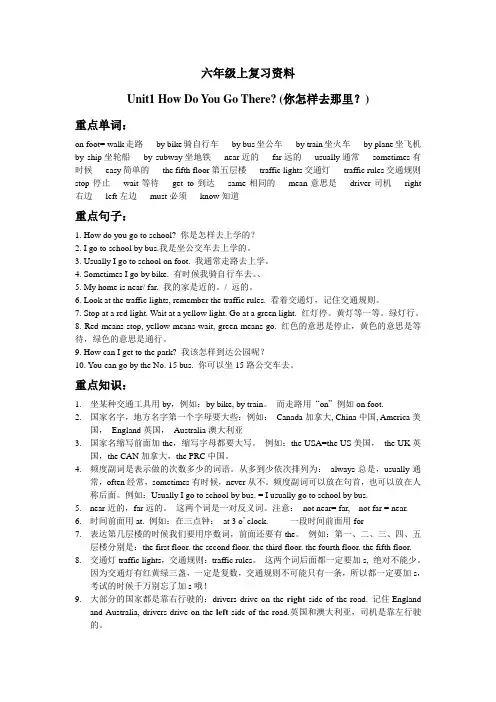
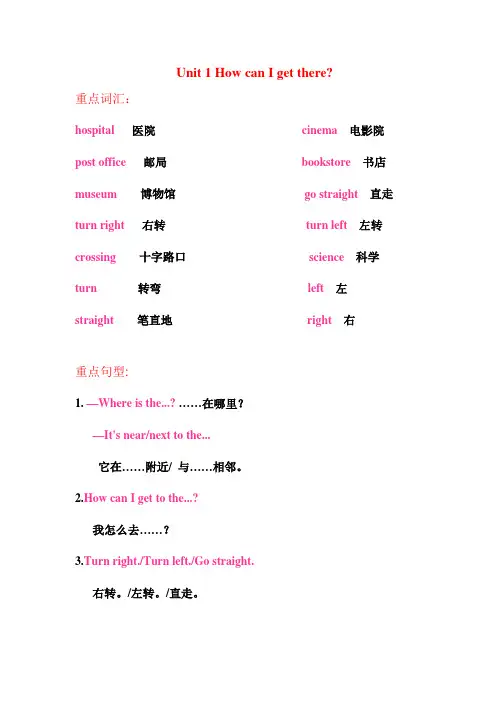
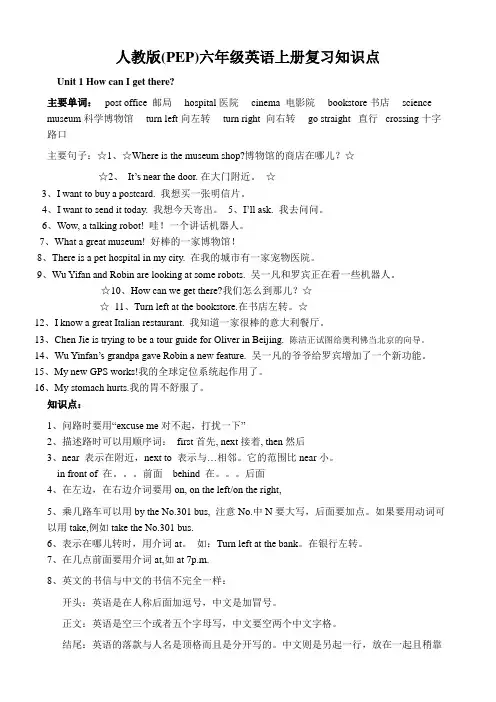
人教版PEP六年级英语上册知识点汇总
- 格式:docx
- 大小:1.77 MB
- 文档页数:15
人教版 PEP 六年级英语上册知识点汇总
Unit1 How can I get there? 我怎样到达这里?
■重点单词:
where 哪里 how 怎样 can 能够 near 近的 ask 问 tell 告
诉 far 远的 science 科学 hospital 医院 museum 博物
馆 postoffice 邮局 library 图书馆
usually 通常 sometimes 有时候 often 经常 know 知道 near 旁边 next to
旁边(比 near 更近) crossing 十字路口 turn left 向左转 turn right 向 bookstore 书店
右转 go straight 直走 in front of 在…的前面 behind 在... 的后面
■重点句子:
3. Usually I go to school on foot. 我通常走路去上学。
4. Sometimes I go by bike. 有时候我骑自行车去。、
5. 问路之前,出于礼貌,我们要说“ Excuse me ”与后面的句子要用标点符号隔开。
6. Look at the traffic lights, remember the trafficrules. 看着交通灯,记住
交通规则。
7. Stop at a red light. Wait at a yellow light. Go at agreen light. 红灯停。
黄灯等一等。绿灯行。 8. Red means stop, yellow means wait, green means go. 红色的意思是停止,黄
色的意思是等待,绿色的意思是通行。
1. 坐某种交通工具用 by ,例如:by bike, by train 。而走路用 “on” 例如 on foot.
2. 国家名字,地方名字第一个字母要大些:例如: Canada 加拿大 , China 中国 ,
America 美国, England 英国, Australia 澳大利亚
3. 频度副词是表示做的次数多少的词语。 从多到少依次排列为: always 总是,usually
通常, often 经常,sometimes 有时候, never 从不。频度副词可以放在句首,也可以
放在人称后面。例如: Usually I go to school by bus. = I usually go to school
bybus.
4. near 近的, far 远的。这两个词是一对反义词。注意: not near= far, not far =
near.
5. 时间前面用 at. 例如:在三点钟: at 3 o’ clock.
6. 交通灯 traffic lights ,交通规则: traffic rules 。这大部分的国家都是靠右
行驶的: drivers drive on the right side of the road. 记住 England and
Australia,drivers drive on the left side ofthe road. 英国和澳大利亚,司机是
靠左行驶的。
7. on foot= walk, 都是走路的意思,但是用法不同, on foot 用在句子末尾,而 walk
用法与 go 相同,可以代替 go 的位置。 例如:走路回家: walk home 走 路去上学: walk to school
walk to the hospital 走路去上班 walk to work 走路去医院
机
by taxi 乘出租车 on foot= walk 走路
Excuse me 打扰一下 please 请 buy 买 want to 想要 a pair of 一
turn left 左转 turn right 右
look for 寻找 top 停止 wait 等
driver 司机 must 必须 转
■重点知识: 1. Is there 开头的问句怎么回答呢?例如: Is there a cinema near here? 只要
把前两个词语的顺序换一下就可以了,肯定回答是: Yes, there is. 否定:No, there
isn ’t.
2. buy 和 by 的区别,这两个词语发音相同, 但是意思完全不同, by :乘,坐 buy :
买
3. 地点名词前面一定要有 the,例如: Where is the cinema?How can I get to the
hospital?
4. 时间前面用 at. 例如:在三点钟: at 3 o’ clock.; 一段时间前面用 for, 例如:
三分钟 for 3 minutes. 星期前面用 on,例如: on Monday, on Tuesday, on
Wednesday,on Thursday, on Friday, on Saturday, on Sunday.
5.在表达第几路公交车时,注意 No. 的书写, N 要大写,后面别少了一点!!!
6.在哪里上下车,在哪里左右转,都用介词 at,例如: Get on/ off at the cinema.
在电影院的地方上下车。
地方左右转。 Turn left/ right at the bookstore. 在书店的
take a trip 旅行 read a magazine 读一本杂志 go to the cinema 去看电
影 this morning 今天上午 this afternoon 今天下午 this evening 今天
晚上 next week 下个星期 tomorrow 明天 tonight 今晚 busy 忙碌 的 go home 回家 post card 明信片 comic book 漫画书 newspaper 报
纸 dictionary 字典 plant trees 种树
■重点句子:
1. What are you going to do on the weekend? 周末你将要做什么?
2. I’m going to visit my grandparents this weekend. 我将要去拜访我的祖父
母。
3. I’m going to have a busy weekend! 我将要度过一个忙碌的周末。
4.I ’m going to the supermarket with my mother. 我将要和我妈妈去超市。
5. Where are you going this afternoon? 今天下午你将要去哪?
6. I’m going to the bookstore. 我将去书店。
11.What are you going to be? I ’m going to be a policeman. 你将要成为什么
样的人?我将要成为一名警察。
1.时间往往放在句子的末尾。例如: What are you going to do this evening?
2.go to school 去上学, go to work 去上班, go to the cinema 去看电影, go 后
面都要有 to,但是要注意“回家”这个词组是: go home, 中间绝对没有 to。
3.with: 和,后面往往跟人。例如: I’m going to play footballwith my friends.
我将要和我的朋友一起去踢足球。 4.疑问词: where :哪里(地点) what :什么(东西,事情或职业) when :
什么时候(时间) how :怎么样(交通工具) who :谁(人) why :为什么(答
句中有 because )
Unit4 I have a pen pal 我有一个笔友
■重点单词:
pen pal 笔友 riding a bike (ride )骑自行车 diving (dive )跳水 hobby 爱
好 watch (watches )TV 看电视 playing the pipa (play )弹琵琶
listening to music (listen ) 听音乐 drawing pictures (draw) 画画 =painting
(paint)
climbing mountains(climb) 爬山 playing (play)sport 做运动
play basketball 打篮球 play football 踢足球 live (lives) in Beijing 居住在
北京 go (goes) to work 去上班 go (goes) to bed 睡觉 go (goes) home
回家 teach (teaches ) English 教英语 read (reads) newspapers 读报
纸 go hiking 远足 study Chinese 研究中文 cook Chinese food 做中国食物 do
word puzzles 猜字谜
3. I like reading stories. 我喜欢看故事书。
4. He likes collecting stamps, too. 他也喜欢集邮。 5. Does she teach English? 她是教英语的吗? Yes, she does. No, she doesn ’
t.
6.Do you like English ? Yes, Ido. No, I don ’t.
7.My name is John. 我是约翰。 His name is Zhang Peng. 他是张鹏。 Her name is Amy.
她是艾米。 /
8. What are you doing? 你正在做什么?
1. 爱好一定要加 ing ,同样的,当看到 like 或者 likes 的时候,后面的动词一定要
加 ing,例如:我喜欢游泳: I like swimming.
2. 当主语是 he, she,it 以及能用这三个词代替的所有的词我们叫做第三人称单数,
后面的动词要加 s,例如 :I like diving. He likes diving.
人名一定是第三人称单数。 She likesdiving.
3. Does 开头的问句回答只有两个,肯定回答: Yes, she/ he/ it does. 否定回答:
No, she/ he/ it doesn ’t. 看到 does ,后面的动词一定要用原形!!!
factory worker 工人 postman 邮递员 businessman 商人 police officer 警察
policeman 男警察 policewoman 女警察 fisherman 渔民 scientist 科学家
pilot 飞行员 coach 教练 singer 歌手 writer 作家 TV reporter 电视台记