
形容词的比较级变化规律
- 格式:pptx
- 大小:51.52 KB
- 文档页数:10

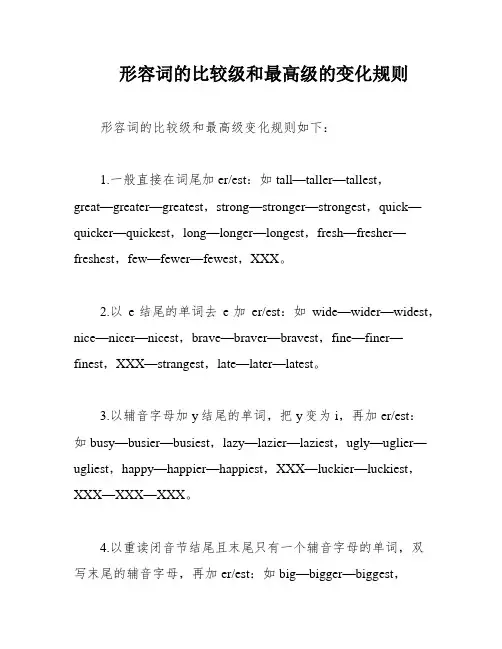
形容词的比较级和最高级的变化规则形容词的比较级和最高级变化规则如下:1.一般直接在词尾加er/est:如tall—taller—tallest,great—greater—greatest,strong—stronger—strongest,quick—quicker—quickest,long—longer—longest,fresh—fresher—freshest,few—fewer—fewest,XXX。
2.以e结尾的单词去e加er/est:如wide—wider—widest,nice—nicer—nicest,brave—braver—bravest,fine—finer—finest,XXX—strangest,late—later—latest。
3.以辅音字母加y结尾的单词,把y变为i,再加er/est:如busy—busier—busiest,lazy—lazier—laziest,ugly—uglier—ugliest,happy—happier—happiest,XXX—luckier—luckiest,XXX—XXX—XXX。
4.以重读闭音节结尾且末尾只有一个辅音字母的单词,双写末尾的辅音字母,再加er/est:如big—bigger—biggest,fat—fatter—fattest,red—redder—reddest,XXX—thinner—thinnest,hot—hotter—hottest,wet—wetter—wettest。
5.部分双音节词,多音节词在词前面加more或most(比较级more + adj;最高级most + adj):us—more us—most us,interesting—more interesting—most interesting,us—more us—most us,carefully—more carefully—most carefully,popular—more popular—most popular,careful—more careful—most careful,useful—more useful—most useful,dangerous—more dangerous—most dangerous,beautiful—more beautiful—most beautiful,important—more important—most important,terrible—more terrible—most terrible,active—more active—most active。

形容词比较级的变化规则一、形容词比较级的变化规则1. 一般情况下,形容词比较级是在原级基础上,加“-er”或“more”来表示。
例如:tall— taller; beautiful — more beautiful;2. 以不发音的“e”结尾的形容词,直接在词尾加“r”来表示比较级。
例如:nice — nicer; large — larger;3. 以一个辅音字母加“y”结尾的形容词,变比较级时,要先将“y”变为“i”,然后再加“-er”。
例如:happy — happier; easy — easier;4. 以重读闭音节结尾的双音节形容词,比较级时,要在前面加“more”。
例如:careful — more careful; clever — more clever;5. 双音节词和多音节词的比较级,要在前面加“more”。
例如:beautiful — more beautiful; intelligent —more intelligent;6. 特殊变化的形容词比较级有:good — better; bad — worse; much — more; many — more; little — less; far —farther/further;二、形容词比较级的用法1. 形容词比较级常用于两者进行比较,即A比B……,表示A比B更……。
例如:This book is much better than that one.这本书比那本书好得多。
2. 形容词比较级也可以表示程度的变化,即A比原来更……。
例如:He's grown much taller since I last saw him.自从我上次见到他以来,他长得更高了。
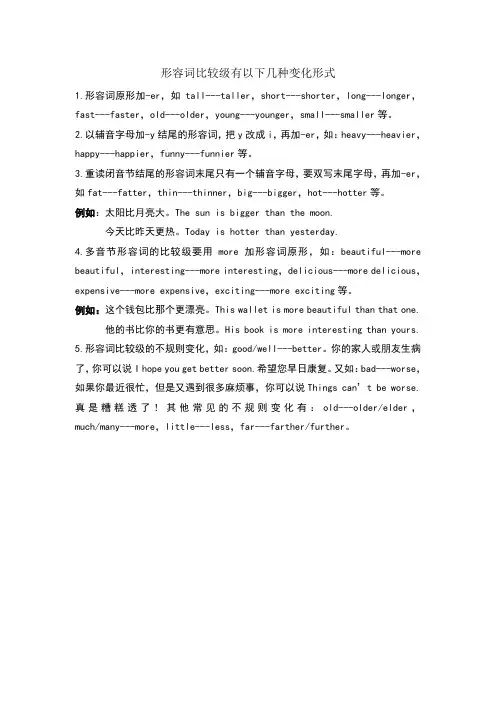
形容词比较级有以下几种变化形式1.形容词原形加-er,如tall---taller,short---shorter,long---longer,fast---faster,old---older,young---younger,small---smaller等。
2.以辅音字母加-y结尾的形容词,把y改成i,再加-er,如:heavy---heavier,happy---happier,funny---funnier等。
3.重读闭音节结尾的形容词末尾只有一个辅音字母,要双写末尾字母,再加-er,如fat---fatter,thin---thinner,big---bigger,hot---hotter等。
例如:太阳比月亮大。
The sun is bigger than the moon.今天比昨天更热。
Today is hotter than yesterday.4.多音节形容词的比较级要用more加形容词原形,如:beautiful---more beautiful,interesting---more interesting,delicious---more delicious,expensive---more expensive,exciting---more exciting等。
例如:这个钱包比那个更漂亮。
This wallet is more beautiful than that one.他的书比你的书更有意思。
His book is more interesting than yours.5.形容词比较级的不规则变化,如:good/well---better。
你的家人或朋友生病了,你可以说I hope you get better soon.希望您早日康复。
又如:bad---worse,如果你最近很忙,但是又遇到很多麻烦事,你可以说Things can’t be worse.真是糟糕透了!其他常见的不规则变化有:old---older/elder,much/many---more,little---less,far---farther/further。
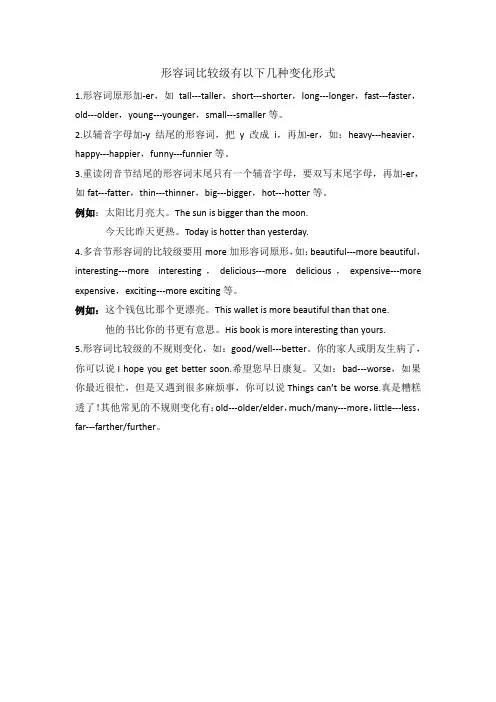
形容词比较级有以下几种变化形式1.形容词原形加-er,如tall---taller,short---shorter,long---longer,fast---faster,old---older,young---younger,small---smaller等。
2.以辅音字母加-y结尾的形容词,把y改成i,再加-er,如:heavy---heavier,happy---happier,funny---funnier等。
3.重读闭音节结尾的形容词末尾只有一个辅音字母,要双写末尾字母,再加-er,如fat---fatter,thin---thinner,big---bigger,hot---hotter等。
例如:太阳比月亮大。
The sun is bigger than the moon.今天比昨天更热。
Today is hotter than yesterday.4.多音节形容词的比较级要用more加形容词原形,如:beautiful---more beautiful,interesting---more interesting,delicious---more delicious,expensive---more expensive,exciting---more exciting等。
例如:这个钱包比那个更漂亮。
This wallet is more beautiful than that one.他的书比你的书更有意思。
His book is more interesting than yours.5.形容词比较级的不规则变化,如:good/well---better。
你的家人或朋友生病了,你可以说I hope you get better soon.希望您早日康复。
又如:bad---worse,如果你最近很忙,但是又遇到很多麻烦事,你可以说Things can’t be worse.真是糟糕透了!其他常见的不规则变化有:old---older/elder,much/many---more,little---less,far---farther/further。