动词语态
- 格式:docx
- 大小:15.34 KB
- 文档页数:2
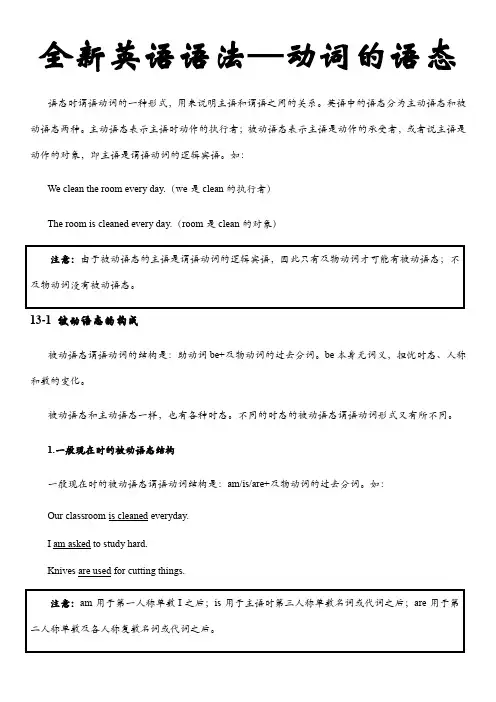
动词语态
1.当句子的主语是动作的执行者时,谓语的形式叫主动语态。
句子的主语是动作承受者时,谓语的形式叫被动作语态。
被动语态由助动词be + 过去分词构成,时态通过be 表现出来。
1)一般现在时:You are required to do this.
2)一般过去时:The story was told by her.
3)一般将来时:The problem will be discussed tomorrow.
4)现在进行时:The road is being widened.
5)过去进行时:The new tool was being made.
6)现在完成时:The novel has been read.
7)过去完成时:He said that the work had been finished.
8)过去将来时:He said that the trees would be planted soon.
2. 一些特殊的被动结构
1)带情态动词的被动结构:The problem must be solved soon.
2)带不定式的被动结构:The room is going to be painted.
The homework needs to be done with care.
3) 短语动词的被动:
a.(不及物)动词+介词:若这类短语动词是及物性的,则可用于被动语态中,如:laugh at, look after, talk about, think of 等。
若这类短语动词是不及物性的则不可用于被动语态中,如:book up, look down. 等
b.(及物)动词+副词:bring about, carry out, find out, make out, put away, put off, take up, turn down, turn out, wipe out等
c. 动词+副词+介词:do away with, face up to, give into ,look down upon, make up with等
d. 动词+名词+介词:catch sight of, keep on eye on, make a fool of , pay attention to , put an end to , set fire/light to , take notice of 等
4) 带复合宾语的动词在改为被动语态时,一般把主动结构中的宾语改为主语,宾语补足语保留在谓语后面。
We always keep the classroom clean.
(比较:The classroom is always kept clean.)
5)主动形式表示被动意义的词。
常见的有:
a.主动形式,这时动名词同句中的主语有动宾关系。
The children need looking after.
The windows wants /requires repairing.
This point deserves mentioning.
b.有些及物动词后须加副词(如:well, easily等),有些可不加,如:act, clean, cut, draw, lock, open, play, read, sell, shut, strike, wash, write 等。
The cloth washes/ sells well.
The door won’t shut. The play won’t act.
c. 形容词worth后直接加动名词时,如:The book is worth reading twice.
某些作表语的形容词后,用不定式主动形式表示被动意义。
The fish is not fit to eat.
d. 某些感官动词(如:feel, look, prove, smell , sound, taste, wear等)与形容词连用时:The water feels very cold.
The dish tastes delicious.
6) 以下动词构成的句子不能改为被动句:
a. 动词leave, enter, reach 等的宾语是表示处所、地点(国家、团体,组织、军队)等。
b. 表示状态的动词,如:become, benefit, cost, contain, equal, fit, fail, have, lack, last, mean, suit, look like等。
c. 下列不及物动词及短语:appear, belong to , break out, die, happen, lie, occur, rise, take place, agree with, belong to, consist of , have on, keep up with 及一些固定词组,如keep words, lose heart, make a face等。
d. 宾语是反身代词,相互代词,同源代词,不定式,动名词,抽象名词等。
7)汉语有一类句子不出现主语,在英语中一般可用被动结构表示。
如:
据说……希望……
据推测说…必须承认……
必须指出…众所周知……
有人会说….. 大家认为…..
有人相信……。