
专题三天气与气候
- 格式:ppt
- 大小:3.70 MB
- 文档页数:5

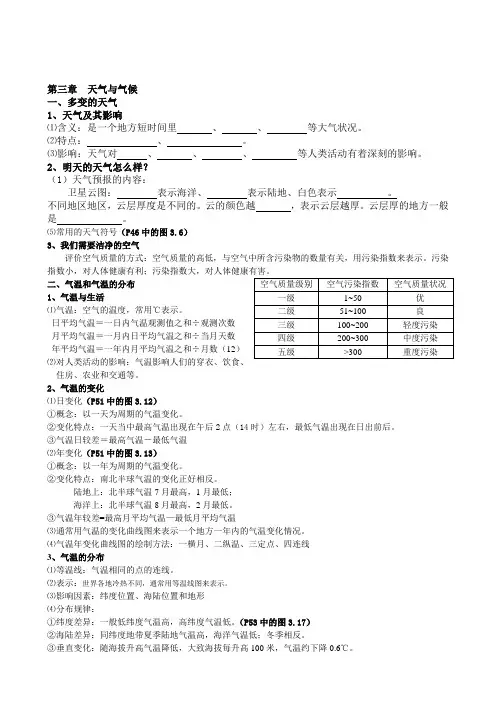
第三章 天气与气候 一、多变的天气 1、天气及其影响⑴含义:是一个地方短时间里 、 、 等大气状况。
⑵特点: 、 。
⑶影响:天气对 、 、 、 等人类活动有着深刻的影响。
2、明天的天气怎么样? (1)天气预报的内容:卫星云图: 表示海洋、 表示陆地、白色表示 。
不同地区地区,云层厚度是不同的。
云的颜色越 ,表示云层越厚。
云层厚的地方一般是 。
⑸常用的天气符号(P46中的图3.6) 3、我们需要洁净的空气评价空气质量的方式:空气质量的高低,与空气中所含污染物的数量有关,用污染指数来表示。
污染指数小,对人体健康有利;污染指数大,对人体健康有害。
二、气温和气温的分布 1、气温与生活 ⑴气温:空气的温度,常用℃表示。
日平均气温=一日内气温观测值之和÷观测次数 月平均气温=一月内日平均气温之和÷当月天数 年平均气温=一年内月平均气温之和÷月数(12) ⑵对人类活动的影响:气温影响人们的穿衣、饮食、住房、农业和交通等。
2、气温的变化⑴日变化(P51中的图3.12)①概念:以一天为周期的气温变化。
②变化特点:一天当中最高气温出现在午后2点(14时)左右,最低气温出现在日出前后。
③气温日较差=最高气温-最低气温 ⑵年变化(P51中的图3.13)①概念:以一年为周期的气温变化。
②变化特点:南北半球气温的变化正好相反。
陆地上:北半球气温7月最高,1月最低; 海洋上:北半球气温8月最高,2月最低。
③气温年较差=最高月平均气温—最低月平均气温⑶通常用气温的变化曲线图来表示一个地方一年内的气温变化情况。
⑷气温年变化曲线图的绘制方法:一横月、二纵温、三定点、四连线 3、气温的分布⑴等温线:气温相同的点的连线。
⑵表示:世界各地冷热不同,通常用等温线图来表示。
⑶影响因素:纬度位置、海陆位置和地形 ⑷分布规律:①纬度差异:一般低纬度气温高,高纬度气温低。
(P53中的图3.17) ②海陆差异:同纬度地带夏季陆地气温高,海洋气温低;冬季相反。



专题03时文阅读理解-天气与气候主题语境—人与自然—气候变化威胁到珊瑚—珊瑚礁自己已恢复。
重点单词:took steps to采取措施做……;abundance大量,充足;1.Though they may not know it, about half a billion people depend on the ecosystems created and sustained by corals. And with climate change threatening coral’s survival, marine scientist Enric Sala had a goal that might have seemed impossible.“We wanted to get into a time machine, go back hundreds of years and actually see a coral reef like they used to be everywhere, before we started exploiting, polluting and killing them,” Sala said.The goal was made possible during an expedition Sala led in 2009. The team traveled to a corner of the South Pacific Ocean, to see if the almost untouched reefs held any clues to bringing damaged reefs in other parts of the ocean back to health.“The bottom was covered by thriving coral. Vivid colors surrounded me-purples, reds, oranges, yellows and greens. It was so beautiful,” Sala said.His team presented their findings to officials in the island country of Kiribati. The government took steps to protect the waters from fishing. But between 2015 and 2016, record levels of ocean warming damaged half the coral reefs the team had been studying.After hearing that news, they lost hope for the health of coral reefs. Last year, they went in for another dive. Despite the reported conditions, the reef had somehow restored itself, filled with life and color once more. Sala and his team were overjoyed. This is something that Sala says can be owed to two key factors.The first is, thankfully, half of the corals had not died. Despite the rise in temperatures, there were enough surviving corals left behind to help reproduce the reefs. The second was the Kiribati government’s decision to fully protect those waters.“It has an abundance of fish. S o they were eating all the algae (藻类) that would cover the dead corals, and make it impossible for the corals to come back, which is what happens in other places like the Caribbean,” Sala explained.1.What seemingly impossible goal does Sala have?A.Educating the public to protect the ecosystems.B.Calling on people to actively respond to climate change.C.Going to old days when corals were in healthy condition.D.Leading an expedition to the South Pacific Ocean.2.What does the underlined word “This” in paragraph 6 refer to?A.The bad news. B.The second diving.C.The reef’s restoration.D.The cheerful mood.3.What can we infer about Caribbean from Sala’s words?A.There is abundant fish in its ocean.B.Algae lie thick over corals there.C.Global warming does little harm to its marine life.D.Corals come back to life thanks to government’s efforts.4.What is the best title for the text?A.Kiribati—A Country of Biodiversity B.A Scientist’s Love for DivingC.The Coral Reef Restored Itself D.Ocean Warming Bothered Government【答案】1.C 2.C 3.A 4.C【导语】这是一篇新闻报道,主要介绍了随着气候变化威胁到珊瑚的生存,海洋科学家Sala有了一个看似不可能的目标,他想和自己的团队回到过去看到原本的珊瑚礁的样子。