
The Humble Administrator
- 格式:ppt
- 大小:2.53 MB
- 文档页数:10
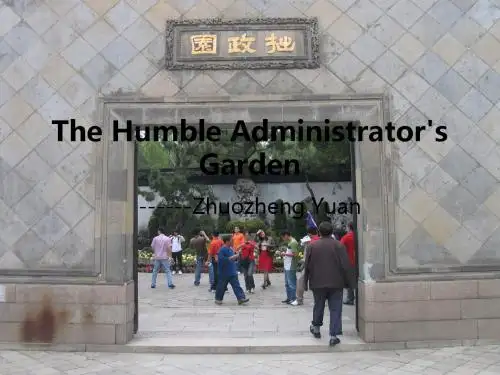

拙政园英文导游词拙政园英文导游词3篇作为一位尽职的导游,总归要编写导游词,导游词是我们引导游览时使用的讲解词。
我们该怎么去写导游词呢?以下是小编精心整理的拙政园英文导游词3篇,欢迎阅读与收藏。
拙政园英文导游词3篇1Everybody is good! Welcome to visit suzhou gardens. I am your tour guide, surnamed pan, just call me pan or pan guide. Let me take you to visit!Suzhou garden with beautiful scenery, is famous for its elegant, have "jiangnan garden enjoys, suzhou garden armor chiangnan" the laudatory name. There are both lakes and mountains, wide, and Bridges the jiangnan water rhyme.Now we came to the humble administrator's garden. Humble administrator's garden is one of the four classical gardens in China. It is located in suzhou in the swallow gate, is the largest one in suzhou garden, also is the representative work of suzhou gardens. You see, the humble administrator's garden is light fitting for property of building layout, the clever, fair, simple natural pure and fresh style? Its layout theme centered on water, the water area is about one 5 of the total, various pavilions hin pavilions built by the water. Main building has far hong tong, snow sweet YunWeiTing, to frost eighteen datura flower pavilion, pavilion, pavilion, 36 yuanyang pavilion, etc. Autographed photos below, you'd better be careful, don't fall into the water or litter!Visit the humble administrator's garden, now everyone with me to the surging waves pavilion. Surging waves pavilion is the oldest a garden in suzhou. Within the garden rocks as blue waves accent. Look, head on a heaped-up mountains, stone pavilion islocated on its blue waves. Is Lord of the garden rockery southeastern md hall building, and there are five hundred MingXian shrine, see mountain building, emerald green and exquisite pavilions, back check pavilion and royal pavilion building through with them. Landscape art is different, not into the garden gate and set a pool of green water around outside in the garden. Chisel below has a pool, landscape are connected to a complex tortuous galleries, how beautiful! The compositionBelow you see the lion grove. Is one of the four classical gardens in suzhou. Because of the high stone mountain park, more like a lion, so the name "lion" Lin. Forest lake stone rockery and more exquisite, architectural distribution of strewn at random have send, the main building there is YanYu hall, see waterfall mountain building, pavilion, ask MeiGe, etc. Lion grove theme is clear, the depth of field is rich, personality, false cave lives the craftsmanship, objects don't have a charm.Finally, let's visit the garden. Lingering garden is one of China's four big gardens. Was built in the Ming dynasty. Central garden covers an area of about 50 acres, with landscape is given priority to, is the essence dominated. The main building has a green mountain, bright floor, quxi far cui pavilion buildings, the wind the place such as the pool pavilion. Keep the number of campus building in the gardens in suzhou crown, fully embodies the ancient landscape of superb artistry and outstanding wisdom.Now that we have finished the few parks are not allowed to visit the suzhou gardens. I would be glad to visit the gardens together with everybody, thank you for your support for my work! Good bye!拙政园英文导游词3篇2Hello, I am your tour guide little hao hao, let us together tosee the famous humble administrator's garden. Humble administrator's garden is typical of the Ming dynasty garden, small home garden is compact, the naive essence. The humble administrator's garden dominated with water as the center. She will be divided into eastern, central and western three parts.We first came to the east park, please see, the south east area of KuangKuo lawn, lawn heap heaped-up mountains to the west and wooden pavilion, lingering around water, AnLiu falls, with stone between Los Angeles and peak, waterside pavilion built by the water, winding, it has rich jiangnan water features, how beautiful!Through the east garden, we came to the garden. In the garden in the pool as the center, pavilions are built around the water, some TingXie is straight out of the water. Everyone to see, that is antique house with fragrant lotus yu character of the main hall of hong tong, every window is connected fully, can ring at the garden scenery. Ladies and gentlemen, please everyone came to north hall, there are LinChi platform, across the pool to enjoy TingXie island mountains and the distance. Here the water clear, planting lotus, tree-lined everywhere on the island, mountain scenery of the four seasons because of time inconsistency, beautiful!Let's go to the west, you can see the west park. Layout is compact, west mountain was built with pavilions. That is the main building, 36 yuanyang pavilion west park, garden owner was treating guests and listen to music. Sunny day by indoor looking at outside through the blue glass window scenery is like a piece of snow. 36 yuanyang pavilion pool trapezoid-shaped.Humble administrator's garden is filled with beautiful scenery, three days and three nights all say not over, you slowly,please. Everyone at the time of visit, please pay attention to health and safety, do not litter.拙政园英文导游词3篇3Welcome to visit humble administrator's garden. The garden of the humble administrator's garden and the city, the Summer Palace in Beijing, chengde summer resort collectively known as the "four big gardens" of our country. After the two belong to the northern royal garden, large scale, decorated, magnificent, full of aesthetic taste of the manchu qing dynasty; And we are two gardens of suzhou is a typical southern literati freehand brushwork in traditional Chinese garden, small home garden is compact, simple pure elegant, is the literati shangri-la in real life. Humble administrator's garden is a master of ancient Chinese gardening art. Style shu lang, create landscape affinity, philosophy contains rich and colorful life, is the most typical landscape works of Ming dynasty in China.At the same time, the great achievement in the central garden landscape, the pattern of "a pool of three island" has become the model of garden creation. Is known as the "mother of the Chinese garden. Humble administrator's garden is one of the biggest private gardens of suzhou, covers an area of 5 hectares. Its creative conception by one of the most famous painter at that time, in the "four" Ming prove Mr Wen penned. Humble administrator's garden was founded in 1509, from the garden, before and after 16 years. Several times in the history of waste, the Lord after several changes, including the king of the taiping heavenly kingdom zhong political. From China's most famous author of the classic novel a dream of red mansions cao xueqin, used to live here, so many descriptions about the grand view garden are in conformity with the humble administrator'sgarden landscape. First, the Lord Wang Xianchen is supervision of the Ming dynasty, equivalent to the prosecutor now, to monitor the collectors administration of local officials, position. Officialdom frustrated after the return of the native, the northeast corner of the city real estate building in suzhou, is now "the humble administrator's garden". Name from the jin dynasty, pan yue's article "irrigation garden greens of jing", "this is the place of those who were compensated.Said wryly that their intellect shallow line can't get the appreciation of the emperor and the country's ambition, only with home became a farmer, since then ignore, enjoy retirement nymphs frame of mind. Much like the "LanXueTang" name, taken from a poem "the wind is aspersed LanXue, independent between heaven and earth." White and self sustaining, express master, handsome generous share common interest. In this carved lacquerware screen we can see clearly on the humble administrator's garden consists of two veranda is divided into three parts: the east is given priority to with pastoral scenery, named after the Ming dynasty Wang Xinyi bought "pushing YuanJu". Once suffered severe damage, rarely keep buildings. Now in this part we can see many tall precious tree species and typical classical architecture. Is dominated in the middle of the essence, also known as "garden", perfectly preserved the Ming dynasty jian ya and extravagance, thickness and the style of light spirit, in the layout design, architectural modeling, painting and sculpture, flowers and trees gardening has a high artistic attainments.Is master Zhang Lvqian rebuilt in the qing dynasty in the west and say "garden", has the blue deck on colour, style of fashion in the qing dynasty characteristics. At the same time, we can seefrom this picture carved lacquerware, most buildings and water garden, adjacent to surface or provoke a volley over the surface of the water, their names are all get inspiration in a flowing water of connected throughout the garden, the jiangnan unique wind-induced depict brilliant. Especially the water through the plant lotus, or hold emerald green green, or red and white dot, or dead branches for the rain, the ancients gave it "rising above the sinful" noble sentiment and favour of the Lord to its "XiangYuan yi qing", all these living poet qing sad things here due to the need of landscape have different performance. Today, the humble administrator's garden's annual "lotus festival", not only sets and hundreds kinds of lotus varieties, still carefully make one thousand ancient lotus seed germination, and develop a bowl lotus and other precious ornamental varieties, tourists won plaudits for.。

描写拙政园的英语作文80词The Humble Administrator's Garden, a masterpiece of classical Chinese garden art, exudes a serene and elegant atmosphere. Its intricate layout, with ponds, bridges, and pavilions, reflects the harmony of nature and human wisdom. Walking through the garden, one is captivated by the lush greenery, the gentle flow of water, and the delicate carvings. It is a paradise for the senses, a place where one can escape the hustle and bustle of the outside world and find tranquility and peace.拙政园,中国古典园林艺术的杰作,散发着宁静而优雅的气息。
其复杂的布局,包括池塘、桥梁和亭子,反映了自然与人类智慧的和谐统一。
漫步在园中,人们会被郁郁葱葱的绿意、柔和的水流和精致的雕刻所吸引。
拙政园是感官的天堂,是人们逃离外界喧嚣、寻找宁静与平和的绝佳之地。
The garden's name, "Humble Administrator's Garden," carries a profound meaning. It was originally built as a private garden for a retired official, a symbol of his desire to lead a humble and unassuming life. Today, it stands as a testament to the rich cultural heritage of China, attracting tourists from all over the world to admire its beauty and appreciate its historical significance.拙政园的名字寓意深远,最初是作为一位退休官员的私人园林而建,象征着他追求谦虚和朴素生活的愿望。
The Humble Administrator's GardenA nu mber of notables, including Lu Ji (187A.D.-219A.D.), the Mayor of Yulin of the Wu S tate in the Three States period, Dai Yong (378 A.D.-447 A.D.), a man of noble character in the Eastern Jin Dynasty, and Lu Guimeng (?- abou t 881 A.D.), the late Tang poet, used to build their garden-houses in historical sequence on the same site of the garden.During the 4th year of the reign of Zhengde of the Ming Dynasty (1509 A.D.) the imperial inspector Wang Xianchen returned to Suzhou after retiring from public life and built his garden. He b orrowed the idea from the essay by the Jin writer Pan Yue, saying,“ To cultivate my garden and sell my vegetable crop... is the policy of humble man.”Hence the name. There used to be 31 sig hts in the garden, including the Ruo Shu Hall and the Meng Yin Tower. With the lu xuriant vegetation,meandering brooks and pools, the beau ty of the Humble Administrator's Garden surpassed all others in Suzhou. In the 12th year of the reig n of Jiajing (1533A.D.), the famous painter and callig rapher Wen Zheng ming wrote an essay ab out the Wangs' Humble Administrator's Garden, painted 31 scrolls of paintings relevant to the garden, each having a poem describing a particular scene. Marked by vicissitudes, the garden has changed hands a number of times ever since its birth. In the 10th year of the reig n of Xianfeng, Li Xiucheng, the Loyal Prince of the Heavenly Kingdom, made it his palace. In the 2nd yearof the reign of Tongzhi (1863 A.D.), it belonged to the Jiangsu Governor Li Hongzhang,whose office was set up within. In the 11th year of the reign of Tongzhi, it became the seat of the Ban ner Men's Association. After the fou nding of the People's Republic of C hina, the garden was repaired,and started to open to the public on Nov.6, 1952.Covering 51,950 sq.m., the Humble Administrator's Garden is the largest of all classical gardens in Suzhou. It is centered u p on the broad expanse of a lake, making u p abou t one fifth of the total area.With well-spaced buildings, the garden landscape and waterscape are simple, extensive and natural, possessing the traditional appearances of the Ming Dynasty. It is divided into three parts: the eastern, middle and western parts. The house lies in the south of the garden.The middle part is the cream of the garden with marvellous mountains, clearwater, exquisite buildings and exuberant trees and flowers reminiscent of the scenery in the sou th of the Lower Yang tze. Lying here and there to the sou th of the lake are garden buildings and courts in clusters. On an east-west axis there's the Hall of Drifting Fragrance in the middle, flanked b y the Loquat Garden C ourt, the Malus Micromalus Makina C ourt, the Poeny Pavilion, the List ening to the Sound of Rain Pavilion, the Small Canglang, “ A Pure Mind Thinks Deep ”, and the Magnolia Hall.Rising from the lake are the East and West Hills made from a mixture of earth and rocks, and co vered with trees. The Prunus Mu me Pavilion and the Orange Pavilion stand atop of the hills. By the side of the lake there are forsythias gently stroking the surface of water, and bringing abou t delightful effects of nature. Much of the surprise comes from the disposition of the Fragrant Isle, the Pavilion in Lotus Breezes and the Mountain-in-View Tower to the west of the lake. From the Secluded Pavilion of Firmiana Simplex and Bamboo one is able to catch sight of the Pag oda of Paying Debts of Gratitude in distance. The pictu resque scene of the pagoda mirrored in water is an example of the garden technique called“borrowed viewfrom afar ”.The buildings in the western part of the garden are properly arranged by the lake. To the sou th of the lake is a big mandarin ducks' hall with two halves. The northern half i s named “ the Hall of 36 Pairs of Mandarin Ducks” and the southern half “the Hall of 18 Camellias”.Built to the west of the lake are the Inducalamus Pavilion,the “With Whom Shall I Sit?” Pavilion, the Floating Green Tower, the Stay-and-Listen Pavilion and the Pag oda Reflection Pavilion. Going up and d own and in a zigzag, a unique veranda over the water is a structure built along the wall to the east of the lake. The Good-For-B oth-Families Pavilion and the Reflection Tower face each other from the ends of the veranda with nearb y scenes reflected in water, creating perhaps a most wonderful view in the western part. The Good-For-Both-Families Pavilion on the top of the hill overlooks the middle and western parts, another example of the garden technique called“b orrowed view from near”.Decorated with the C ymbidium Virens Hall, the Lotus Pavilion, the Celestial Spring Pavilion, the Far Away Looking Pavilion an d the All Blue Pavilion, the eastern part of the garden has verdant hills with pines and bamboo, distant islands encircled by winding streams, and an extensive area of grass, flowers and trees. Glowing ou t of the mud, lotus blooms still keep themselves pure and clean. The farther their smell drifts the purer it becomes. A g ood number of buildings in the gar den are named after lotus blooms, often known as “a true person of virtue”among flowers, such as the Hall of Drifting Fragrance, the Lotus Pavilion,the Pavilion in the Lotus Breezes, and the Stay-and-ListenPavilion, expressing the theme of the whole garden --- to be as pure as lotus blooms.Lying to the south of the garden is the house, which is the typical residence in Suzhou. On a north-south axis there are four successive buildings, namely the Sedan-Chair Hall, the Reception Hall and two two-storeyed buildings. To the east of the axis are the Mandarin Ducks' Hall with flower-basket decoration, the Flower Hall and the Four-Sided Viewing Hall.The Humble Administrator's Garden boasts altogether 48 different buildings,101 parallel couplets and door plateaux, 40 stelae, 21 precious old trees, namely Wistaria, Sabina chinensis, Pterocarya stenoptera, etc. falling into 13 different catalogues, and over 700 b onsai (potted landscape) kept in the B onsai Garden in the western part of the garden ,representing the Suzhou style bonsai, one of the four leading b onsai styles in C hina.。

关于拙政园的英语作文小学小学Title: The Enchanting Beauty of Humble Administrator's GardenThe Humble Administrator's Garden, also known as the Zhuozheng Yuan, is a magnificent classical garden located in Suzhou, China. It is considered one of the most famous and well-preserved gardens in China. With its unique design, stunning landscapes, and rich cultural significance, the Humble Administrator's Garden captivates visitors from all over the world.Spread across an area of about 52,000 square meters, the Humble Administrator's Garden is divided into three main sections - the eastern garden, the central garden, and the western garden. Each section has its own distinctive features and elements that showcase the essence of traditional Chinese gardening.The eastern garden, known for its grandeur, features a large pond surrounded by beautiful pavilions, bridges, and mesmerizing rock formations. The tranquil water reflects the nearby structures, creating a picturesque scene that evokes a sense of peace and harmony. As visitors stroll across the bridges and pathways, they can enjoy the delicate fragrance of flowers and the peaceful melodies of birds singing.Moving towards the central garden, visitors are greeted by a landscape filled with lush greenery and vibrant blooms. This section combines natural elements with man-made structures, such as courtyards, halls, and corridors. One of the highlights here is a small island connected to the mainland by the zigzag bridge, representing the balance between nature and human intervention. The careful arrangement of plants, trees, and flowers further enhances the garden's aesthetic appeal.Finally, the western garden features intricate rockeries, winding streams, and elegant pavilions, all harmoniously integrated into the landscape. This section is reminiscent of the mountainous regions of China, with its artificial hills creating a sense of serenity and grandeur. As visitors explore the garden, they can find hidden caves and grottoes, adding an element of adventure and discovery.The Humble Administrator's Garden is not only a feast for the eyes but also a treasure trove of Chinese culture and history. Its construction dates back to the Ming Dynasty, and the design principles draw inspiration from traditional Chinese poetry, paintings, and philosophy. The gardenreflects the Chinese concept of blending architecture with nature, creating a seamless connection between humans and the environment.Today, the Humble Administrator's Garden is recognized as a UNESCO World Heritage Site and attracts millions ofvisitors every year. It serves as a vital link to China'srich cultural heritage, giving visitors a glimpse into the country's ancient traditions and artistic sensibilities. The garden's beauty and tranquility provide an escape from the bustling city life, allowing visitors to appreciate the elegance and simplicity of traditional Chinese aesthetics.In conclusion, the Humble Administrator's Garden is a breathtaking masterpiece of landscape design. Its enchanting beauty, meticulous craftsmanship, and cultural significance make it a must-visit destination for both locals and foreigners. Whether strolling through its pavilions, admiring the mesmerizing rockeries, or simply enjoying the serenity of its surroundings, the Humble Administrator's Garden offers a truly immersive experience that lingers in the hearts and minds of all who visit.。