初中英语语法之主谓一致
- 格式:docx
- 大小:15.01 KB
- 文档页数:3
初中英语语法之主谓一致主谓一致
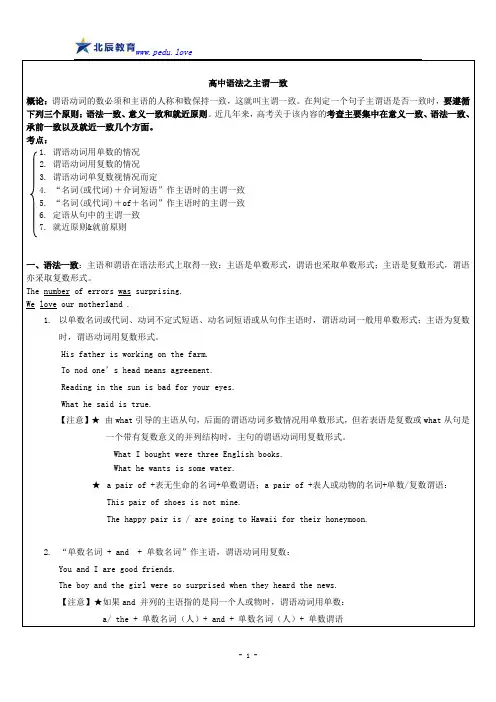
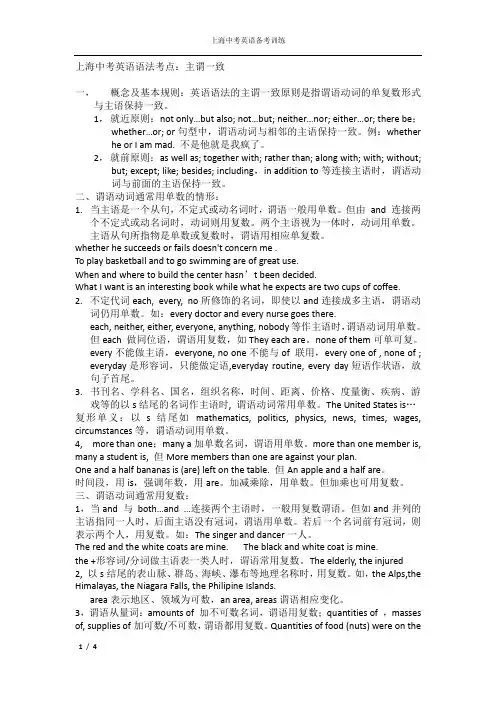
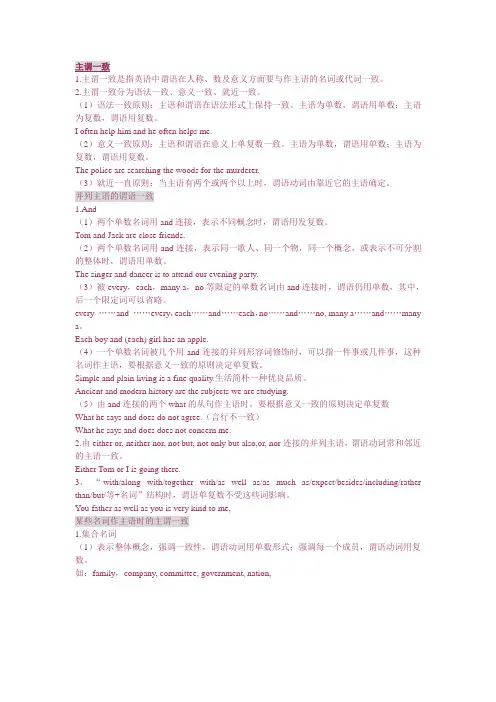
主谓一致是指主语和谓语必须保持人称和数的变化一致,即句中谓语的变化形式由句子主语 的人称和数的形式决定。主谓一致通常遵循三个原那么语法一致、意义一致和就近一致原那么。 语法一致语法一致是指主语的单复数决定谓语动词的单复数。
考点一:一般情况下,主语为单数可数名词或代词、不可数名词时,谓语动词用单数形式; 主语为复数可数名词或代词时,谓语动词用复数形式。
考点二:动词不定式或动词-ing形式作主语时,谓语动词用单数形式。
考点三:复合不定代词 anyone, anybody, anything, someone, somebody, something,
everyone,everybody, everything, no one, nobody, nothing 作主语时,谓语动词用单数形式。 注意:
1. "neither of/none/either of +复数可数名词/代词”作主语时,谓语动词用单、复数 形式皆可。
2. either指"两者之中任何一个”,作主语时,谓语动词用单数形式。
3. each作同位语时,谓语动词的单、复数形式取决于主语的数;"each of +复数可数名词 /代词”作主语时,谓语动词用单数形式。
考点四:当用both ... and…连接并列主语时,谓语动词常用复数形式。当and连接的两个 名词表示两个不同的概念时,谓语动词用复数形式;当表示同一人、同一物或同一个概念, 或表示不可分的整体时,谓语动词用单数形式。
考点五:当主语后面跟有 with, except, including, along with, together with, as well as, in addition
to等词语引导的短语时,谓语动词的单、复数形式由主语的单、复数形式决定。
考点六:一些由两局部构成的表示物体的名词作主语时,谓语动词通常用复数形式,如shoe, glove,
trouser, scissor, chopstick等。但如果这些名词前有量词如pair等修饰时,谓语动词 的数与量词保持一致。
考点七:当主语是“a/this kind of +名词”构成 其谓语动词用单数形式。
当主语是“…kinds of +名词”构成,其谓语动词用复数形式。
【考例链接】I .单项选择
()l.There a large bowl of jiaozi on the table.
A. isare
B. be()2.Mr. Wang together with his wife and children in the countryside.
A. enjoys livingenjoy living
B. enjoys to liveenjoy to live
()3.Peter with his classmates for the bus when the earthquake happened.
A. is waitingwas waiting
B. are waitingwere waiting
()4.—Lucy, there too many things on the desk. What a mess!
—Sorry, Mum. I, II put them away.
A. haveis
B. are()5.As we all know, using public chopsticks necessary when we eat with others.
A. isare
B. wasII.用括号内所给单词的适当形式填空
1. Beijing Opera, an important part of Chinese culture,(have) a history of over 200 years.
2. My grandfather often that he wants to go back and live in the countryside, (repeat)The milk
sour. Don' t drink it. (smell)
3. Her mother her goodbye as she goes to school every day. (kiss)Bill is new and nobody(know) him.
4. None of my children (have) blonde hair and they all have black hair.
5. These exercises are not easy and each of them usually(take) one or two minutes to do.
6. Both his brother and sister(enjoy) tennis. They often play it together.
7. Linda' s birthday is coming and I think a pair of gloves(be) a nice present for her.
8. Scissors(be) used for cutting things.
III.根据括号内的汉语意思或首字母填写单词Some scientists (相信)that there will be more
robots in the future.
1. We all(仰慕)those heroes who work hard to fight against the virus (病毒).
2. This elephant(重量是)many times more than this panda.
3. Shake the bottle well so that the milk(混合)with the tea.
4. As we all know, the sun(升起)in the east.
5. Nothing more than people' s safety and health.(要紧)7,This kind of special noodles tso
delicious that I can' t help asking for more.
意义一致意义一致是指谓语动词和主语的一致不是取决于主语的语法形式,而是由其意义所决定。
考点一:
1 . “a (large/small) number of +复数可数名词”作主语时,谓语动词用复数形式;“the number of
+复数可数名词"作主语时,谓语动词用单数形式。
2 ."分数/百分数+ of +名词”和"the rest/most/half of +名词”作主语时,谓语动词 的数由名词决定。
考点二:有些集体名词常指复数的人或物,谓语动词用复数形式,如police ;有些集体名词 作主语时,如果作为一个整体看待,谓语动词用单数形式;如果指集体中的成员,谓语动词 用复数形式,如 family, class, team, group, crowd 等;当 population 意为“人口 数量”时, 谓语动词用单数形式;意为“全体居民”时,谓语动词用单、复数形式皆可。
考点三:以-s结尾的单数名词如news, physics, maths, politics等作主语时,谓语动词用单数 形式。
考点四:“the+姓氏的复数形式”表示某一家人或夫妇两人,其作主语时,谓语动词用复数 形式。
考点五:当couple表示夫妇两人,作主语时,谓语动词用单、复数形式皆可。
【考例链接】I .单项选择
()1.—The talent show Youth With You (青春有你)is becoming hotter and hotter online.
—Exactly. Half of our class interested in it recently.
A. isare
B. was()2.——The number of tourists over 33 million this year.
一Yes. A large number of tourists so far because of the new look of our city.
A. is; have comeis; has come
B. are; has comeare; have come
II.用括号内所给单词的适当形式填空Look! The Browns(eat) supper in the kitchen.
1. The couple(not change) their house since they had a second child.
2. The good news(be) that it will be fine and sunny tomorrow.
3. In 1992 the population of Cairo(be) about 6,500,000.
4. Our discussion group(be) meeting this week for the new task. 就近一致就近一致是指谓语动词的数要与其最近的主语在人称和数上保持一致。
考点一:以 or, not only... but also either... orneither... nor...等连接的名词(或代词)作 主语时,谓语动词要和离它最近的主语在人称和数上保持一致。
考点二:在there be句型中,如果有两个或两个以上的主语时,主语与谓语的一致通常遵循 就近一致原那么。
【考例链接】单项选择
()1.一What' s in the picture on the wall?
—There a teacher and some students playing soccer on the playground.
A. hasare
B. ishave
()2.Not only Jack but also I crazy about the football match.
A. amis
B. arebe
()3.Either the students or the teacher him very well.
A. knowsto know
B. knowknew
()4.Neither my sister nor I been to Xi' an before.
A. have neverhave ever
B. has neverhas ever
图片参考答案
语法一致I . 1-5 AABCA
II. 1. has 2. repeats 3. smells 4. kisses 5. knows6. have / has 7. takes 8. enjoy 9. is 10. are
III. 1. believe 2. admire 3. weighs 4. mixes 5. risesmatters 7. tastes