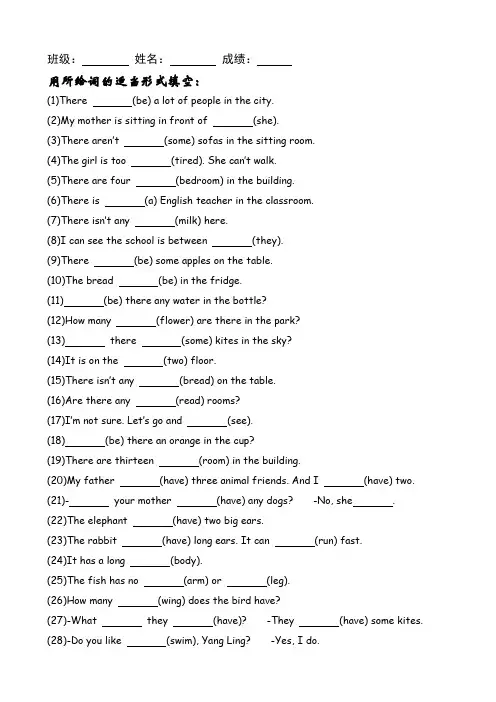
新译林版英语五年级上册第一二单元语法专练
- 格式:doc
- 大小:33.50 KB
- 文档页数:2
There be 句型语法讲解
1.There be 句型表示:在某地有某物(或人)
2.在there be 句型中,主语是单数,be 动词用is ; 主语是复数,be 动词用are ;
如有几件物品,be 动词根据最近be 动词的那个名词决定。
3. there be 句型的否定句在be 动词后加not ,如有some要变成any.
4. 一般疑问句把be 动词调到句首。
5. there be句型与have(has) 的区别:
there be 表示在某地有某物(或人);have(has) 表示某人拥有某物。
6.some 和any 在there be 句型中的运用:some 用于肯定句,any 用于否定句或疑问句。
7.and 和or 在there be句型中的运用:and 用于肯定句, or 用于否定句或疑问句。
8.针对数量提问的特殊疑问句的基本结构是:
How many + 名词复数 + are there + 介词短语?
How much + 不可数名词 + is there + 介词短语?
9.针对主语提问的特殊疑问句的基本结构是: What’s + 介词短语?
专项练习
一、用is, are填空。
1. There ______ a spoon on the plate.
2. There ______ some milk on the table. There ______ coffee, too.
3. There ______ some clouds in the sky. There ______ some boats on the river.
4. There ______ some knives in the box.
5. There ______ a newspaper in the living room.
6. ______ there any books in the room? Yes, there ______ .
______ there any magazines on the television? No, there ______ .
7. There ______ a policeman in the kitchen.
8. There ______ 60 minutes in an hour.
9. There ______ a pencil, a ruler and 2 books on the desk.
10. There ______ 2 glasses and a cup on the table.
二、把下例句子改成一般疑问句。
1. There are four apples on the ground. 疑问句:_______________________________________
2. There are five birds in the tree. 疑问句:_______________________________________
3.
There are five birds singing in the tree. 疑问句:____________________________
4. There is an armchair in the living room. 疑问句:_______________________________
5. There’s a sofa in the living room. 疑问句:__________________________________
6. There’s a duck in the farm. 疑问句:______________________________________
三、把下例句子改成否定句。
1. There are two bowls on the table. 否定句:__________________________________________
2. There are some beautiful flowers in the garden. 否定句:_____________________________
3. There is a tree in the garden. 否定句:___________________________________________
4. There is an apple tree in the garden. 否定句:_______________________________ 四、用some, any填空。
1. There's ______ water in the cup. There isn't ______ tea in the cup.
2. Is there ______ bread here? Yes, there is. There's ______ on the table.
3. Are there ______ cars in front of the building? No, there aren't.
4. There isn't _____ chocolate on the table.
5. Is there ______ soap on the dressing table?
五、there be 与have区别。
1. This desk _________ four legs.
2. __________ some books on the desk.
3. Everyone ___________ a dictionary in my class.
4. ______________ (没有) knives in the room.
5. I ___________ a new sweater.
6. ______________ some flowers and a desk in the room.
7. __________ nothing in the bag.
8. They ____________ something to eat.
六、 按要求进行句型转换
1. There are some kites on the wall.(改为否定句)
_________________________________________________________
2. There is some rice in the bag.(改为一般疑问句)
_________________________________________________________
3. There are forty-eight pupils in Miss Guo's class.(对画线部分提问)
_________________________________________________________
4. Mr. Green has two sons. (对画线部分提问)
___________________________________________________
5. There is a woman near the house.(变复数)
_________________________________________________
6. There are some buses near the hill.(变单数)
____________________________________________________
7. There are some apples on the tree.(变一般问句)
______________________________________________________
8. There are some oranges in the glass.(变否定句)
_______________________________________________________
9. Is there a baby in the room?(变复数)
_____________________________________________________
10. There are many beautiful flowers in the garden. (就划线部分提问)
___________ ___________ in the garden?
12.There is a bookcase in my study. (变一般问句)
________ _________ ________ ________ in your study?
13.There is a soccer ball and a basketball on the floor.
___________ __________ on the floor?
14、My new dress is in the wardrobe(衣橱). (就划线部分提问) .
_________ ___________ your new dress?
15.There are some big trees behind my house. (就划线部分提问)
_________ __________ _________ big trees?