
SMART GRID COMMUNICATIONS
- 格式:pdf
- 大小:685.96 KB
- 文档页数:2

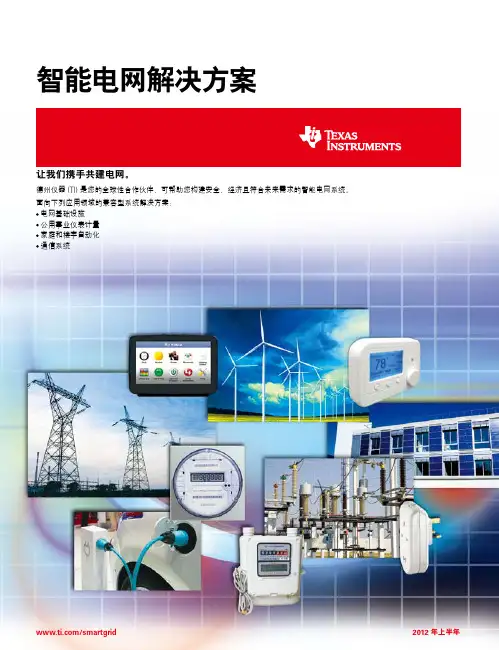
Smart Grid Solutions智能电网解决方案德州仪器 (TI) 是您的全球性合作伙伴,可帮助您构建安全、经济且符合未来需求的智能电网系统。
面向下列应用领域的兼容型系统解决方案:电网基础设施公用事业仪表计量家庭和楼宇自动化通信系统/smartgrid 2012 年上半年TI 的雄厚实力可加快您的产品上市进程。
在全球范围内得到广泛推广使用的计量技术诀 窍与产品;丰富全面的端到端片上系统 (SoC) 解决方案; 高稳健性的产品系列采用创新专业技术,具备 仪表计量的所有主要功能。
利用更加智能化的解决方案超越竞争对手。
优化的电表 SoC (LM4F1xx);灵活的应用处理器 SoC (LM4F1x); 针对图形用户界面的高性能 (AM18xx / AM335x Sitara TM ARM ® MPU);优化的低功耗射频 SoC (CC1101 / CC1120 ISM);灵活的电力线通信处理器 (TMS320F28电力线 载波通信 (PLC)xx);安全的射频识别 (RFID) 预付费功能; 配套的接口及电源管理; 成本效益型集成和批量制造;符合 wM-Bus 和 802.15.4g 标准; 顺应未来的全球安全性要求。
运用 T I 高度灵活的解决方案缩短您的设计周期。
完整的硬件、软件和片上系统 (SoC) 产品库可 充分满足功能需求;符合未来需求的解决方案;可升级的系统内可编程闪存能够支持不断演进 发展的全球性国际标准;可用的标准包括 IEC 、ANSI 、ZigBee ®、无 线 M-Bus (wM-Bus)、电力线载波通信 (PLC) 和6LoWPAN 等;TI 电网解决方案具有可扩展性,能针对系统要 求进行相应的优化。
德州仪器 (TI) 是您的全球性合作伙伴,可帮助您构建安全、经济且符合未来需求的智能电网系统。
我们的智能电网解决方案包括电网基础设施、智能计量仪表以及家庭/楼宇自动化。
Smart Grid Technologies:Communication Technologies and StandardsVehbi C.Güngör,Member,IEEE,Dilan Sahin,Taskin Kocak,Salih Ergüt,Concettina Buccella,Senior Member,IEEE,Carlo Cecati,Fellow,IEEE,andGerhard P.Hancke,Senior Member,IEEEAbstract—For100years,there has been no change in the basic structure of the electrical power grid.Experiences have shown that the hierarchical,centrally controlled grid of the20th Century is ill-suited to the needs of the21st Century.To address the challenges of the existing power grid,the new concept of smart grid has emerged.The smart grid can be considered as a modern electric power grid infrastructure for enhanced efficiency and reliability through automated control,high-power converters, modern communications infrastructure,sensing and metering technologies,and modern energy management techniques based on the optimization of demand,energy and network availability, and so on.While current power systems are based on a solid information and communication infrastructure,the new smart grid needs a different and much more complex one,as its di-mension is much larger.This paper addresses critical issues on smart grid technologies primarily in terms of information and communication technology(ICT)issues and opportunities.The main objective of this paper is to provide a contemporary look at the current state of the art in smart grid communications as well as to discuss the still-open research issues in thisfield.It is expected that this paper will provide a better understanding of the technologies,potential advantages and research challenges of the smart grid and provoke interest among the research community to further explore this promising research area.Index Terms—Advanced metering infrastructure(AMI),com-munication technologies,quality-of-service(QoS),smart grid, standards.I.I NTRODUCTIONT ODAY’S electrical infrastructure has remained un-changed for about100years.The components of the hierarchical grid are near to the end of their lives.While theManuscript received May16,2011;revised August04,2011;accepted Au-gust09,2011.Date of publication September06,2011;date of current version November09,2011.The work of V.C.Gungor,D.Sahin,T.Kocak,and S. Ergüt was supported in part by Türk Telekom under Award Number11316-01 and the work of C.Buccella and C.Cecati was supported by DigiPower s.r.l., L’Aquila,Italy,and the work of G.P.Hancke was supported by Eskom,South Africa.Paper no.TII-11-252.V. C.Güngör, D.S¸ahin,and T.Koçak are with the Department of Computer Engineering,Bahçes¸ehir University,˙Istanbul34353,Turkey (e-mail:cagri.gungor@.tr;dilan.sahin@.tr; taskin.kocak@.tr).S.Ergüt is with Türk Telekom Group R&D Division,˙Istanbul34353,Turkey (e-mail:salih.ergut@.tr).C.Buccella and C.Cecati are with the University of L’Aquila,Department of Industrial and Information Engineering and Economics,L’Aquila67100, Italy,and with DigiPower Ltd.,L’Aquila67100,Italy(e-mail:concettina.buc-cella@univaq.it;carlo.cecati@univaq.it).G.P.Hancke is with the Department of Electrical,Electronic and Computer Engineering,University of Pretoria,Pretoria0002,South Africa(e-mail: g.hancke@).Color versions of one or more of thefigures in this paper are available online at .Digital Object Identifier10.1109/TII.2011.2166794electrical grid has been ageing,the demand for electricity has gradually increased.According to the U.S.Department of En-ergy report,the demand and consumption for electricity in the U.S.have increased by2.5%annually over the last20years[1]. Today’s electric power distribution network is very complex and ill-suited to the needs of the21st Century.Among the deficiencies are a lack of automated analysis,poor visibility, mechanical switches causing slow response times,lack of situational awareness,etc.[2].These have contributed to the blackouts happening over the past40years.Some additional inhibiting factors are the growing population and demand for energy,the global climate change,equipment failures,energy storage problems,the capacity limitations of electricity gen-eration,one-way communication,decrease in fossil fuels,and resilience problems[5].Also,the greenhouse gas emissions on Earth have been a significant threat that is caused by the electricity and transportation industries[6].Consequently,a new grid infrastructure is urgently needed to address these challenges.To realize these capabilities,a new concept of next genera-tion electric power system,the smart grid,has emerged.The smart grid is a modern electric power grid infrastructure for im-proved efficiency,reliability and safety,with smooth integration of renewable and alternative energy sources,through automated control and modern communications technologies[1],[11].Re-newable energy generators seem as a promising technology to reduce fuel consumption and greenhouse gas emissions[7].Im-portantly,smart grid enabling new network management strate-gies provide their effective grid integration in Distributed Gen-eration(DG)for Demand Side Management and energy storage for DG load balancing,etc.[8],[9].Renewable energy sources (RESs)are widely studied by many researchers[10]and the integration of RES,reducing system losses and increasing the reliability,efficiency and security of electricity supply to cus-tomers are some of the advances that smart grid system will in-crease[12].The existing grid is lack of communication capabil-ities,while a smart power grid infrastructure is full of enhanced sensing and advanced communication and computing abilities, as illustrated in Fig.1.Different components of the system are linked together with communication paths and sensor nodes to provide interoperability between them,e.g.,distribution,trans-mission and other substations,such as residential,commercial, and industrial sites.In the smart grid,reliable and real-time information becomes the key factor for reliable delivery of power from the gener-ating units to the end-users.The impact of equipment failures, capacity constraints,and natural accidents and catastrophes, which cause power disturbances and outages,can be largely1551-3203/$26.00©2011IEEEFig.1.Smart grid architecture increases the capacity andflexibility of the net-work and provides advanced sensing and control through modern communica-tions technologies.avoided by online power system condition monitoring,diagnos-tics and protection[1].To this end,the intelligent monitoring and control enabled by modern information and communication technologies have become essential to realize the envisioned smart grid[1],[14].The U.S.,Canada,China,South Korea,Australia,and Eu-ropean Community(EC)countries have started doing research and development on smart grid applications and technologies. For example,the ernment has announced the largest power grid modernization investment in the U.S.history,i.e., $3.4billion in grant awards,funding a broad range of smart grid technologies[2].Local Distribution Companies(LDCs)are in-tegrating advanced metering and two-way communication,au-tomation technologies to their distribution systems[15].In ad-dition to research and development projects,many electric util-ities are also taking incremental steps to make the smart grid technology a reality.Most of them are signing agreements with telecom operators or smart meter vendors to carry out smart grid projects.All these agreements define the main requirements and features of the necessary communications infrastructure to provide online communication between smart meters and the utility’s back-haul system,i.e.,the so-called advanced metering infrastructure(AMI).In general,the AMI is a two-way com-munications network and is the integration of advanced sensors; smart meters,monitoring systems,computer hardware,software and data management systems that enable the collection and dis-tribution of information between meters and utilities[14].In this paper,a comprehensive but brief review on smart grid communications technologies is presented.Section II describes smart grid communications technologies and their advantages and disadvantages.Section III mentions smart grid communi-cations requirements in terms of security,system reliability, robustness,availability,scalability and the quality-of-service (QoS)mechanism.The standardization activities are reviewed in Section IV.Finally,this paper is concluded in Section V.II.C OMMUNICATIONS T ECHNOLOGIES A V AILABLEFOR S MART G RIDSA communications system is the key component of the smart grid infrastructure[1],[14],[16].With the integration of ad-vanced technologies and applications for achieving a smarter electricity grid infrastructure,a huge amount of data from dif-ferent applications will be generated for further analysis,con-trol and real-time pricing methods.Hence,it is very critical for electric utilities to define the communications requirements andfind the best communications infrastructure to handle the output data and deliver a reliable,secure and cost-effective ser-vice throughout the total system.Electric utilities attempt to get customer’s attention to participate in the smart grid system,in order to improve services and efficiency.Demand side manage-ment and customer participation for efficient electricity usage are well understood,furthermore,the outages after disasters in existing power structure also focus the attention on the impor-tance of the relationship between electric grids and communi-cations systems[1].Different communications technologies supported by two main communications media,i.e.,wired and wireless,can be used for data transmission between smart meters and electric utilities.In some instances,wireless communications have some advantages over wired technologies,such as low-cost infrastructure and ease of connection to difficult or unreachable areas.However,the nature of the transmission path may cause the signal to attenuate.On the other hand,wired solutions do not have interference problems and their functions are not dependent on batteries,as wireless solutions often do. Basically,two types of information infrastructure are needed for informationflow in a smart grid system.Thefirstflow is from sensor and electrical appliances to smart meters,the second is between smart meters and the utility’s data centers.As sug-gested in[17],thefirst dataflow can be accomplished through powerline communication or wireless communications,such as ZigBee,6LowPAN,Z-wave,and others.For the second infor-mationflow,cellular technologies or the Internet can be used. Nevertheless,there are key limiting factors that should be taken into account in the smart metering deployment process,such as time of deployment,operational costs,the availability of the technology and rural/urban or indoor/outdoor environment,etc. The technology choice thatfits one environment may not be suitable for the other.In the following,some of the smart grid communications technologies along with their advantages and disadvantages are briefly explained.An overview of smart grid communication technologies can be found in Table I.A.ZigBeeZigBee is a wireless communications technology that is rela-tively low in power usage,data rate,complexity,and cost of de-ployment.It is an ideal technology for smart lightning,energy monitoring,home automation,and automatic meter reading,etc. ZigBee and ZigBee Smart Energy Profile(SEP)have been re-alized as the most suitable communication standards for smart grid residential network domain by the U.S.National Institute for Standards and Technology(NIST)[18].The communica-tion between smart meters,as well as among intelligent home appliances and in home displays,is very important.Many AMI vendors,such as Itron,Elster,and Landis Gyr,prefer smart me-ters,that the ZigBee protocol can be integrated into[37].ZigBee integrated smart meters can communicate with the ZigBee inte-grated devices and control them.ZigBee SEP provides utilitiesGÜNGÖR et al.:SMART GRID TECHNOLOGIES:COMMUNICATION TECHNOLOGIES AND STANDARDS 531TABLE IS MART G RID C OMMUNICATIONS TECHNOLOGIESto send messages to the home owners,and home owners can reach the information of their real-time energy consumption.1)Advantages:ZigBee has 16channels in the 2.4GHz band,each with 5MHz of bandwidth.0dBm (1mW)is the max-imum output power of the radios with a transmission range be-tween 1and 100m with a 250Kb/s data rate and OQPSK mod-ulation [18].ZigBee is considered as a good option for me-tering and energy management and ideal for smart grid imple-mentations along with its simplicity,mobility,robustness,low bandwidth requirements,low cost of deployment,its operation within an unlicensed spectrum,easy network implementation,being a standardized protocol based on the IEEE 802.15.4stan-dard [4].ZigBee SEP also has some advantages for gas,water and electricity utilities,such as load control and reduction,de-mand response,real-time pricing programs,real-time system monitoring,and advanced metering support [18],[19].2)Disadvantages:There are some constraints on ZigBee for practical implementations,such as low processing capabil-ities,small memory size,small delay requirements and being subject to interference with other appliances,which share the same transmission medium,license-free industrial,scientific and medical (ISM)frequency band ranging from IEEE 802.11wireless local area networks (WLANs),WiFi,Bluetooth and Microwave [18].Hence,these concerns about the robustness of ZigBee under noise conditions increase the possibility of corrupting the entire communications channel due to the interference of 802.11/b/g in the vicinity of ZigBee [20].In-terference detection schemes,interference avoidance schemes and energy-efficient routing protocols,should be implemented to extend the network life time and provide a reliable and energy-efficient network performance.B.Wireless MeshA mesh network is a flexible network consisting of a group of nodes,where new nodes can join the group and each node can act as an independent router.The self-healing characteristic of the network enables the communication signals to find an-other route via the active nodes,if any node should drop out of the network.Especially,in North America,RF mesh-based sys-tems are very popular.In PG&E’s SmartMeter system,every smart device is equipped with a radio module and each of them routes the metering data through nearby meters.Each meter acts as a signal repeater until the collected data reaches the elec-tric network access point.Then,collected data is transferred to the utility via a communication network.A private company,SkyPilot Networks uses mesh networking for smart grid appli-cations due to the redundancy and high availability features of mesh technology [37].1)Advantages:Mesh networking is a cost effective solu-tion with dynamic self-organization,self-healing,self-config-uration,high scalability services,which provide many advan-tages,such as improving the network performance,balancing the load on the network,extending the network coverage range [21].Good coverage can be provided in urban and suburban areas with the ability of multihop routing.Also,the nature of a mesh network allows meters to act as signal repeaters and adding more repeaters to the network can extend the coverage and capacity of the network.Advanced metering infrastructures and home energy management are some of the applications that wireless mesh technology can be used for.2)Disadvantages:Network capacity,fading and interfer-ence can be counted as the major challenges of wireless mesh networking systems.In urban areas,mesh networks have been faced with a coverage challenge since the meter density cannot provide complete coverage of the communications network.Providing the balance between reliable and flexible routing,a sufficient number of smart nodes,taking into account node cost,are very critical for mesh networks.Furthermore,a third party company is required to manage the network,and since the metering information passes through every access point,some encryption techniques are applied to the data for security purposes.In addition,while data packets travel around many neighbors,there can be loop problems causing additional overheads in the communications channel that would result in a reduction of the available bandwidth [20].C.Cellular Network CommunicationExisting cellular networks can be a good option for com-municating between smart meters and the utility and between far nodes.The existing communications infrastructure avoids utilities from spending operational costs and additional time for building a dedicated communications infrastructure.Cel-lular network solutions also enable smart metering deployments spreading to a wide area environment.2G,2.5G,3G,WiMAX,and LTE are the cellular communication technologies available to utilities for smart metering deployments.When a data transfer interval between the meter and the utility of typically 15min is used,a huge amount of data will be generated and a high data rate connection would be required to transfer the data to the utility.For example,T-Mobile’s Global System for Mobile532IEEE TRANSACTIONS ON INDUSTRIAL INFORMATICS,VOL.7,NO.4,NOVEMBER2011Communications(GSM)network is chosen for the deployment of Echelon’s Networked Energy Services(NES)system.An embedded T-Mobile SIM within a cellular radio module will be integrated into Echelon’s smart meters to enable the com-munication between the smart meters and the back-haul utility. Since T-Mobile’s GSM network will handle all the communi-cation requirements of the smart metering network,there is no need for an investment of a new dedicated communications net-work by utilities.Telenor,Telecom Italia,China Mobile,V oda-fone have also agreed to put their GSM network into service for dataflow of smart metering communications.Itron’s SEN-ITEL electricity meter is integrated with a GPRS module and communicates with a server running SmartSynch’s Transaction Management System.Code-division multiple-access(CDMA), wideband code-division multiple-access(WCDMA),and Uni-versal Mobile Telecommunications System(UMTS)wireless technologies are also used in smart grid projects.A CDMA smart grid solution for the residential utility market has been introduced by Verizon,and Verizon’s3G CDMA network will be used as the backbone of the smart grid communications with the SmartSynch smart grid solutions[37].UMTS is IP-based and a packet oriented service that is suitable for metering appli-cations[37]Telenor with Cinclus technology is offering UMTS technology for smart grid communications[37].An Australian energy delivery company,SP AusNet,is building a dedicated communications network for smart grid applications and chose WiMAX technology for the commu-nications need of the smart meters.WiMAX chip sets are embedded into the smart meters and wireless communications is dedicated between smart meters and the central system in SP AusNet’s system.A U.S.wireless carrier,Sprint Nextel, had signed a partnership with the smart grid software provider, Grid Net,on a project to provide communication between smart meters and smart routers over its4G wireless network. General Electric(GE)is developing WiMAX-based smart meters with CenterPoint Energy and had collaborated with Grid Net,Motorola,and Intel to focus on WiMAX connectivity solutions.In GE’s smart meter project with CenterPoint En-ergy,it will deploy WiMAX-based MDS Mercury3650radios to connect the utility’s back-haul system to collection points, which will collect data from smart meters that are installed by CenterPoint[37].Furthermore,some major companies,such as Cisco,Silver Springs Network,and Verizon,also implement WiMAX smart grid applications.The world’s largest WiMAX vendor,Alvarion,has announced its partnership with a U.S. utility company,National Grid,for a WiMAX-based smart grid project.Lower deployment and operating costs,proper security protocols,smooth communications,high data speeds(up to75 Mb/s),an appropriate amount of bandwidth and scalability are the advantages of today’s WiMAX technology.1)Advantages:Cellular networks already exist.Therefore, utilities do not have to incur extra cost for building the commu-nications infrastructure required for a smart grid.Widespread and cost-effective benefits make cellular communication one of the leading communications technologies in the market.Due to data gathering at smaller intervals,a huge amount of data will be generated and the cellular networks will provide sufficient bandwidth for such applications.When security comes into dis-cussion,cellular networks are ready to secure the data transmis-sions with strong security controls.To manage healthy commu-nications with smart meters in rural or urban areas,the wide area deployment capability of smart grid becomes a key com-ponent and since the cellular networks coverage has reached al-most100%.In addition,GSM technology performs up to14.4 Kb/s,GPRS performs up to170Kb/s and they both support AMI,Demand Response,Home Area Network(HAN)applica-tions.Anonymity,authentication,signaling protection and user data protection security services are the security strengths of GSM technology[37].Lower cost,better coverage,lower main-tenance costs,and fast installation features highlight why cel-lular networks can be the best candidate as a smart grid com-munications technology for the applications,such as demand re-sponse management,advanced metering infrastructures,HAN, outage management,etc.2)Disadvantages:Some power grid mission-critical appli-cations need continuous availability of communications.How-ever,the services of cellular networks are shared by customer market and this may result in network congestion or decrease in network performance in emergency situations.Hence,these considerations can drive utilities to build their own private com-munications network.In abnormal situations,such as a wind storm,cellular network providers may not provide guarantee pared to public networks,private networks may handle these kinds of situations better due to the usage of a va-riety of technologies and spectrum bands.D.Powerline CommunicationPowerline communication(PLC)is a technique that uses the existing powerlines to transmit high-speed(2–3Mb/s)data sig-nals from one device to the other.PLC has been thefirst choice for communication with the electricity meter due to the direct connection with the meter[20]and successful implementations of AMI in urban areas where other solutions struggle to meet the needs of utilities.PLC systems based on the LV distribution network have been one of the research topics for smart grid ap-plications in China[22].In a typical PLC network,smart meters are connected to the data concentrator through powerlines and data is transferred to the data center via cellular network tech-nologies.For example,any electrical device,such as a powerline smart transceiver-based meter,can be connected to the power-line and used to transmit the metering data to a central loca-tion[37].France has launched the“Linky meter project”that includes updating35million traditional meters to Linky smart meters.PLC technology is chosen for data communication be-tween the smart meters and the data concentrator,while GPRS technology is used for transferring the data from the data con-centrator to the utility’s data center[37].ENEL,the Italian elec-tric utility,chose PLC technology to transfer smart meter data to the nearest data concentrator and GSM technology to send the data to data centers.1)Advantages:PLC can be considered as a promising technology for smart grid applications due to the fact that the existing infrastructure decreases the installation cost of the communications infrastructure.The standardization efforts on PLC networks,the cost-effective,ubiquitous nature,and widely available infrastructure of PLC,can be the reasons forGÜNGÖR et al.:SMART GRID TECHNOLOGIES:COMMUNICATION TECHNOLOGIES AND STANDARDS533its strength and popularity[23].Data transmissions are broad-cast in nature for PLC,hence,the security aspects are critical. Confidentiality,authentication,integrity,and user intervention are some of the critical issues in smart grid communications. HAN application is one of the biggest applications for PLC technology.Moreover,PLC technology can be well suited to urban areas for smart grid applications,such as smart metering, monitoring and control applications,since the PLC infrastruc-ture is already covering the areas that are in the range of the service territory of utility companies.2)Disadvantages:There are some technical challenges due to the nature of the powerline networks.The powerline trans-mission medium is a harsh and noisy environment that makes the channel difficult to be modeled.The low-bandwidth charac-teristic(20kb/s for neighborhood area networks)restricts the PLC technology for applications that need higher bandwidth [37].Furthermore,the network topology,the number and type of the devices connected to the powerlines,wiring distance be-tween transmitter and receiver,all,adversely affect the quality of signal,that is transmitted over the powerlines[37].The sen-sitivity of PLC to disturbances and dependency on the quality of signal are the disadvantages that make PLC technology not suited for data transmission.However,there have been some hy-brid solutions in which PLC technology is combined with other technologies,i.e.,GPRS or GSM,to provide full-connectivity not possible by PLC technology.E.Digital Subscriber LinesDigital Subscriber Lines(DSLs)is a high-speed digital data transmission technology that uses the wires of the voice tele-phone network.It is common to see frequencies greater than 1MHz through an ADSL enabled telephone line[16].The al-ready existing infrastructure of DSL lines reduces installation cost.Hence,many companies chose DSL technology for their smart grid projects.The Current Group,a Smart Grid Solution Company,has collaborated with Qwest to implement a Smart Grid project.Qwest’s existing low latency,secure,high capacity DSL network will be used for data transmissions.Xcel Energy’s “SmartGridCity”project has also proved the interoperability of the technology by utilizing the Current’s intelligent sensors and OpenGrid platform and Qwest’s DSL network.A smart metering project has been carried out for Stadtwerke Emden-Municipal Utilities in Germany by Deutsche Telekom.In the project,Deutsche Telekom is responsible to provide the data communications for electric and gas meters.A communication box will be installed at the customer premises and the consump-tion information will be transmitted over DSL to Stadtwerke Emden[37].Deutsche Telekom offers many services in this project,such as reading consumption data,installation and op-eration,data transmission,etc.However,the throughput of the DSL connection depends on how far away the subscriber is from the serving telephone exchange and this makes it difficult to characterize the performance of DSL technology[16].1)Advantages:The widespread availability,low-cost and high bandwidth data transmissions are the most important rea-sons for making the DSL technology thefirst communications candidate for electricity suppliers in implementing the smart grid concept with smart metering and data transmission smart grid applications.2)Disadvantages:The reliability and potential down time of DSL technology may not be acceptable for mission critical applications.Distance dependence and lack of standardization may cause additional problems.The wired DSL-based commu-nications systems require communications cables to be installed and regularly maintained,and thus,cannot be implemented in rural areas due to the high cost of installingfixed infrastructure for low-density areas.To conclude,wired technologies,such as DSL,PLC,optical fiber,are costly for wide area deployments but they have the ability to increase the communications capacity,reliability and security.On the other hand,wireless technologies can reduce the installation costs,but provide constrained bandwidth and security options.III.S MART G RID C OMMUNICATIONS R EQUIREMENTS The communication infrastructure between energy genera-tion,transmission,and distribution and consumption requires two-way communications,interoperability between advanced applications and end-to-end reliable and secure communi-cations with low-latencies and sufficient bandwidth[25]; Moreover,the system security should be robust enough to pre-vent cyber-attacks and provide system stability and reliability with advanced controls.In the following,major smart grid communication requirements are presented.A.SecuritySecure information storage and transportation are extremely vital for power utilities,especially for billing purposes and grid control[24].To avoid cyberattacks,efficient security mecha-nisms should be developed and standardization efforts regarding the security of the power grid should be made.B.System Reliability,Robustness and Availability Providing the system reliability has become one of the most prioritized requirements for power utilities.Aging power infra-structure and increasing energy consumption and peak demand are some of the reasons that create unreliability issues for the power grid[26].Harnessing the modern and secure communi-cation protocols,the communication and information technolo-gies,faster and more robust control devices,embedded intel-ligent devices(IEDs)for the entire grid from substation and feeder to customer resources,will significantly strengthen the system reliability and robustness[26].The availability of the communication structure is based on preferred communication technology.Wireless technologies with constrained bandwidth and security and reduced installation costs can be a good choice for large-scale smart grid deployments[24].On the other hand, wired technologies with increased capacity,reliability and secu-rity can be costly[24].To provide system reliability,robustness and availability at the same time with appropriate installation costs,a hybrid communication technology mixed with wired and wireless solutions can be used.C.ScalabilityA smart grid should be scalable enough to facilitate the op-eration of the power grid[3].Many smart meters,smart sensor。