
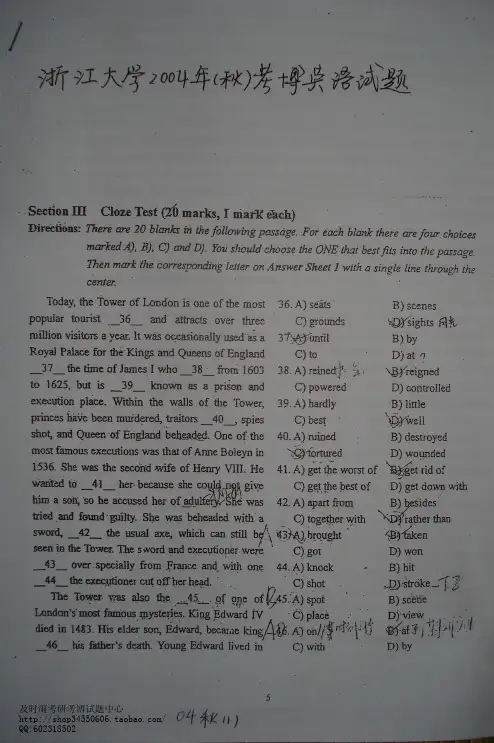
04秋浙大考博英语试题
- 格式:pdf
- 大小:11.09 MB
- 文档页数:9
考博士英语试题及答案一、阅读理解(共40分)1. 阅读下列短文,然后根据短文内容回答问题。
(每题2分,共10分)[短文内容略](1) What is the main idea of the passage?(2) What does the author suggest about the future of technology?(3) Why are some people hesitant to adopt new technologies?(4) What is the role of education in technological advancement?(5) How can individuals contribute to the development of technology?2. 阅读以下文章,然后根据文章内容选择最佳答案。
(每题2分,共10分)[文章内容略](1) A(2) B(3) C(4) D(5) E3. 阅读以下文章,并根据文章内容回答问题。
(每题3分,共20分) [文章内容略](1) What is the primary purpose of the article?(2) How does the author describe the impact of globalization?(3) What are some of the challenges faced by developing countries?(4) What solutions does the author propose to address the issues?(5) What is the author's conclusion regarding the futureof globalization?二、词汇与语法(共30分)1. 根据句子意思,选择正确的词汇填空。
Test OneSection ADirections: In this section you will hear 10 short conversations between two speakers. At the end of each conversation, a third voice will ask a question about what was said. You will hear the question only once. When you have heard the question, read the four possible answers marked A, B, C and D and decide which is the best answer. Mark your answer by blackening the corresponding letter on the Answer Sheet with a pencil.1. A. He’s worried. B. It’s getting late.C. He heard a noise outside.D. He can’t see out of the window.2. A. Soon B. In 20 minutes. C. They don’t care. D. They don’t know.3. A. Here. B. A pass.C. An official.D.A letter of introduction.4. A. Home. B. To town. C. To his friends. D. To a restaurant.5. A. She uses coffee. B. She hates coffee.C. She never liked coffee.D. She liked coffee before.6. A. The pay isn’t imp ortant. B. They don’t need the money.C. He wants to save the money.D. He doesn’t like waiting in line for his pay.7. A. He wants to go to sleep. B. Doctors always tell him lies.C. He doesn’t believe in medicine.D. He needs a rest without being bothered.8. A. He eats too much. B. He kills chickens.C. He only eats chickens.D. He married a greedy person.9. A. Buying trees. B. Who owns the tree.C. Their family trees.D. How old the tree is.10.A. A stranger. B. A ticket seller. C. A train attendant. D. Anotherpassenger.Section BDirections: In this section of the test you will hear three brief talks. You will hear them only once.After each one you will hear some questions. You will hear each question only once. After you hear the question, you will have 15 seconds to choose the best answer from the four choices given. Mark your answer on the Answer Sheet by blackening the corresponding letter with a pencil.11. A. Be a doctor. B. Join the army. C. Not join the army. D. Improve his reading.12. A. A lady. B. The doctor. C. His mother. D. His neighbour.13. A. He pretended he couldn’t see. B. He answered his questions wrong.C. He pretended to get on the wrong bus.D. He pretended not to know where to go.14. A. A seller. B. A driver. C. A thief .D. A policeman.15. A. He was beaten by a robber. B. He was robbed at gunpoint.C. A customer of his was robbed.D. His truck was stolen by a thief.16. A. His truck was turned over. B. He was questioned by police.C. He was attacked by another robber.D. His witnesses hurried to his aid.17. A. Because she’d had a bad fall. B. Because she’d been born that way.C. Because she’d had a car accident.D. Because she’d had a very high fever.18. A. She was quiet and shy. B. She was uncontrollable.C. She was weak from illness.D. She was bright and friendly.19. A. Her husband. B. Her parents. C. Her teacher. D. Her brother.20. A. As a political leader. B. As famous scientist.C. As an example to others.D. As an extraordinary doctor.Section CThere are four parts in this section—Part A, Part B, Part C and Part D. You will take the test part by part. Each part has its own directions. Remember t hat while you are doing your test, you should first put down your answers in you r test booklet. At the end of the listening comprehension section, you will have five minutes to transfer your answers from your test booklet to Answer Sheet 1.Part ADirections: Fill in the following blanks, using no more than three words for each answer. You will hear the recording twice. Now you have 25 seconds to read the table below.When he opened the door, Mr. Herbert suddenly saw _____1The three enormous men wore _____2At that dangerous moment, Mr. Herbert felt _____3The next day when he went back, he found a _____4He kept it in his pocket as a _____5Part BDirections: Answer questions 6-10 while listening. Use no more than five words for each answer.You will hear the recording twice. Now you have 40 seconds to read the questions.Who won the football match the night in an exhibition game? _____6How did the eight previous games end in? _____7How many people watched the exhibition game? _____8When was the Italian's second goal scored? _____9How many times has the captain Bobby Moore played for England? _____10Part CDirections: Questions 11-13 are based on the following talk. Choose the correct answer from the four choices given. Now you have 30 seconds to read the questions.11.What factors make Hollywood ideal for film making?A. Its excellent studios.B. Its “happy ending” films.C. Its diverse natural conditions.D. Its rapid changes in the film industry.12.Why did film makers bring more violence on the screen?A. More profits were made.B. They became more violent.C. Audie nce rejected “happy ending” films.D. It fitted in with modern people's lifestyles.13.What does “PG” in “PG13” stand for?A. Paying guests.B. Public in general.C. Parental guidance.D. Parents and grandparents.Part DDirections: Questions 14-18 are based on the following talk. Use the information in the right column to match with that in the left column. Now you have 30 seconds to read the related information.14.President Roosevelt A. allergic to cats15. President Johnson B. his dog became the most common breed in thecountry16. President Nixon C. once being suspected of mistreating animals17. President Bush D. had a Scotch Terrier named “Falla”18. President Clinton E. his wife wrote a book about their dogTest TwoSection ADirections: In this section you will hear 10 short conversations between two speakers. At the end of each conversation, a third voice will ask a question about what was said. You will hear the question only once. When you have heard the question, read the four possible answers marked A, B, C and D and decide which is the best answer. Mark your answer by blackening the corresponding letter on the Answer Sheet with a pencil.1. A.Because he is lazy. B. Because he has to work.C. Because he hasn’t got time.D. Because he doesn’t like women.2. A. In bed. B. At work. C. In the kitchen. D. In the bathroom.3. A. Dancing. B. Carrying something.C. Jumping up and down.D. Running up the stairs.4. A. Sorry. B. Happy. C. Angry. D. Surprised.5. A. There are no taxis. B. The taxi is out of order.C. The telephone doesn’t work.D. The man is afraid to call for a taxi.6. A. Her pass was no good. B. The guard wouldn’t let her.C. The guard wouldn’t give her a pass.D. She was too fat to go through the gate.7. A. There is no money. B. There is enough money.C. Money is not important.D. There might not be enough money.8. A. Because he is a fool. B. Because he is dangerous.C. Because he seems to be an expert.D. Because he knows what he’s doing.9. A. Because they are tired. B. Because they need a rest.C. Because the box is too heavy.D. Because they hear footsteps coming down.10.A. He’s feeling sick. B. He’s feeling fine.C. He’s feeling lonely.D. He’s feeling very tired.Section BDirections: In this section of the test you will hear three brief talks. You will hear them only once.After each one you will hear some questions. You will hear each question only once. After you hear the question, you will have 15 seconds to choose the best answer from the four choices given. Mark your answer on the Answer Sheet by blackening the corresponding letter with a pencil.11. A. Home. B. To the park. C. To a restaurant. D. To another movie.12. A. Pearls. B. The moon. C. Bright stars. D. A golden waterfall.13. A. Joe. B. Joe’s mother. C. Joe’s friend. D. Joe’s girlfriend.14. A. In Illinois. B. On railroad tracks.C. In a passenger train.D. In a club near the town.15. A. Clark’s sister. B. A young man. C. A little girl. D. A truck driver.16. A. Looking at girls. B. Eating a sandwich.C. Making a phone call.D. Walking on therailroad tracks.17. A. Weather balloons. B. Children’s play balloons.C. Balloons used for sport.D. Balloons used for safety patrols.18. A. Only in the morning. B. During the early afternoon.C. In the early afternoon or late at night.D. In the early morning or the late afternoon.19. A. Three Americans. B. A single American.C. Several FrenchmenD. An American and a Frenchman.20. A. One day. B. Six days. C. Three days. D. Eleven days. Section CThere are four parts in this section—Part A, Part B, Part C and Part D. You will take the test part by part. Each part has its own directions. Remember t hat while you are doing your test, you should first put down your answers in you r test booklet. At the end of the listening comprehension section, you will have five minutes to transfer your answers from your test booklet to Answer Sheet 1.Part ADirections: Fill in the following blanks, using no more than three words for each answer. You will hear the recording twice. Now you have 25 seconds to read the table below.Weather in New York state: _____1Weather in Michigan state: _____2Weather in the northern Plains: _____3Weather in Washington: _____4Temperature in Texas state: _____5Part BDirections: Answer questions 6-10 while listening. Use no more than five words for each answer.You will hear the recording twice. Now you have 40 seconds to read the questions.How many square miles does the fault which has been found cover? _____6What does the fault system mean to Los Angeles? _____7What three factors decide the amount of damage that a quake can do? _____8How many dollars of damage did the 1987 earthquake do? _____9How often would a quake that involved all three segments occur? _____10Part CDirections: Questions 11-13 are based on the following talk. Choose the correct answer from thefour choices given. Now you have 30 seconds to re ad the questions.11.How many American households own two or more cars?A. 5%.B. 65%.C. 80%.D. 95%.12.What is one of the uses of a reliable car?A. For joining the “Triple A”.B. For providing help in emergencies.C. For making trips in town.D. For commuting to work.13.What kind of help can not an auto club provide for its members?A. Insurance.B. Gasoline.C. Car repairs.D. Road maps.Part DDirections: Questions 14-17 are based on the following interview. Choose the correct answer from the four choices given. Now you have 30 seconds to read questions.14.According to Theroux, what should one see in his grand tour today?A. The present and the future.B. The past cultures and traditions.C. Cathedrals and castles.D. A better place than their home.15.What is not mentioned as a necessary quality to be a good traveler?A. Curiosity.B. Cooperation among themselves.C. Courage.D. Tolerance of solitude.16.What is the explorer trying to do?A. To be the first to see something, not the last.B. To find an idealized version of home.C. To find places that no one has ever been to.D. To walk with all the animals in the Amazon.17. Which of the following can we infer from the talk?A.A good traveler has to be willing to go to strange and unusual places.B. People should travel in groups to enjoy their journey better.C. Explorers look for places that will give them ideas of ancient civilization.D. Vacationers know the true meaning of travel.Test ThreeSection ADirections: In this section you will hear 10 short conversations between two speakers. At the end of each conversation, a third voice will ask a question about what was said. You will hear the question only once. When you have heard the question, read the four possible answers marked A, B, C and D and decide which is the best answer. Mark your answer by blackening the corresponding letter on the Answer Sheet with a pencil.1. A. In a grocery. B. In a drugstore.C. In a doctor’s office.D. In a department store.2. A. $240. B. $200. C. $300. D. $120.3. A. One. B. Two. C. Three D. None.4. A. Home. B. At work C. At the store. D. In the hospital.5. A. He wants the woman to fix his watch.B. He will call her when the watch is fixed.C. He wants her to fix the watch within a week.D. He will need more than a week’s time to fix the watch.6. A. The wind has stopped, but it’s still raining.B. The wind is blowing, but the rain has stopped.C. It’s still raining, and the wind is blowing.D. Both the rain and the wind have stopped for some time.7. A. $114. B. $104. C. $40. D. $140.8. A. At 8:15. B. At 10:18. C. At 8:00. D. At 8:30.9. A. Home. B. To Dover.C. To London.D. To see the railway station.10. A. Jim’s position. B. Jim’s future career.C. The woman speaker’s health.D. The harmful gossip about him.Section BDirections: In this section of the test you will hear three brief talks. You will hear them only once.After each one you will hear some questions. You will hear each question only once. After you hear the question, you will have 15 seconds to choose the best answer from the four choices given. Mark your answer on the Answer Sheet by blackening the corresponding letter with a pencil.11. A. Because Mr. Grey wanted to sell them.B. Because Mr. Grey became a biology professor.C. Because the Greys were moving to a new home.D. Because these men were moving to a new home.12. A. A van. B. Furniture.C. A large wooden box.D. The Grey’s possessions.13. A. He did nothing. B. He nearly dropped the box.C. He treated the box very gently.D. He nearly threw it into the van.14. A. The trainer set them free. B. An accident broke open their cage.C. An old lady freed them by mistake.D. Their keeper forgot to lock the cage.15. A. To a nearby grassland. B. To the trainer’s house.C. To a nearby private zoo.D. To an elderly lady’s house.16. A. Because she is fearless. B. Because she likes lions.C. Because she thought the lion was a big dog.D. Because the trainertold her not to be afraid.17. A. It killed the old lady. B. It returned to its cage.C. It fell asleep on the bedroom rug.D. It left for the grassland and slept there.18. A. Lloyd. B. Jack. C. John. D. A movie star.19. A. It got a lot of rain. B. It was filmed in the mountains.C. The rivers and streams were beautiful.D. It was flat and not beautiful at all.20. A. When he saw the picture post card shots.B. When he saw the farmer working in his field.C. When the dust storm destroyed the farmer’s crop.D. When he saw all his wheat killed for lack of rain.Section CThere are four parts in this section—Part A, Part B, Part C and Part D. Y ou will take the test part by part. Each part has its own directions. Remember t hat while you are doing your test, you should first put down your answers in you r test booklet. At the end of the listening comprehension section, you will have five minutes to transfer your answers from your test booklet to Answer Sheet 1.Part ADirections: Fill in the following blanks, using no more than three words for each answer. You will hear the recording twice. Now you have 25 seconds to read the table below.A few months ago some friends invited me to join them _____1One boy was bitten on the leg by a rattlesnake while _____2The leg stayed lower than the heart so thatthe poison would travel as _____3The father used the knife to make _____4Having been given an injection, the boy was kept in _____5Part BDirections: Answer question 6-10 while listening. Use no more than five words for each answer.You will hear the recording twice. Now you have 40 seconds to read the questions.When did the two boats sink off the coast of Florida? _____6Who first came to the rescue around 2 a.m. EST? _____7What might have caused the sinking of the first boat? _____8How many people were still missing late Saturday? _____9What did the whole incident involve? _____10Part CDirections: Questions 11-13 are based on the following report. Choose the correct answer from the four choices given. Now you have 30 seconds to read the questions.11. What did President Clinton propose to preserve?A. Civil War battlefields.B. Wildlife refuges.C. National parks.D. All precious lands.12. How much money would be allocated for land conservation every year?A. $1.25 billion.B. $1 billion.C. $900 million.D. $500 million.13.What happened to the fund raised for land conservation?A. It is often used for other purposes.B. It increases by 125 percent every year.C. It comes from local taxes.D. It has been reduced in the past few years. Part DDirections: Questions 14-16 are based on the following report. Choose the correct answer from the four choices given. Now you have 30 seconds to read the questions.14. On a high-fat diet, what happened to the experimental mice with one or no copies of the gene?A. They rapidly developed diabetes.B. They rapidly gained weight just like other normal mice.C. They didn't gain weight or get the sign of diabetes.D. They couldn't eat and died of slow starvation.15. What is the characteristics of type Ⅱdiabetes?A. Insulin-resistant.B. High-fat diet.C. Insulin-sensitive.D. Weight gains.16. How many people die in the world every year from the complications ca used by diabetes?A. 28 million.B. 10 million.C. 130 million.D. 2.8 million.Test FourSection ADirections: In this section you will hear 10 short conversations between two speakers. At the end of each conversation, a third voice will ask a question about what was said. You will hear the question only once. When you have heard the question, read the four possible answers marked A, B, C and D and decide which is the best answer. Mark your answer by blackening the corresponding letter on the Answer Sheet with a pencil.1. A. In London. B. In the country.C. In a mountain village.D. Somewhere in the capital.2. A. Because he is busy at the moment.B. Because he is afraid of the woman.C. Because he is a foreigner himself.D. Because he is confused by the woman’s question.3. A. Because the rug is blue. B. Because the light is blue.C. Because the light is green.D. Because the light is yellow.4. A.$39.95. B.$45. C.$39. D.$95.5. A. To keep a cat as a pet.B. To buy a picture of the pet cat.C. To hunt animals and sell them for a camera.D. To take pictures of animals instead of killing them.6. A. Spelling words. B. Reading aloud.C. Practising dictation.D. Improving her pronunciation.7. A. She cannot read. B. Nobody can tell. C. She has no watch .D. She is too sorry.8. A. The dog is friendly. B. They fight sometimes.C. They ignore each other.D. The cat is hard to get along with.9. A. No, not at all. B. Yes, with her mother.C. Yes, if she goes home early.D. Only if she goes out with the man.10.A.He spent the money. B. He lost his wallet.C. Somebody took his wallet.D. Somebody borrowed his wallet.Section BDirections:In this section of the test you will hear three brief talks. You will hear them only once.After each one you will hear some questions. You will hear each question only once. After you hear the question, you will have 15 seconds to choose the best answer from the fourchoices given. Mark your answer on the Answer Sheet by blackening the corresponding letter with a pencil.11.A. Women. B. Men’s clothing.C. Women’s clothing.D. Old dress requirements at restaurants.12.A. Wear skirts. B. Be more formal.C. Be more informal.D. Be more interested in restaurants.13.A. Nimi. B. San Francisco.C. The Pacific Ocean.D. Along the U.S.coast.14.A. The earthquake was serious.B. New earthquakes are not expected.C. An island was destroyed by the earthquake.D. Injuries and damage have not been reported yet.15.A. They will be of high intensity. B. They will occur along the coast.C. They will be of unknown intensity.D. They are predicted 100 miles away.16.A. Limited. B. Declined. C. Exhausted. D. Unlimited.17.A. Because they are important food supplies.B. Because the noted biologist insisted on it.C. Because fish are fewer than Indian tigers.D. Because the great fisheries are already exhausted.18.A. Resources of land. B. Resources of the air.C. Resources of the sea.D. Important species for conservation.19.A. They can last forever.B. They are threats to tigers and eagles.A.A.The fish supply has no effects on people.D. The threats to fish may be even more alarming.20.A. The sea resources were unlimited.B. The threats to birds are alarming.C. The problems of sea resources can not be ignored.D. Fishes, tigers and eagles can all be part of people’s diet.Section CThere are four parts in this section—Part A, Part B, Part C and Part D. You will take the test part by part. Each part has its own directions. Remember t hat while you are doing your test, you should first put down your answers in you r test booklet. At the end of the listening comprehension section, you will have five minutes to transfer your answers from your test booklet to Answer Sheet 1.Part ADirections: Fill in the following blanks, using no more than three words for each answer. You will hear the recording twice. Now you have 25 seconds to read the table below.The Shanghai Post and Telecommunications Administration andthe Shanghai Information Investment Co., Ltd. and the US AT&T (China)recently signed _____1They agreed to set up an IP Service Network, including _____2The agreement was reached with the Government's approvalafter the two sides' long-term _____3In order to offer first-rate services to customers,they will introduce advanced _____4The implementation plan for the trial cooperativeproject will win approval from _____5Part BDirections: Answer questions 6-10 while listening. Use no more than five words for each answer.You will hear the recording twice. Now you have 40 seconds to read the questions.What was Antonio? _____6What did the house he bought look like from outside? _____7How did he feel when he saw a womanbehind him in the mirror one morning? _____8What did he decide to do one evening when he came home? _____9What happened after his letter disappeared? _____10Part CDirections: Questions 11-14 are based on the following news. Choose the correct answer from the four choices given. Now you have 30 seconds to read the questions.11.How did Lemak murder her three children?A. Cut them into pieces.B. Made them eat a lot of sleeping pills.C. Suffocated them by her own hands.D. Dragged them into the furnace.12.Who reported the deaths?A. David Lemak.B. Marilyn Lemak.C. Birkett.D. Nicholas.13.Which of the following statement is not true according to the talk?A. Lemak had been into jail before.B. Lemak was in the process of divorcing.C. Lemak injured herself deliberately and was in the hospital.D. Lemak might be sentenced to the death penalty.14.Which of the following is true about the children's father?A. He divorced his wife years ago.B. He was too sad to cooperate in the investigation.C. He helped his wife murder their three children.D. He was a doctor working in the emergency room.Part DDirections: Questions 15-17 are based on the following conversation. Choose the correct answer from the four choices given. Now you have 30 seconds to read the questions.15. What does the policeman think of his job?A. Not dangerous if he knows how to handle it appropriately.B. Not dangerous if he carries weapons.C. Dangerous because of more crimes and bigger fights.D. Dangerous because of drunken people.16. What will he first do if he sees a fight?A. He intervenes and then fight with them.B. He radios immediately for assistance.C. He sizes up what is happening.D. He takes out the truncheon to warn them.17. What is his opinion about carrying guns?A. Good. It is the best way to override criminals.B. Good. Because he was once shot, so he should carry a gun to protect himself.C. Not good. It's too heavy and pulls down his trousers.D. Not good. It may result in more violence.Test FiveSection ADirections: In this section you will hear 10 short conversations between two speakers. At the end of each conversation, a third voice will ask a question about what was said. You will hear the question only once. When you have heard the question, read the four possible answers marked A, B, C and D and decide which is the best answer. Mark your answer by blackening the corresponding letter on the Answer Sheet with a pencil.1. A. In a bank. B. In a restaurant. C. In the man’s house.D. In a departmentstore.2. A. 8:00. B. 8:15. C. 8:30. D. 8:45.3. A. The woman. B. The door keeper. C. It’s on the desk. D. Mr. Richardson.4. A.$50. B.$30. C.$35. D.$53.5. A. She enjoys the singing. B. The singer sang beautifully.C. The singer tried her best.D. The singer lacks practice.6. A. The car. B. The man. C. The road. D. The tree.7. A. Who should drive the car. B. Who called the taxi first.C. Who was driving in front of the other.D. Who was standing in front of the other.8. A.He likes honest work. B. He wishes for good pay.C. He needs a better office.D. He wants to change his way of life.9. A. Seven. B. Six. C. Five. D. One.10.A. How the house is to be decorated. B. How the kitchen is to be fixed up.C. When the painters will be finished.D. When the house will be ready to move into. Section BDirections: In this section of the test you will hear three brief talks. You will hear them only once.After each one you will hear some questions. You will hear each question only once. After you hear the question, you will have 15 seconds to choose the best answer from the four choices given. Mark your answer on the Answer Sheet by blackening the corresponding letter with a pencil.11.A. They have to wait for a long time to be served.B. They often have to take dull, tasteless meals.C. They can’t find an adequate meal at a reasonable price.D. They are dissatisfied with the nourishment of the food.12.A. In a business-like atmosphere. B. Leisurely, in pleasant surroundings.C. Hastily in a medium-priced restaurant.D. In the most expensive restaurant inEngland.13.A. They are among the best in the world.B. They can’t compare with the best in any country.C. They usually prepare food in large quantities.D. They offer food similar to that of popular restaurant.14.A. Cheap. B. Expensive. C. Most expensive. D. Less expensive.15.A. Because he wanted to see the judge.B. Because he wanted to shock his lawyer.C. Because he wanted to send the judge a present.D. Because he wanted to make friends with the judge.16.A. One week later. B. A few days later. C. Several weeks later. D. Several monthslater.17.A. He sent his lawyer a present.B. He sent his opponent a present.C. He sent a birthday card with the wine.D. He sent the judge good win e in his opponent’s name.18.A. He was searching for a letter.B. He was holding a letter to read it.C. He was looking for a place to hide the letter.D. He was throwing something onto a pile of junk.19.A. Open up the door. B. Open up the letter.C. Go back to his desk.D. Look around the room.20.A. A dead silence fell upon the room.B. The man found the letter in a pile of letters.C. The man walked to the door and returned home.D. Some people with guns entered the room quickly.Section CThere are four parts in this section—Part A, Part B, Part C and Part D. Y ou will take the test part by part. Each part has its own directions. Remember t hat while you are doing your test, you should first put down your answers in you r test booklet. At the end of the listening comprehension section, you will have five minutes to transfer your answers from your test booklet to Answer Sheet 1.Part ADirections: Fill in the following blanks, using no more than three words for each answer. You will hear the recording twice. Now you have 25 seconds to read the table below.The writer left his computer awaiting because he had a story to _____1The man stopped the writer near the snack bar, trying to sell him _____2。
English Test for Doctoral Candidates(Jan. 16, 2005)Part I Listening Comprehension (20%)Section ADirections:In this section, you will hear 5 short conversations. After each conversation, a question will be asked about what was said. Both the conversation and question will be read only once. Listen carefully and choose the best answer to each question. Then mark your answer on your Answer Sheet A.1. A. To be back Tuesday morning.B. To come and see him Wednesday.C. To call him on Thursday.D. To make an appointment for Thursday.2. A. Every day.B. Every day except Thursday.C. Monday, Wednesday and Friday.D. Monday, Tuesday and Friday.3. A. On a train.B. On a boat.C. On a plane.D. On a bus.4. A. It was sold out.B. It was too expensive.C. She didn’t like it.D. It was uninteresting.5. A. Go for a long walk with her friend.B. Rest and take care of herself.C. Stay at home and do her exercises.D. Catch up with her reading.Section BDirections:In this section, you will hear 2 short passages. The passage will be read only once. At the end of the passage, you will hear 5 questions about what was said. Listen carefully and choose the best answer to each question.Passage 16. A. Almost half their money.B. Almost all their money.C. Almost one-third of their money.D. Most of their money.7. A. Right after the food is ready.B. Right after the father makes the cross over the bread with aknife.C. Right after the mother distributes each member a piece of brad.D. Right after the father gives everyone a piece of bread.8. A. The famous French food.B. The French family meal.C. The French family reunion.D. The French gable manners.Passage 29. A. Means for winter traveling.B. Methods of fishing.C. How to hunt large animals.D. Political ways.10. A. Iron tools.B. Building canoes.C. Blazing trails.D. Planting crops.Section C Spot DictationDirections:In this part, you are going to hear a longer passage. The passage is printed below with some words and expressions missing. As you listen, fill in each of the blanks with the words and expressions you have heard.Our sleep time over the past century has been reduced by almost 20 percent.Generally, adults need to sleep one hour for every two hours awake, which means that most need about eight hours of sleep a night. Of course, some people need more and some less. Children and teenagers need an average of about ten hours.The brain keeps an exact (11) ______________ of how much sleep it is owed. My colleagues and I coined the term sleep debt because accumulated lost sleep is like a monetary debt: it must be paid back. If you get an hour less than a full night’s sleep, you carry an hour of sleep debt into the next day—and your (12) ______________ to fall asleep during the daytime becomes stronger.During the five-day workweek, if you get six hours of sleep each night instead of the eight you needed, you would build up a sleep debt of ten hours (five days times two hours). Because sleep debt accumulates in an additive (13) ______________, by day five your brain would tend toward sleep as strongly as if you’d stayed up all night. From this perspective, sleeping until noon on Saturday is not getting enough to pay back the ten lost hours as well as meet your nightly (14) ______________ of eight; you would have to sleep until about 5 p.m. to balance the sleep ledger.But for most people it is difficult to sleep that long because of the alerting mechanism of our (15) ______________ clock.Section D SummaryDirections:Listen to the passage and write a summary in no less than 50 words.Part II Reading Comprehension (20%)Directions:In this section, there are 4 short passages for you to read. Read each passage carefully, and then do the questions that follow. Choose the best answer A, B, C and D, and mark the corresponding letter on Answer Sheet A.Passage 1However important we may consider school life to be, there is no denying the fact that children spend more time at home than in the classroom. Therefore, the great influence of parents cannot be ignored or discounted by the teacher. They can become strong allies of the school personnel or they can consciously or unconsciously hinder and thwart curricular objectives.Administrators have been aware of the need to keep parents apprised (告知) of the newer methods used in schools. Many principals have conducted workshops explaining such matters as the reading readiness program, manuscript writing and development mathematics.Moreover, the classroom teacher, with the permission of the supervisors, can also play an important role in enlightening parents. The informal tea and the many interviews carried on during the year, as well as new ways of reporting pupils’ progress, can significantly aid in achieving a harmonious interplay between school and home.To illustrate, suppose that a father has been drilling Junior in arithmetic process night after night. In a friendly interview, the teacher can help the parent sublimate his natural paternal interest into productive channels. He might be persuaded to let Junior participate in discussing the family budget, buying the food, using a yardstick or measuring cup at home, setting the clock, calculating mileage on a trip and engaging in scores of other activities that have a mathematical basis.If the father follows the advice, it is reasonable to assume that he will soon realize his son is making satisfactory progress in mathematics, and at the same time, enjoying the work.Too often, however, teachers’ conferences with parents are devoted to petty accounts of children’s misdemeanors, complaints about laziness and poor work habits, and suggestion for penalties and rewards at home.16. The central idea conveyed in the above passage is that _______.A. home training is more important than school trainingbecause a child spends so many hours with his parentsB. teachers can and should help parents to understand andfurther the objective of the schoolC. there are many ways in which the mathematics program canbe implemented at homeD. parents have a responsibility to help students in doing homework17. The author directly discussed the fact that _______.A. parents drill their children too much in arithmeticB. principals have explained the new art programs to parentsC. a father can have his son help him construct articles at homeD. a parent’s misguided efforts can be properly directed18. It can reasonably be inferred that the author _______.A. is satisfied with present relationships between home and schoolB. feels that schools are woefully lacking in guidance personnelC. believes that the traditional program in mathematics isslightly better than developmental programD. feels that the parent-teacher interviews can be made muchmore constructive than they are at present19. The author implies that _______.A. participation in interesting activities relating to asubject improves one’s achievements in that areaB. school principals do more than their share in interpretingthe curriculum to the parentsC. only a small part of the school day should be set apart fordrilling in arithmeticD. teachers should occasionally make home visit to parents20. We may infer that the writer of the article does not favor _______.A. a father’s helping his son with the latter’s studiesB. written communications to the parent from the teacherC. having the parent observe lessons which the children are being taughtD. principal-parent conferences rather than teacher-parent conferencesPassage 2E-business requires instantaneous decision-making and KM (knowledge management) has a tremendous role to play in achieving this as well as quality feedback. Real-time business without proper knowledge and feedback information quickly turns into real-time unsupervised and valueless chaos. Lack of adequate knowledge flow and coherent real-time views of a situation inevitably lead to disastrous consequences. The infamous Barings Bank operated a real-time futures business without real-time checks and balances, and did not ensure adequate quality of knowledge flows from the trading floor to controllers and managers. Itwas too-much-too-fast coupled with too-little-quality-feedback and insufficient understanding. There was too little real-time knowledge at hand and it turned out a spectacular disaster.The missing link was KM. No serious e-business effort should be undertaken without considering, planning and implementing a strong KM infrastructure. Real-time knowledge must flow from those who have it to those who must be able to make the right move at the right time. And there is no time to spare. E-businesses must be equipped with interactive workflow tools and real-time business intelligences feedback in a clear and understandable format. People involved must have access to all underlying documents at all times at a snap of their fingers. Otherwise they will guess rather than make informed decisions. Or words, in fear of making a huge mistake, people will make no decisions at all.Take a home loan application process for example. You would most likely apply to a number of banks at the same time. They would obviously complete on pricing, but the bank that can make your credit assessment first and most effectively, process the documentation and inform you on the progress every step of the way will get your business. The rest may be stuck with less demanding, more risk-prone customers. This may affect their overall profitability, and ability to complete on price and service in the future. It could put them out of business altogether. So is therea link between e-business and KM? I surely think so.21. According to the passage, in doing e-business, you must _______.A. make quick decisionsB. learn many disciplinesC. work hardD. know how to promote yourself22. As the author puts it, being short of _______ will lead to failure in e-business.A. support from the governmentB. sufficient knowledge flow and accurate views of the situationC. qualified managersD. loan from the bank23. Barings Bank went bankrupt because _______.A. it involved itself in the futures businessB. its manager was not an expertC. it failed to smooth the knowledge flow and the feedback processesD. of its slow decision-making process24. Some managers do not make decisions because _______.A. they are not provided with sufficient informationB. they are slow in thinkingC. they are very democraticD. they have limited rights in the company25. When you apply for a home loan, you tend to choose a band with _______.A. offers the lowest interestB. if located quite near to your houseC. will keep you informed of the on-goings in the processD. is big and famousPassage 3When it comes to leisure activities, Americans aren’t quite the funseekers they’ve been supposed to be. For one out of five, weekends and vacations are consumed by such drudgeries as housecleaning, yardworking, and cooking; only one-third of them enjoy the luxury of relaxing in the sun, going camping, playing sports, or simply relaxing.Americans were asked how they occupy themselves on days they are not at work. According to the poll, older people, the rich, and the well-educated are most apt to spend their spare time doing the things they “want to do” rather than those they “have to”.Overall, high-salaried respondents were more active than those with lower incomes—they reported watching less television and were ore likely to engage in social and cultural activities. Furthermore, those with college degrees were about twice as likely as those with no more than a high school education to spend time playing sports (42 percent compared to 23 percent).On the subject of vacations, the study found that college graduates were more likely than those with only high school degrees to have vacation plans (80 percent versus 60 percent). Of those who did intend to take some time off, 46 percent planned a sightseeing vacation (34 percent in the United States, 12 percent abroad), 34 percent expected to visit friends or relatives, 22 percent headed for the beach or lake, and 12 percent intended to relax at home.People who are divorced, widowed, or separated, the survey concluded, are the least likely of any group to take a vacation—and the least likely to attach any important to it.26. The passage is mainly about _______.A. different ways of spending one’s leisure timeB. active entertainment and passive entertainmentC. factors that affect people’s attitudes towards vacationD. how Americans spend their holidays27. According to a recent study, how many Americans spend theweekends doing housework?A. One fifth of them.B. Four fifths of them.C. One third of them.D. Two thirds of them.28. According to the passage, the most popular type of vacationin the United States is _______.A. relaxing in the sunB. visiting friends or relativesC. playing sportsD. visiting interesting places29. Who are the least likely to take a vacation?A. Businesswomen.B. Factor workers.C. Separated couples.D. Elderly people.30. Which of the following if NOT mentioned as a factor thatinfluences the way people spend their holidays?A. Family income.B. Social position.C. Age.D. Educational background.Passage 4If national health insurance would not cure the problems of the American health-care system, what, then, is responsible for them? Suspicion falls heavily on hospitals, which make up the largest component of the system. In 1988 hospitals accounted for 39 percent of all expenditures—more than doctors, nursing homes, drugs, and home health care combined.Although US hospitals provide outstanding research and frequently excellent care, they also exhibit the classic attributes of inefficient organizaions; increasing costs and decreasing use. The average cost of a hospital stay in 1987—$3,850—was more than double the 1980 cost. A careful government analysis published in 1987 revealed the inflation of hospital costs, over and above general price inflation, as a major factor in their growth, even after allowances were made for increase in the population and in intensity of care. While the rate of increase for hospital costs was 27 percent greater than that of all medical care and 163 percent greater than that for all other goods and services, demand for hospital services fell by 34 percent. But hospitals seemed obvious of the decline: during this period the number of hospital beds shrank only by about three percent, and the number of full-time employees grew by more than 240,000.After yet another unexpectedly high hospital-cost increase last year, one puzzled government analyst asked, “Where’s the money going?” Much of the increase in hospital costs—amounting to $180 billion from 1965 to 1987—went to duplicating medical technology available in nearby hospitals and maintaining excess beds. Modern healthcare, a leading journal in the field, recently noted that “anecdotes of [hospitals] unne cessary spending on technology abound.” Medical technology is veryexpensive. An operating room outfitted to perform open-heart surgery costs hundreds of thousands of dollars. From 1982 to 1989 the number of hospitals with open-heart-surgery facilities grew by 33 percent, and the most rapid growth occurred among smaller and moderate-sized hospitals. This growth was worrisome for reasons of both costs and quality. Underused technology almost inevitably decreases quality of care. In medicine, as in everything else, practice makes perfect. For example, most of the hospitals with the lowest mortality rates for coronary-bypass surgery perform at least fifty to a hundred such procedures annually, and in some cases many more; the majority of those with the highest mortality rates perform fewer than fifty a year.31. According to the passage, the American health-care system _______.A. is working smoothlyB. is the best system in the worldC. is not working efficientlyD. is on the point of collapse32. In 1980, the average cost of a hospital stay was _______.A. $3,850B. less than $1,925C. $1,925D. more than $1,92533. When demand for hospital services fell, hospitals _______.A. took effective measures to reduce their expendituresB. were fully aware of the situation and took some measures accordinglyC. reduced the number of hospital beds sharplyD. continued to take on more full-time medical workers34. According to the passage, hospital costs went up greatlymainly because _______.A. hospitals spent a lot of money unnecessarily on medical technologyB. hospitals bought too much expensive operating equipmentC. hospitals employed too many unskilled medical workersD. hospitals were under poor management35. It is implied in the last paragraph that if a hospital usesits medical technology to the full, _______.A. it will decrease its quality of treatmentB. it will certainly push up its expendituresC. it will have a high mortality rate from surgeryD. it will maintain its good quality of carePart III Translation (20%)Section A Put the following into Chinese:When the war began on January 18th, the authorities believed that the multi-national force was irresistible and that the war would be short and swift. But now, the situation seems quite the reverse; the war is likely to take at least several months before it blows itself out.No matter how long the war lasts, it is undeniably a great tragedy. The region is now bristling with bombers, warships and soldiers. Saddam Hussein has already begun to make random bombing attacks on Israel and Saudi Arabia. He has even brazenly threatened to use missiles charged with biological or chemical warheads.Whether or not the Gulf War is a just war is a hotly debated question. Although most people agree with the deployment of soldiers in the region, a considerable number of people do not want Britain to get involved.Section B Put the following abstract into English:摘要:本文从英文标题、作者署名与工作单位、英文摘要、英文关键词等四个方面阐述了科技论文英文摘要的写作特点、模式及摘要写作中应避免出现的一些问题,同时强调对摘要写作的客观性、学术性和语体风格等问题给予足够的重视。

2004年医学博士外语真题试卷(题后含答案及解析)题型有:1. 2. 3. 4. 5. PartⅢCloze 6. PartⅣReading Comprehension 7. PartⅤWritingSection A听力原文:W: I can’t tell if my breast is still there. Have you taken it off?M: No, Mrs. Green. We just took out the lump. So you can see we’ve caught this thing very early and some X-ray therapy should stop spreading.Q: What is the woman suffering from?1.A.Breast cancer.B.Lung cancer.C.Pneumonia.D.Leukemia.正确答案:A解析:通过对话中的breast,lump(肿块)以及X—ray therapy可以推断女士患了乳腺癌。
听力原文:M: My left ankle is still hurting from the fall I had from my bike last week. I wonder if I should visit a doctor.W: To play it safe, you probably should.Q: What does the woman suggest the man do?2.A.Visit his uncle’ s doctor.B.See a doctor.C.Ride more carefully.D.Take it easy.正确答案:B解析:男士觉得自己应当去visit a doctor,女士表示为了安全,确实应当去,也就是建议他去看医生。