
4.to Helen
- 格式:ppt
- 大小:1.83 MB
- 文档页数:16

译林版六年级上册Unit 4考点精练(B)班级:_________ 姓名:_________一.选择( )1.【易错】______ your mother see a film yesterday evening?A. AreB. DidC. WasD. Is( )2.【易错】--What’s Helen________for? --Her new bag.A. lookingB. lookingC. look( )3.We ______ a kite and _____ games in the last Thursday.A. fly; playedB. flew; playedC. flew; plaied( )4.Tom was 12 years old last year. He _____ school by himself. A. could went to B. could go to C. can go to( )5.Helen was only 2 years old.A. She could read and write.B. She can read and write.C.She could not read or write. ( )6.I can’t find my books. They on the desk in the morning. But they there now.A. are; wereB. were; aren’tC. are; were not( )7.The Americans invented the _________. A. aeroplane B. ship C. train( )8.--Who invented(发明) the train?--The .A.CanadiansB.AustraliansC.British( )9. Can you make a sentence _______“have”?A. inB. onC. withD. by( )10.Although(虽然) she was ill, she went to work. A. still B. often C. usually二.填入适当的词1.holiday(复数)2. fish(复数)3. radio(复数)4. read(过去式)5.teach(名词)6.China(形容词)7. clever(反义词)st(反义词)9.watch(三单) 10.then(反义词)11.--What day (be) it yesterday? -- It (be) Friday.12.They (take) photos near the river an hour ago.13.She (write) her address on the blackboard after class.14.【易错】There (be) a pair of glasses on the desk yesterday.15.【易错】How about (watch) the running race?16.【很易错】My father used a telephone (call) his friends before.17.Don’t ______ the house. Mum _______ it yesterday. (clean)18.What ____ you ______ just now? I _______ some housework. (do)19.【易错】Yang Ling ____________ (wait) for the bus now.20.【易错】Su Hai,_______ (put) your hands on the desk.21.Miss Li didn’t ____ (do) housework last Sunday.22.We (be) hungry now.三.翻译1.读读画画2.写信给……3.听收音机4.在网上购物5.朝窗外看6.在学校交友7.全世界8.(变得)生气9.继续10. 一岁11.十三岁12.在度假13.努力工作14.打电话给人们15.发明飞机16.在网上读新闻17.给他打电话18.Tom is still ______________ (朝…...外看) the window.19.My father is a teacher, now he is _______________ (度假).20.We can use a mobile phone to call people (到处).21.你们上个儿童节做了什么?我们参观了动物园。
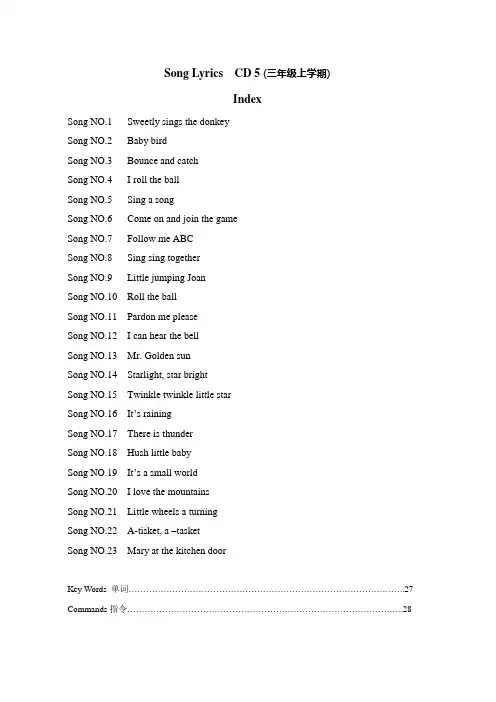
Song Lyrics CD 5(三年级上学期)IndexSong NO.1 Sweetly sings the donkeySong NO.2 Baby birdSong NO.3 Bounce and catchSong NO.4 I roll the ballSong NO.5 Sing a songSong NO.6 Come on and join the gameSong NO.7 Follow me ABCSong NO.8 Sing sing togetherSong NO.9 Little jumping JoanSong NO.10 Roll the ballSong NO.11 Pardon me pleaseSong NO.12 I can hear the bellSong NO.13 Mr. Golden sunSong NO.14 Starlight, star brightSong NO.15 Twinkle twinkle little starSong NO.16 It’s rainingSong NO.17 There is thunderSong NO.18 Hush little babySong NO.19 It’s a small worldSong NO.20 I love the mountainsSong NO.21 Little wheels a turningSong NO.22 A-tisket, a –tasketSong NO.23 Mary at the kitchen doorKey Words 单词 (27)Commands指令 (28)Song NO.1 Sweetly sings the donkeyLyrics:Sweetly sings the donkeyOn the break of dayIf you do not feed himThis is what he’ll sayHee haw!Hee haw!Hee haw hee haw hee haw hee haw!Key words:sweetly donkey feedDialogue1. A: What’s this? B: It’s a donkey.2. A: Do you like donkeys?B: Yes, I like donkeys.3. A: What does a donkey say?B: A donkey says “hee haw”4. A: Who can you feed?B: I can feed a baby/donkey.5. A: Do you like sweet food?B: Yes, I like sweet food.6. A: How can you feel happy?B: If I can fly, then I am very happy!Song NO.2 Baby birdLyrics:Here’s a baby birdie.He’s hatching from his shell.Out comes his head.And then comes his tail.Now his legs he stretches.His wings he gives a flap.Then he flies and flies and flies.Now what do you think of that!Down down down down down. Boom!Key words:baby bird hatch shell head tailleg stretch wing flag flyDialogue1. A: What’s this? B: It’s a baby bird.2. A: What comes out? B: His head comes out,and his tail comes out.3. A: Do you have wings? B: No, I don’t have wings.4. A: Can you stretch? B: Yes, I can stretch.5. A: Can you fly? B: No, I can’t fly.Song NO.3 Bounce and catchLyrics:Bounce and catch and pass it on.Bounce and catch and pass it on.Bounce and catch and pass it on.Everybody turn around.Bounce and catch and pass it on.Bounce and catch and pass it on.Bounce and catch and pass it on.Everybody turn around.Commands:1.Bounce the ball. 弹回球。

CET4 词汇(四.1)1.How close parents are to their children _____ a strong influence on thecharacter of the children.A) have C) having B) has D) to have2. Helen was much kinder to her younger child than she was to the other, _____,of the course, made the others jealous.A) who C) what B) that D) which3. _____ is known to the world, Mark Twain is a great American writer.A) That C) As B) Which D) It4. You will want two trees about ten feet apart, from _____ to suspend youtent. A) there C) that B) them D) which5. In some countries, _____ is called "equality" does not really mean equalright for all people. A) which C) that B) one D) what6. I had just started back for the house to change my clothes _____ I heardvoices. A) as C) after B) while D) when7. The mere fact _____ most people believe nuclear war would be madness doesnot mean that itwill not occur. A) that C) what B) which D) why8. _____ that the trade between the two countries reached its highest point.A) During the 1960's B) It was in the 1960'sC) That it was in the 1960's D) It was the 1960's9. I hope all the precautions against air pollution, _____ suggested by thelocalgovernment, will be seriously considered here.A) while B) Since C) After D) As10. I've never been to Beijing, but it's the place ______.A) where I'd like to visit B) I most want to visitC) In which I'd like to visit D) that I want to visit it most11. They are teachers and don't realize _____ to start and run a company.A) what it takes B) what takes itC) what they take D) what takes them12. I have kept that portrait _____ I can see it every day, as it always reminds me of my university days in London. A) which B) where C) whether D) when13. _____ might be expected, the response to the question was very mixed.A) As B) That C) It D) What14. By success I don't mean_____ usually thought of when that word is used.A) what is B) that we C) as you D) all is15. As_____ announced in today's papers, the Shanghai Export Commodities Fair is Also open on Sunday.A) being B) is C) to be D) been16. Although he knew little about the large amount of work done in the field, hesucceeded_____ other more well-informed experiments failed.A) which B) that C) what D) where17. Living in the central Australian desert has its problems, ______ obtaining water is not the least.A) for which B) to which C) of which D) in which18. A survey was carried out on the death rate of new-born babies in thatregion, _____were surprising. A) as results B) which results C) the results of it D) the results of which六.非谓语、独立主格(一)19. A new technique _____, the yields as a whole increased by 20 per cent.A) working out B) having worked outC) having been worked out D) to have been worked out20. ______ with the size of the whole earth, the highest mountain does not seem high at all.A) When compared B) Compare C) While comparing D) Comparing21.The children went there to watch the iron tower _____.A) to erect B) erecting C) be erected D) being erected22. The manager promised to keep me_____ of how our business was going on.A) to be informed B) on informing C) informed D) informing23. John regretted ______ to the meeting last week.A) not going B) not to go C) not having been goingD) not to be going24. Mrs. Brown is supposed_____ for Italy last week.A) to have left B) to be leaving C) to leave D) to have been left25. The match was cancelled because most of the members_____ a match withouta standard court.A) objected to having B) were objected to haveC) objected to have D) were objected to having26. The teacher doesn't permit_____ in class.A) smoke B) to smoke C) smoking D) to have a smoke27. I appreciate_____ to your home.A) to be invited B) to have invitedC) having invited D) being invited28. The speaker, _____ for her splendid speeches, was warmly received by the audience. A) having known B) being known C) knowing D) known29. After ______ for the job, you will be required to take a language test.A) being interviewed B) interviewedC) interviewing D) having interviewed30. Mr. Johnson preferred______ heavier work to do.A) to be given B) to be giving C) to have given D) having given31. I remember _____ to help us if we ever got into trouble.A) once offering B) him once offeringC) him to offer D) to offer him32.Mark often attempts to escape _____, whenever he breaks traffic regulations. A) having been fined B) to have been finedC) being fined D) to be fined33. No matter how frequently _____, the works of Beethoven always attract largeaudiences. A) performed B) performing C) to be performed D) being performed 34. Jean did not have time to go to the concert last night because she was busy_____ forher examination.A) to prepare B) to be prepared C) preparing D) being prepared35. I would appreciate _____ it a secret.A) you to keep B) your keeping C) that you keepD) that you will keep36. Your hair wants _____. You'd better have it done tomorrow.A) cut B) cutting C) to cut D) being cut37. _____ , a man who expresses himself effectively is sure to succeed more rapidly than a man whose command of language is poor.A) Other things to be equal B) Were other things equalC) To be equal to other things D) Other things being equal38. The man in the corner confessed to _____ a lie to the manager of the company.A) have told B) having told C) being told D) be told39.______ such a good chance, he planned to learn more.A) To be given B) Having been given C) Having given D) Giving40. The project, _____ by the end of 2000, will expand the city's telephone network to cover 1,000,000 users.A) accomplished B) being accomplishedC) to be accomplished D) having been accomplished41. Ann never dreams of _____ for her to be sent abroad very soon.A) there being a chance B) there to be a chanceC) there be a chance D) being a chance42. All things _____, the planned trip will have to be called off.A) considered B) be considered C) considering D) having considered.CET4 词汇(四.2)非谓语、独立主格(二)43.A Dream of the Red Chamber is said ______into dozens of languages in the lastdecade. A) to have been translated B) to translateC) to be translated D) to have translated44. The speech ______, a lively discussion started.A) being delivered B) be deliveredC) was delivered D) having been delivered45. _______the earth to be flat, many feared that Columbus would fall off the edge of theearth.A) Having believed B) Believing C) Believed D) Being believed46. If I correct someone, I will do it with as much good humor and self-restraint as if I were the one ______.A) to correct B) correcting C) having corrected D) being corrected47. The ancient Egyptians are supposed ______rockets to the moon.A) to send B) to be sending C) to have sent D) to have been sending48. There's a man at the reception desk who seems angry and I think he means______ trouble. A) making B) to have made C) to make D) having made答案:BDCDD DABDB ABAAB DCDCA DCAAA CDDAABCACB BCBBC AACDB DCC。

Unit 22A Aspects of LovePart OneA. 1. c 2. b 3. d 4. a 5. cB. 1. love marriages appear to be on the rise, often in defiance of parents' wishes在印度,传统上婚姻都是由新娘新郎的父母包办的。
但现在自由恋爱婚姻呈上升趋势,而且常常是违背父母意愿的。
2. they would marry someone with all the right qualities; too important a step to leave to chance在一份对印度大学生的问卷调查中,76%的人说他们愿意和一个具备所有优良品格的人结婚,即使不爱他/她也没关系。
因为人们认为婚姻太重要了,不能出任何纰漏。
3. not so much because of the future we hope to build; because of the past we hope to live again根据这个理论,我们爱我所爱并非是因为期待共建未来,而是因为期待重新体验过去。
Part TwoAnswers will vary. Sample answers:1. Because she had been in love twice and she wanted to better understand her own experiences of love's overwhelming power.2. Serotonin is a powerful chemical in the brain and body that is connected with our moods, emotions and desires. Her conclusion was that love and mental illness may be difficult to tell apart.3. Helen Fisher has been looking at love with the aid of an MRI machine. She discovered that love increases a chemical called dopamine, which lights up (stimulates) the areas of the brain linked to reward and pleasure.4. Fisher says that relationships frequently break up after about four years because that's about how long it takes to raise a child through infancy. A couple only needs to stay together long enough to raise the child they bring into this world.5. Oxytocin, a hormone our body produces that promotes mutual feeling of connection and bonding. According to Helen Fisher, couples should make an effort to keep close and frequent physical contact as this can trigger the production of more oxytocin so that they feel closer to each other.After You ListenA. 1. has become the norm2. in defiance of government regulations3. have a greater inclination to cheat4. are inherent in our educational system5. We have to recruit new members to our clubB. Answers will vary.Part One文本Love: A Chemical Reaction?Some anthropologists once thought that romance was a Western idea, developed in the Middle Ages. Non-Western societies, they thought, were too occupied with social and family relationships for romance. Today, scientists believe that romance has existed in human brains in all societies since prehistoric times. In one study, for example, men and women from Europe, Japan, and the Philippines were asked to fill out a survey to measure their experiences of passionate love. All three groups said that they felt passion with the same extreme intensity.But though romantic love may be universal, its cultural expression is not. To the Fulbe people of northern Cameroon, men who spend too much time with their wives are insulted and looked down on. Those who fall deeply in love are thought to have fallen under a dangerous spell. For the Fulbe, to be controlled by love is seen as shameful. In India, marriages have traditionally been arranged, usually by the bride and groom's parents, but today love marriages appear to be on the rise, often in defiance of parents' wishes. The victory of romantic love is celebrated in Bollywood films. However, most Indians still believe arranged marriages are more likely to succeed than love marriages. In one survey of Indian college students, 76 percent said they would marry someone with all the right qualities even if they weren't in love with the person. Marriage is considered too important a step to leave to chance.Finding the Right PersonSome psychiatrists, such as Thomas Lewis from the University of California, hypothesize that romantic love is rooted in experiences of physical closeness in childhood -- for example, how we felt in our mother's arms. These feelings of comfort and affection are written on our brain, and as adults our constant inclination is to find them again. According to this theory, we love whom we love not so much because of the future we hope to build, but rather because of the past we hope to live again. The person who "feels right" has a certain look, smell, sound, or touch that activates very deep memories.Evolutionary psychologists explain, however, that survival skills are inherent in our choice of a mate. According to this hypothesis, we are attracted to people who look healthy -- for example, a woman with a 70 percent waist-to-hip ratio is attractive because she can likely bear children successfully. A man with rugged features probably has a strong immune system and therefore is more likely to give his partner healthy children.On the other hand, perhaps our choice of a mate is a simple matter of following our noses. Claus Wedekind of the University of Lausanne in Switzerland conducted an interesting experiment with sweaty T-shirts. He asked 49 women to smell T-shirts previously worn by a variety of unidentified men. He then asked the women to rate which T-shirts smelled the best and which the worst. He found that women preferred the smell of a T-shirt worn by a man who was the most genetically different from her. This genetic difference means that it is likely that the man's immune system possesses something hers does not. By choosing him as the father of her children, she increases the chance that her children will be healthy.A. Multiple Choice.Question 1. What example best illustrates the statement "though romantic love may be universal, its cultural expression is not"?Question 2. Why do most Indians prefer arranged marriages?Question 3. Which of the following best expresses Thomas Lewis' theory? Question 4. According to evolutionary psychology, why would a woman choose a man with rugged features?Question 5. What seems to be a woman's great concern in the choice of a mate according to Claus Wedekind's experiment?B. Dictation and Translation.1. In India, marriages have traditionally been arranged, usually by the bride and groom's parents, but today love marriages appear to be on the rise, often in defiance of parents' wishes.2. In one survey of Indian college students, 76% said that they would marry someone with all the right qualities even if they weren't in love with the person. Marriage is considered too important a step to leave to chance.3. According to this theory, we love whom we love not so much because of the future we hope to build, but rather because of the past we hope to live again.Part Two 文本Is It All Just Chemicals?According to other researchers, love may be caused by chemicals in the body. Donatella Marazziti, a professor at the University of Pisa in Italy, has studied the biochemistry of lovesickness. Having been in love twice herself and felt its overwhelming power, Marazziti became interested in exploring the similarities between love and obsessive-compulsive disorder (OCD).Marazziti examined the blood of 24 people who had fallen deeply in love within the past six months, and measured their levels of serotonin. Serotonin is a powerful chemical in the brain and body that is connected with our moods, emotions, and desires. She found that their levels of serotonin were 40 percent lower than normal people -- the same results she found from people with OCD. Her conclusion was that love and mental illness may be difficult to tell apart.Another scientist, anthropologist Helen Fisher, from Rutgers University, U.S.A., has been looking at love with the aid of an MRI machine. She recruited subjects who were "madly in love," and once they were inside the MRI machine, she showed them two photographs, one neutral, the other of their loved one.What Fisher saw fascinated her. When each subject looked at his or her loved one, the parts of the brain linked to reward and pleasure "lit up." Love "lights up" these areas using a chemical called dopamine. Dopamine creates intense energy, exhilaration, focused attention, and motivation to win rewards.Dopamine levels do eventually drop, though, and studies around the world confirm that a decrease in passion is the norm.Fisher has suggested that relationships frequently break up after about four yearsbecause that's about how long it takes to raise a child through infancy. Passion, that wild feeling, turns out to be practical after all. A couple not only needs to bring a child into this world; they also need a bond that continues long enough to raise a helpless human infant.Maintaining LoveEventually, all couples find that their passion declines over time. For relationships that get beyond the initial stage of passion to have a real chance of lasting, a chemical called oxytocin may be the key. Oxytocin is a hormone our body produces that promotes mutual feelings of connection and bonding. It is produced when we hug our long-term husbands and wives or our children. In long-term relationships that work, oxytocin is believed to be abundant in both partners. According to Helen Fisher, couples who want their relationships to last should make an effort to keep a close physical relationship. Through frequent physical contact, they can trigger the production of more oxytocin -- and in this way feel closer to each other.2B Animal AttractionBefore You Listen1. F2. T3. NG4. T5. FListening ComprehensionA. 1. b 2. a 3. c 4. d 5. cB. Some answers will vary. 1. to attract / impress a female bird of paradise so as to be chosen as her mate; 2. male birds of paradise; 3. the dense and humid jungle of New Guinea; 4. remarkably complex dances on the ground; 5. "butterfly dance"; 6. "ballerina dance"; 7. Brightly colored feathers; 8. "sexual selection"; 9. Diversity;10. the demand for the birds' beautiful feathers; 11. Large farms; 12. Oil prospecting and mining;13. encouraging protection of the birds' habitatAfter You ListenA. 1. species 2. ritual 3. bouncing 4. prominent5. absurd6. dense7. harsh8. evokedB. Answers will vary.文本Feathers of LoveCovered in soft, black feathers, the noble performer bows deeply to his audience. From the top of his head grow several long feathers that tap the ground as he begins his dance. This dancing bird is Carola's parotia, just one of the fascinating and unique birds of paradise that live on the island of New Guinea. What is the reason for the dance show? This male bird is attempting to impress a row of females that are watching him from a branch above.Keeping the females' attention isn't easy, so he really gives it his all. He pauses for dramatic effect, then commences his dance again. His neck sinks and his head moves up and down, head feathers bouncing. He jumps and shakes his feathers until his performance attracts the attention of one of the females -- the one that will be his mate.An Amazing PerformanceIn the dense and humid jungle of New Guinea is nature's most absurd theater, the very special mating game of the birds of paradise. To attract females, males' feathers resemble costumes worthy of the stage. The bright reds, yellows, and blues of their feathers stand out sharply against the green of the forest. It seems that the more extreme the male's costume and colors, the better his chance of attracting a mate.Not only do most male birds of paradise have extremely beautiful feathers, they know how to use them. Each species has its own type of display behavior. Some dance remarkably complex dances on the ground, in areas that they have cleared and prepared like their own version of a dance floor. Others perform their display high in the trees.The male red bird of paradise shows off his delightful red and yellow feathers in a display sometimes called a "butterfly dance," spreading and moving his wings intensely like some giant butterfly. The male Carola's parotia has at least six different dance moves, including one in which he spreads out his feathers like a dress in a move called the "ballerina dance." While some birds of paradise perform alone, others, like Goldie's birds of paradise, often perform together, creating an eye-catching performance that female birds find impossible to resist. Hanging from nearby branches, male Goldie's birds prominently display the clouds of soft red feathers that rise from their backs as they flap their wings with great energy. Excited females soon arrive to choose the one that pleased them the most.The Evolution of ColorThese brilliantly colored birds of paradise have evolved over millions of years from ancient birds whose feathers were dark and boring in comparison. Of today's 38 brightly colored birds of paradise species, 34 of them live only on New Guinea and the surrounding islands. These birds of paradise invite us to solve a mystery of nature. It seems to be a contradiction that such extreme feathers and colors could have been favored by the process of evolution. After all, these same brightly colored feathers that attract mates also make them much more noticeable to predators and slow the birds down, making fleeing from those predators more difficult. The answer lies in the safe environment in which the birds live, and a process of evolution known as "sexual selection.""Life here is pretty comfortable for birds of paradise. The island's unique environment has allowed them to go to extremes unheard of elsewhere," says biologist Ed Scholes of New York's Museum of Natural History. Under harsher conditions, he says, "evolution simply wouldn't have come up with these birds." Fruit and insects are abundant all year in the forests of New Guinea, and predators are few. The result is a perfect environment for birds. Sexual selection has thus been the driving force in the evolution of birds of paradise. Freed of other pressures, birds of paradise began to specialize in attracting mates. Over millions of years, they have slowly undergone changes in their color, feathers, and other talents. Characteristics that made one bird more attractive than another were passed on and enhanced over time. "The usual rules of survival aren't as important here as the rules of successful mating," Scholes adds.The diversity of New Guinea's birds also springs from its varied environments: fromhumid coastal plains to high-elevation cloud forests, from swamps to mountains rising as high as 5,000 meters (16,000 feet). The landscape has many physical barriers that isolate animal populations, allowing them to develop into separate and distinct species.Bird Performers, Human DancersThe people of New Guinea have been watching the displays of the birds of paradise for centuries. "Locals will tell you they went into the forest and copied their rituals from the birds," says anthropologist Gillian Gillison of the University of Toronto, who lived among New Guinea tribes for more than a decade. At local dance performances, now more tourist entertainment than true ritual, the painted dancers still evoke the birds with their movements and beautiful costumes. "By wearing the feathers," Gillison says, "... you capture the animal's life force. It makes you a warrior."In the past, demand for the birds' beautiful feathers resulted in a huge amount of hunting. At the peak of the trade, in the early 1900s, 80,000 skins a year were exported from New Guinea for European ladies' hats. However, surprisingly few birds die for these costumes nowadays. Ceremonial feathers are passed down from generation to generation. Local people are still permitted to hunt birds of paradise for traditional uses. However, hunters usually target older male birds, leaving younger males to continue breeding.There are more serious threats to the birds' welfare. An illegal market in feathers still exists. Large farms use up thousands of acres of forest where birds of paradise once lived, as does large-scale industrial logging. Oil prospecting and mining also present dangers to New Guinea's wildest forests. Meanwhile, human populations continue to grow. Land is owned by different local families whose leaders disagree about which areas should be protected.However, there may be some good news for the birds. David Mitchell, a conservationist, is using local villagers to record where the birds display and what they eat. He hopes not only to gather data, but also to encourage protection of the birds' habitat. The strategy seems to be working. "I had come to cut down some trees and plant yam vines," says Ambrose Joseph, one of Mitchell's farmers. "Then I saw the birds land there, so I left the trees alone." For millions of years these impressive birds have danced to find their mates. They'll keep dancing for as long as the forest offers them a stage.A. Multiple Choice.Question 1. Why do birds of paradise dance and display their feathers? Question 2. What does the writer mean by the phrase "he really gives it his all"?Question 3. Which type of bird dances in a group?Question 4. Which factor is NOT mentioned as a reason for birds' unusual characteristics?Viewing The Love BirdBefore You ViewA. 1. canopy 2. courtship 3. perch 4. elaborateB. Answers will vary.Viewing ComprehensionA. 1. dense 2. species 3. elaborate 4. affection 5. evoke6. mutual7. harsh8. inclined9. prominent 10. recruitB. Identifying. First bird: a, c; Second bird: d, e; Third bird: b, f Describing. Answers will vary. Sample Answers:a. His chances are ruined by some amateur males practicing their own dances nearby.b. He finishes off with a victorious pose.c. This male bounces from side to side with its wings outstretched, desperate to gain the female's attention.d. He makes a brave attempt to woo the object of his affections with his passionate performance.e. Another male riflebird sounds his mating call from a perch high in the canopy.f. Some kinds of riflebirds can even clap their wings to produce a sound that can be heard up to 60 meters away.After You ViewA. Answers will vary.B. Answers will vary.。