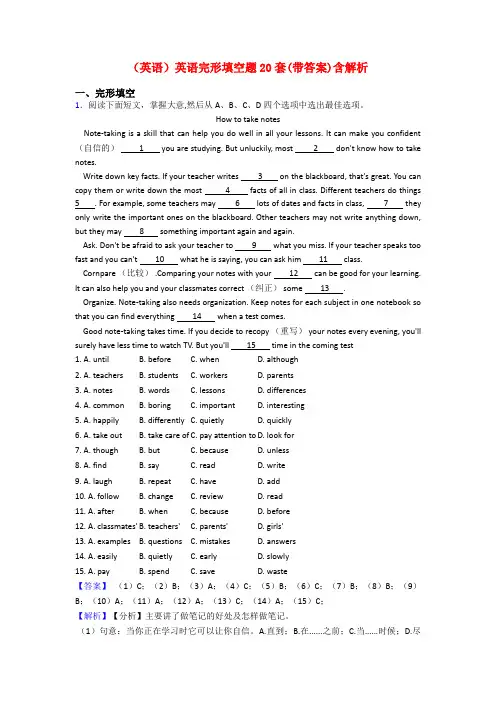
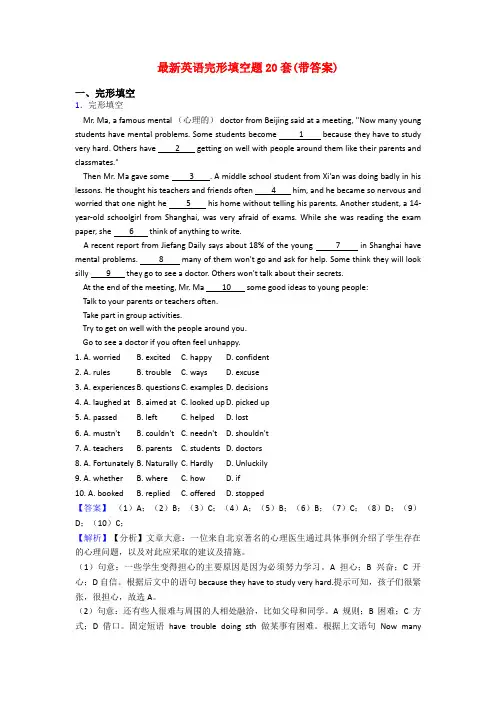
完形填空题
- 格式:doc
- 大小:71.00 KB
- 文档页数:21
完形填空题Unit 1Modern philosophers do not say much about friendship, but ancient philosophers thought it was essential to ethics(伦理学、道德学) and the good life. They also did not think men and women could have 1 , with which most people might 2 today. For Aristotle, friendship was a necessary part of a healthy, well 3 life, the good life. Ken points out that we owe something 4 our friends; what happens if the obligations 5 with one's morality There is clearly a philosophical concern 6 friendship. John asks whyliving a life by yourself is not simply sufficient, why are friends 7 For Martha Nussbaum, friendship is about 8 the things we care about. She says that one can understand the things one cares about 9 when that person shares it with others, where we can help someone for his/her own 10 .All this sharing is nice, but Ken asks about friends we keep, with 11 we have large 12 over politics orreligion for instance. Clearly there is a difference here. Martha notes that there are different 13 for friendships, some are for pleasure, shared business, or deeper goals, things that make your life 14 .There is also a moral significance behind friendship 15 what you owe your friends or they 16 you. For Martha, the most important factor is giving time to another person. The American legal system also regards the secrets shared in a relationship like a marriage as 17 for friendship. Thereis also a 18 of empathy(同感,共鸣) and sympathy for friends.Is friendship a genetic 19 Ken believes we are coalition-forming(组合,结合) creatures, and that humans morally flourish by 20 another as a mirror, who also has concern for you.1. A) friendship B) love C) children D) morality2. A) disapprove B) discuss C) disallowD) disagree3. A) functioned B) functioning C) functions D) function4. A) with B) for C) on D) to5. A) conflict B) fight C) oppose D) compete6. A) under B) beyond C) behind D) outside7. A) called B) claimed C) demanded D) needed8. A) sharing B) allotting C) dividing D) possessing9. A) more B) forever C) worse D) better10. A) account B) sake C) favour D) interest11. A) that B) which C) whom D) them12. A) disagreements B) arguments C) misunderstandings D) conflicts13. A) bottoms B) bases C) roots D) stands14. A) hopeful B) dependent C) meaningful D) companied15. A) viewing B) including C) regarding D) accounting16. A) owe B) lend C) debt D) help17. A) serious B) urgent C) crucial D) fateful18. A) place B) role C) point D) part19. A) trait B) code C) leftover D) material20. A) depending B) trusting C) holding D) havingCloze1. A2. D3. B4. D5. A6. C7. D 8. A 9. D 10. B11. C 12. A 13. B 14. C 15. C 16. A 17. C 18. B 19. B20. DUnit 2eenagers in love have a higher risk for depression, alcohol problems and delinquency than those who do not get romantically involved. And 1 girls, especially younger ones, are ata(n) 2 higher risk for depression than boys.The greater 3 of teen girls to romances might explain, 4 , 5 females begin 6 higher ratesof depression in adolescence than males. The analysis of almost 8,200 teens is the first nationally representative study to 7 the impact of romantic relationships 8 adolescent depression, 9 is often used as an indicator of adolescent well-being and has also been linked to well-beingin young adulthood, including depression, early marriage and marital dissatisfaction.Using a sample of . teens in grades 7 through 12 in 134 public, 10 and parochial schools from the National Longitudinal Study of Adolescent Health, the researchers analyzed 11 in the teens' romantic and psychological 12 between two interviews about one year 13 . They found that adolescents who were romantically involved during the year experienced a significantly larger increase in 14 of depression than adolescents who were not romantically involved. They also found that depression levels of romantically involved girls increased more sharply than 15 of romantically involved boys, especially among younger adolescents.Furthermore, the 16 interest that an adolescent expressed in romance, the 17 their increase in depression, 18 with their counterparts who showed no or little interest. In analyzing why romantically inclined teenagers are at risk for depression, the researchers find that some experience significant downturns in their relationships with their parents, some begin faltering at school and some experience 19 relationships. 20 , both adolescent boys and girls who "fall in love" experience more alcohol problems and delinquency than those with no history of romantic involvement.1. A) love-sick B) sensitive C) introvert D) extrovert2. A) more B) much C) evenD) evidently3. A) sensibility B) vulnerability C) sensitivity D) intelligence4. A) for some extent B) in great extent C) on an extent D) to a great extent5. A) how B) what C) that D) why6. A) exhibiting B) identifying C) representing D) possessing7. A) reveal B) examine C) research D) show8. A) in B) on C) to D) at9. A) which B) that C) what D) it10. A) high B) primary C) private D) secondary11. A) tendencies B) possibilities C) situations D) changes12. A) state B) condition C) status D) identity13. A) ago B) before C) later D) apart14. A) symptoms B) syndromes C) expressions D) reactions15. A) which B) those C) that D) what16. A) lower B) higher C) more D) less17. A) less B) more C) smaller D) larger18. A) compared B) comparing C) contrasted D) contrasting19. A) long B) short C) unstable D) perfect20. A) Nevertheless B) In addition C) As a result D)On the contraryCloze1. A2. C3. B4. D5. D6. A7. B 8. B 9. A 10. C11. D 12. C 13. D 14. A 15. B 16. C 17. D 18. A 19. C20. BUnit 3A British team has begun an exhausting trek to the North Pole to discover how quickly the Arctic sea-ice is 1 .Renowned Arctic explorer Pen Hadow and two companions were dropped onto the ice by plane 800km off the northern coast of Canada on Saturday. During their 1,000km journey they plan to take 2 of the thickness of the ice. It will be the most detailed survey of its kind this season, and should be completedin late May.BBC environment correspondent David Shukman said that 3 there were gaps in the ice, the team would put on survival suits and swim. At the rear of one sledge is a mobile radar unit which will constantly measure the 4 of the ice. Satellites have shown how the area of Arctic sea-ice has been shrinkingin recent years, but this expedition should give scientists a better idea of how thin the ice is becoming.The sea-ice is widely believed to be melting at a(n) 5 rate because of warmer air temperatures above the ice and because of warmer waters 6 it. The major scientific institutions and agencies that study the Arctic 7 the changes to global warming. A few years ago, researchers 8that by the end of this century the Arctic could be 9 icein summer. Some now say that could come far sooner.Mr. Hadow and the other members of the British Catlin Arctic Survey group will attempt to gather important new data about the 10 of the ice in winter and early spring -- when the ice reaches its greatest 11 . It is intended to give scientists the very latest "ground truth", to better constrain their models and their interpretation of the 12 coming from satellites.Arctic ice modeller Professor Wieslaw Maslowski, a science adviser to the survey, hopes the data will enable him to 13 his forecast of when the first ice-free summer might arrive. Currently, he has it down for 2013 -- but with an uncertainty range between 2010 and 2016.Mr. Hadow became the first person to trek alone and without support from Canada to the North Pole in 2003. He said this expedition would be about science and discovery."We're making the surface journey because that's the only way we have 14 gathering these 15 observations of how thick the ice is. That's what the scientists really needto know." He added: "If the ice is thinning quickly, then it should 16 alarm bells ringing around the world." He said each member of the team would be dragging a sledge 17 upto 120kg for about 12 hours a day.And his biggest fear was the 18 of having to swim with all his equipment for up to two hours at a time in darkness. They will be 19 every 20 to 25 days on their mission but have had to 20 on excess weight because, although they will be taking in 6,000 calories a day, they will be using up around 7,500.1. A) lowering B) thickening C) melting D) missing2. A) notice B) data C) samples D) measurements3. A) which B) if C) where D) when4. A) thickness B) extent C) width D) size5. A) decreased B) increasing C) steady D) increased6. A) under B) around C) surrounding D) below7. A) connect B) attribute C) contribute D) link8. A) believed B) foresaw C) predicted D) announced9. A) full of B) free of C) lack of D) no10. A) state B) situation C) status D) presence11. A) extension B) expansion C) extent D) existence12. A) observations B) information C) truth D) data13. A) confine B) prove C) refine D) restrain14. A) in B) of C) to D) with15. A) direct B) exhausting C) detailed D) surface16. A) send B) set C) cause D) make17. A) weighed B) weight C) weighing D) overweighed18. A) danger B) plan C) prospect D) requirement19. A) back B) fed C) re-supplied D) treated20. A) gain B) carry C) live D) put1. C2. D3. C4. A5. D6. D7. B 8. C 9. B 10. A11. C 12. A 13. C 14. B 15. A 16. B 17. C 18. C 19. C20. DUnit 4Perhaps the most fundamental 1 of psychodynamic theory is that what you see is not what you've got. Behavior and even 2 , insofaras they are 3 , are only the surface. The truth lies beneath, in inner and, usually, 4 causes. It is in this matter of causative focus that behavioral psychology departs most 5 from psychodynamic thought. For the behaviorists, the most important causesof behavior are proximal causes, causes that lie 6 the behavior itself and can therefore be readily 7 .As in many other quarrels among the various 8 , the differenceis a matter of 9 . 10 , it is a very big difference. Faced witha student who is 11 following a poor showing on an exam, a psychodynamic theorist would not ignore the fact of the exam, but would consider it a jumping-off point for more fundamental 12 : How did failure during childhood 13 his relationship with his parents And what are the chances that his true 14 is not perhaps depression but something that the depression is covering -- anger, for example, at his parents Faced with the same student, the behavioral theorist would not ignore childhood experiences with failure, but would be more interested in current experiences: What did the student say to himself before the exam, and after What circumstances in his environment 15 the failure, and what current 16 and circumstances may be operating to 17 the response of depression.This difference in focus between psychodynamic and behavioral theorists is 18 in their methods. Psychodynamic theorists, interested in the inner reaches of the psyche, must 19 forgo scientific verifiability. The behaviorists' proximal focus, 20 ,is in part the result of their insistence on scientific method.1. A) development B) assumption C) conception D) conclusion2. A) feelings B) thoughts C) ideas D) dreams3. A) conceived B) conscious C) intentional D) deliberate4. A) direct B) possible C) remote D) ultimate5. A) extremely B) basically C) revolutionarily D) radically6. A) far from B) close to C) upon D) beneath7. A) observed B) identified C) discovered D) recognized8. A) perspectives B) opinions C) viewpoints D) theories9. A) view B) stress C) attention D) emphasis10. A) Otherwise B) Whereas C) Nevertheless D) Consequently11. A) disappointed B) disappointing C) depressed D) depressing12. A) explorations B) exploration C) researches D) research13. A) influence B) effect C) impact D) affect14. A) mood B) emotion C) feelings D) reaction15. A) may cause B) may have caused C) would have caused D) have caused16. A) perceptions B) experiences C) situations D) conceptions17. A) stimulate B) enhance C) increase D) encourage18. A) demonstrating B) demonstrated C) reflected D) reflecting19. A) frequently B) always C) constantly D) continuously20. A) however B) as a result C) namely D) by contrastCloze1. B2. A3. B4. C5. D6. B7. B 8. A 9. D 10. C11. C 12. A 13. D 14. B 15. B 16. A 17. D18. C 19. A 20. DUnit 5This week the world's 1 passenger car was launched in Mumbai, India. The Nano, made by Tata Motors, is expected to cause a transportation 2 for millions of Indian families.The small four-door car is about three meters long. It will cost one hundred thousand Indian rupees, 3 two thousand dollars. That is about 4 the price of similar cars 5 by the nearest competitor. The Nano is expected to make car ownership 6 for more of India's population. So it is being called "The People's Car." Tata Motors chairman, Ratan Tata, says that was his main goal in building the Nano.He also said, "It was 7 conceived of as being the cheapest car. It was conceived of as being a car that would give the people of India an opportunity to own a car that had not been within their 8 before.I hope that is what we will achieve."The Nano is a very 9 car. The lowest-priced version does not include a radio or air conditioning. It has a six hundred twenty-fourcubic centimeter, thirty-five horsepower, gas-powered engine. Still, itis a 10 vehicle in a country where many families of three or four people ride two-wheeled vehicles.Industry observers 11 that soon roads throughout the country could be filled with Nanos. Tata, India's top automaker, has done almost no traditional advertising of the Nano. 12 , early interest in the vehicle has been huge. The company says the Nano's Website has been visited thirty million times.Tata Motors says it will begin 13 orders for the car on April9th both at car dealerships and on the Internet. However, the cars will not be ready for purchase until July. 14 is expected to be far greater than supply.Ratan Tata says the first one hundred thousand buyers of the car will be chosen 15 . 16 of the Nano has been delayed for several months. Land protests last year forced the company to close its factoryin the Indian state of West Bengal. A new factory is being built in the state of Gujarat.The car is expected to be popular in industrial as well as 17 nations. The company says it plans to sell a version of the Nano in Europein 2011. After 18 , the car will also be available in the United States. Experts say demand for low-priced automobiles 19 likelyto increase as the international economic crisis continues.However, the Nano also has its 20 . Some say the new cars will increase India's traffic and pollution problems. However, Tata company officials say the Nano will produce less pollution than any other carin the country.1. A) lowest-pricing B) highest-price C) lowest-priced D) highest-priced2. A) reform B) transformation C) revolution D) progress3. A) / B) or C) and D) that is4. A) half B) half of C) twice D) nearly5. A) provided B) given C) offered D) asked6. A) realize B) likely C) possible D) impossible7. A) not only B) used to C) ever D) never8. A) reach B) ability C) power D) dream9. A) cheap B) common C) simple D) small10. A) wanted B) welcomed C) needed D) welcoming11. A) conclude B) guess C) predict D) estimate12. A) But B) Still C) However D) While13. A) receiving B) accepting C) following D) taking14. A) Sales B) Demand C) Purchase D) Order15. A) by chance B) accidentally C) in order D) by them16. A) Advertising B) Production C) Sales D) Supply17. A) developed B) other C) developing D) African18. A) that B) it C) which D) what19. A) are B) will C) is D) will be20. A) criticism B) enemy C) pessimists D) criticsCloze1. C2. C3. B4. A5. C6. C7. D8. A9. C 10.B11. C 12. C 13. D 14. B 15. A 16. B 17. C 18. A 19. C 20.DUnit 6Stereotyping can have 1 negative effects, especially when educators or managers make fewer attempts to 2 those of other cultures because they 3 not to expect participation! Or do not realize there may be something wrong when a student or employee of a different ethnicity makes little eye contact with them. Faye Lee, a 4 Japanese-American wrote: "How anyone can try to 5 about an entire continent of people, 6 all the Asian Americans and theinfinite permutations of people's differing experiences, is 7 me."As we interact with others of different cultures, there is no good 8 for receptiveness to interpersonal feedback, good observation skills, effective questions, and some common sense. There is 9to be gained by observing 10 people of the same culture interact with each other. Don't be afraid to ask questions as most people 11 very positively to inquiries about their culture. Ask 12 peopleso you can get a 13 view.Making a 14 effort to find the positive historical, literary, and cultural contributions of 15 ; learning a few polite expressions in another person's language; and showing appreciation16 the food and music of another culture can have especially positive effects.My contention, then, is not that there are no cultural differences. These differences between cultures and peoples are real and can 17 richness (and humor) to the fabric of life. My assertion is that people everywhere have much 18 , such as a need for affiliation and love, participation, and contribution. When the exterior is 19 , thereare not so many differences 20 .1. A) intense B) intensive C) intensified D) tense2. A) notice B) care C) involve D) concern3. A) have taught B) have been taught C) are teaching D) are taught4. A) concerning B) relating C) concerned D) relevant5. A) draw conclusions B) make generalizationsC) make assumptions D) give definitions6. A) and B) with C) as D) plus7. A) beyond B) in C) upon D) under8. A) substitution B) replacement C) choice D) substitute9. A) some B) many C) much D) few10. A) how B) why C) what D) when11. A) reply B) respond C) answer D) react12. A) a variety of B) a number of C) a lot of D) a few of13. A) different B) various C) general D) balanced14. A) true B) hard C) genuine D) real15. A) a nation B) a society C) a country D) a community16. A) to B) with C) in D) for17. A) add B) increase C) provide D) develop18. A) in essence B) in common C) difference D) in need19. A) removed B) torn out C) opened up D) peeled off20. A) in reality B) any way C) after all D) eventuallyClozeCloze1. A2. C3. B4. C5. B6. D7. A8. D9. C 10. A11. B 12. A 13. D 14. C 15. B 16. D 17. A 18. B 19. D 20.CUnit 7Amidst the athletes, medals, podiums and pride, rapt Olympics viewers may vaguely detect evidence of values that motivate the international athletic movement -- Olympics. Those viewers are onto something. There 1 are things called Olympic values, and they are 2 the viewpoints of Pierre de Coubertin, the founder of the modern Olympic Games.He believed that sport, which 3 one's ability to think and concentrate, can and 4 play a formative role 5 human development on a par with 6 , literature and the arts. Theself-control, adherence to rules, and 7 for others necessary in athletic pursuits, are also necessary off the playing field, 8 in the classroom, at work or at home. So when he set out to 9 the Olympic Games in 1894, he wanted to do 10 establish a modern sporting competition. He wanted to 11 an international movement that 12 sport and education and positioned sport as a model for peace and harmony. According to Coubertin, the Olympics should have a set of values that 13 all Olympic activities and can 14 well beyond the playing field, thereby distinguishing the Olympic Games 15 all other sporting events.This holistic approach towards sports taken by Coubertin 16 that taken by the ancient Greeks. Sports were not only essential for a well-rounded education but also necessary to help 17 the road towards greater harmony, understanding and peace in society. "Sport is Man's best way to achieve perfection in every 18 ," Coubertin said.Without losing focus of the ultimate goal of perfection, Coubertin emphasized, in the words of Aerosmith's Steven Tyler, that life's a 19 , not a destination. "The important thing in life is not the triumph, but the 20 ," said Coubertin. "The essential thing is not to have won, but to have fought well."1. A) actually B) frankly C) genuinely D) possibly2. A) dated from B) referred to C) built up D) based on3. A) enables B) enhances C) equips D) enlightens4. A) would B) must C) ought D) should5. A) in B) of C) at D) for6. A) politics B) language C) science D) experiments7. A) reward B) reform C) response D) respect8. A) whether B) where C) when D) what9. A) regulate B) reserve C) repeat D) revive10. A) other than B) more than C) better than D) rather than11. A) cause B) compete C) create D) coordinate12. A) combined B) shared C) compared D) exchanged13. A) undergoes B) underlies C) undertakes D) undermines14. A) expand B) increase C) extend D) enlarge15. A) off B) between C) from D) among16. A) reflects B) resists C) results D) renews17. A) create B) proclaim C) pave D) produce18. A) place B) respect C) point D) detail19. A) hiking B) voyage C) journey D) travel20. A) format B) failure C) fiber D) fightCloze1. A2. D3. B4. D5. A6. C7. D8. A9. D 10.B11. C 12. A 13. B 14. C 15. C 16. A 17. C 18. B 19. C 20.DUnit 8What can present single children do if they are 1 from televisions and the internet A survey has been 2 recently, which wants to find out what children can do 3 they are not allowed to watch television or play online games in 4 time. The survey includes Shi Yingjie and 23 other students in Shanghai. Children under the survey were 5 into three groups, those who cannot watch television, those who cannot play online games and those who cannot do either of them. A week is not long, 6 , for these students, they might experience a "lifetime" challenge 7 most of them like watching TV or playing games during their spare time. After reading students' 8 for the one week, Professor Lu, who helped organize the survey, found several problems: most children did not do many 9 activities 10 play with their mates; there is lack of public equipments or public places for children to play; and students should 11 more hobbies. Professor Lu said all children that took the survey are the only son or daughter in their families and the biggest difference 12 Chinese children and American children was 13 American children like to play outside 14 Chinese children do not. 15 ,American children are more likely to 16 the new environment easily. What is the secret Chinese children 17 most of their time 18 at home 19 , playing piano, do some reading or painting, etc, 20 their parents told them to do so.1. A) different B) left C) isolated D) parted2. A) given B) conducted C) included D) made3. A) what B) which C) when D) where4. A) a week's B) week C) the week's D) the week5. A) divided B) separated C) invited D) marked6. A) so B) however C) but D) moreover7. A) if B) thus C) so D) because8. A) writing B) dailies C) diaries D) homework9. A) indoor B) outside C) outdoor D) inside10. A) and B) but C) or D) with11. A) cultivate B) form C) nurture D) change12. A) with B) in C) for D) between13. A) that B) because C) due to D) lead to14. A) which B) while C) and D) although15. A) Because B) Even C) Therefore D) Since16. A) get used to B) adapt to C) be familiar with D)feel like17. A) have B) cost C) spend D) consume18. A) to play B) play C) playing D) played19. A) by their own B) by themselves C) in their own D) in themselves20. A) like B) which C) as D) thatCloze1. C2. B3. C4. A5. A6. B7. D8. C9. C 10. C11. A 12. D 13. A 14. B 15. C 16. B 17. C 18. C 19. B 20. C。