感官动词的用法
- 格式:doc
- 大小:38.39 KB
- 文档页数:4
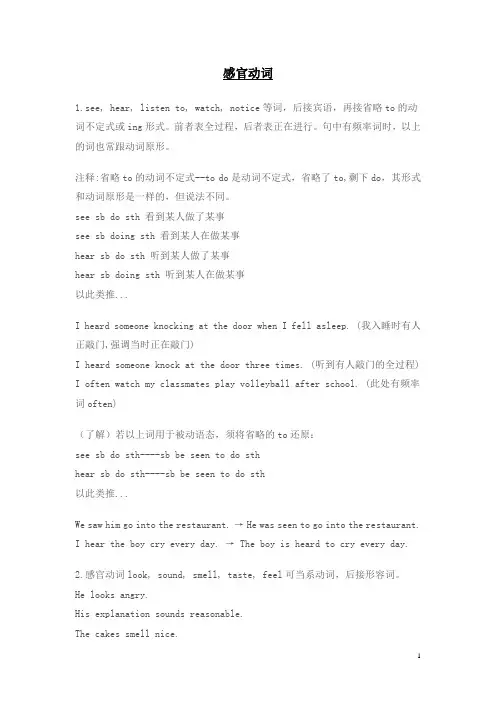
感官动词的用法
Sensory verbs play a crucial role in our everyday lives, as they allow
us to experience the world around us through our senses. These
verbs, such as see, hear, smell, taste, and touch, help us
communicate our perceptions and sensations to others. For example,
when we say "I see a beautiful sunset," we are using the sensory verb
"see" to convey our visual experience to someone else. These verbs
are essential for effective communication and are used in various
contexts, from descriptive writing to casual conversations.
感官动词在我们日常生活中起着至关重要的作用,因为它们使我们通过感官体验周围的世界。这些动词,例如看、听、闻、尝和触摸,帮助我们将自己的感知和感觉传达给他人。例如,当我们说“我看到了美丽的日落”时,我们使用感官动词“看”来向他人传达我们的视觉体验。这些动词对于有效沟通至关重要,它们在各种场景中使用,从描述性写作到随意对话。
Furthermore, sensory verbs not only allow us to convey our sensory
experiences but also help us evoke emotions and create vivid
imagery in writing. By using sensory verbs, writers can paint a picture
in the reader's mind and make their writing more engaging and immersive. For instance, instead of simply stating "the coffee tasted
good," a writer could use sensory verbs to describe the experience in
more detail, such as "the rich aroma of the coffee filled the air, and
the warm, velvety liquid danced on my taste buds." This level of
detail enhances the reader's experience and makes the writing more
impactful.
此外,感官动词不仅能够让我们传达我们的感官体验,还能够帮助我们唤起情感并在写作中创造生动的意象。通过使用感官动词,作者可以在读者的脑海中栩栩如生地绘制画面,使他们的写作更加引人入胜和沉浸式。例如,作者可以使用感官动词来描述体验,而不是仅仅陈述“咖啡味道不错”,比如“浓郁的咖啡香气弥漫在空气中,温暖而柔滑的液体在我的味蕾上起舞”。这种细节的描述增强了读者的体验,使写作更加有影响力。
Moreover, sensory verbs are not limited to describing physical
sensations but can also be used to convey emotions and feelings. For
example, the phrase "I feel overwhelmed" uses the sensory verb
"feel" to express an emotional state rather than a physical sensation.
By incorporating sensory verbs into language, we can more
effectively communicate our internal experiences and connect with
others on a deeper level. This allows for more nuanced and expressive communication, enhancing our ability to convey complex
emotions and thoughts.
此外,感官动词不仅局限于描述身体感觉,还可以用来表达情绪和感受。例如,“我感觉不知所措”这个短语使用感官动词“感觉”来表达一种情绪状态,而非身体感觉。通过将感官动词融入语言中,我们可以更有效地传达内在体验,并在更深层次上与他人建立联系。这样可以实现更加细致和有表现力的沟通,增强我们传达复杂情绪和思想的能力。
On a sensory level, these verbs allow us to engage with the world in
a more meaningful way, as they enable us to fully experience our
surroundings and appreciate the beauty and complexity of our
environment. Whether it's the sound of birds chirping in the morning,
the taste of a home-cooked meal, or the feel of a loved one's hand in
ours, sensory verbs help us connect with the world on a sensory and
emotional level. They enrich our experiences, making the mundane
moments of life more vibrant and significant.
在感官层面上,这些动词使我们能够以更有意义的方式与世界互动,因为它们让我们能够充分体验周围的环境,欣赏美丽和复杂性。无论是清晨鸟儿鸣叫的声音,家常饭菜的味道,还是爱人手拉着我们的感觉,感官动词帮助我们在感官和情感层面上与世界建立联系。它们丰富了我们的体验,使生活中那些平凡的时刻变得更加丰富多彩和重要。
In conclusion, sensory verbs are powerful tools that help us engage
with the world, convey our experiences, evoke emotions, and
connect with others on a deeper level. By incorporating sensory
verbs into our communication, we can enrich our interactions,
enhance our writing, and deepen our understanding of ourselves and
the world around us. These verbs are not just words on a page but a
gateway to experiencing life in all its richness and beauty. Let us
embrace the sensory world and all it has to offer, through the
language of our senses.感觉动词是我们与世界互动,传达我们的体验,唤起情感并与他人在更深层次上建立联系的强大工具。通过将感官动词融入我们的交流中,我们可以丰富我们的互动,提升我们的写作,并加深我们对自己和周围世界的理解。这些动词不仅仅是纸面上的文字,更是体验生活丰富多彩和美好的门户。让我们通过感官的语言拥抱感官世界及其所提供的一切。