移相器工作原理
- 格式:doc
- 大小:36.88 KB
- 文档页数:2
移相器工作原理
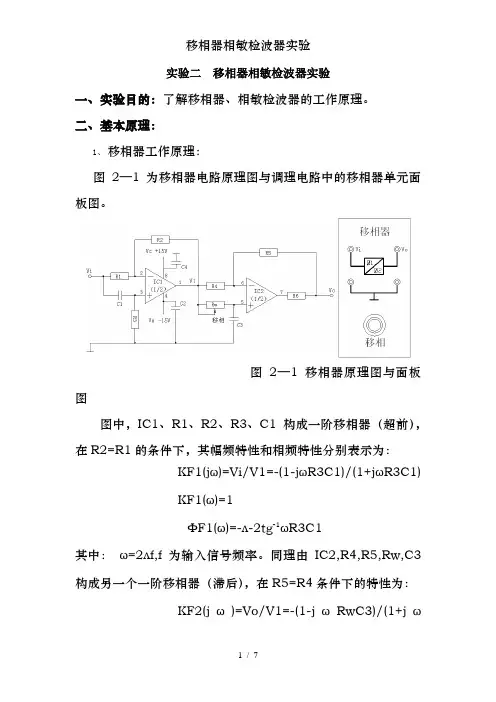
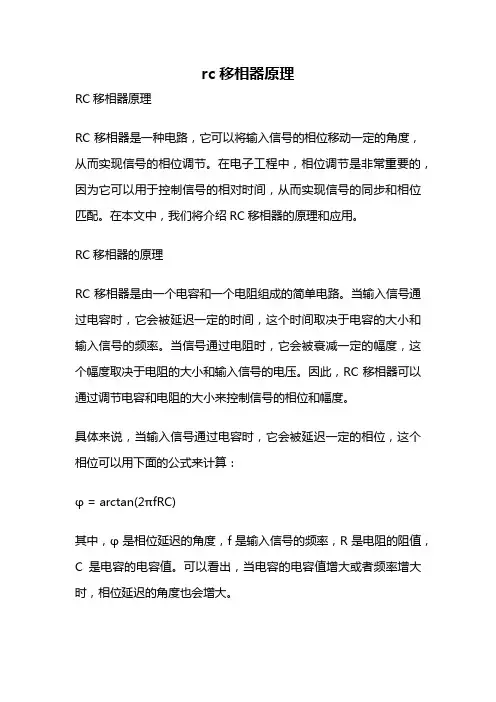
A phase shifter, also known as a phase shifter, is a device that
changes the phase of a signal, most commonly used in the field of
electronics. 移相器,也称为移相器,是一种改变信号相位的设备,在电子领域最常用。
The basic operating principle of a phase shifter is to delay or advance
the phase of the input signal in order to align it with another signal
or to achieve a specific phase relationship. 移相器的基本工作原理是延迟或提前输入信号的相位,以便将其与另一个信号对准或实现特定的相位关系。
There are various types of phase shifters, including passive and active
phase shifters. Passive phase shifters do not require an external
power source and operate based on passive components such as
resistors, capacitors, and inductors. 有各种类型的移相器,包括被动和主动的移相器。被动移相器不需要外部电源,并且基于电阻、电容和电感等被动元件运作。
Active phase shifters, on the other hand, require an external power
source and use active components like transistors and operational
amplifiers to achieve phase shifting. 主动移相器则需要外部电源,并使用晶体管和运算放大器等主动元件来实现相位移位。
In addition to changing the phase of a signal, phase shifters are also
used in various applications such as frequency synthesis, signal
modulation, and antenna beam steering. 除了改变信号的相位,移相器还用于各种应用,如频率合成、信号调制和天线波束导向。
Overall, phase shifters play a key role in electronics and
telecommunications by enabling precise control and manipulation of
signal phase for a wide range of applications. 总的来说,通过实现信号相位的精确控制和操作,移相器在电子和通信领域方面发挥着重要作用。