
不规则词汇变形
- 格式:ppt
- 大小:129.50 KB
- 文档页数:12


特殊变形词不可不会英语最基本的构词法(word formation )有三种:派生(derivation )、合成( compounding )和转化(conversion )。
利用构词法记忆单词,可以记忆成串,举一反三。
派生词缀和词根结合,或者粘着词根和粘着词根结合构成单词的方法,叫做派生法( derivation )。
用派生法构成的词叫做派生词(derivative )。
派生词的词缀法是英语构词法中最活跃的一种,在英语构词的历史上发挥极其重要的作用。
另外,这种构词法也是我们可以发挥能动性借以扩大词汇量的一种构词法。
词缀分为前缀和后缀两种。
考纲要求考生掌握3000多个英语单词。
因此,掌握常用派生词的构词方法不仅能帮助同学们做好语法填空题,还能帮助同学们扩大词汇量,为同学们在高考中稳操胜券奠定基础。
1.熟悉又陌生的派生词之名词。
常见词缀要记牢,-tion/-sion/-ness/-cy/-ce/-th/-dom/-ty...recognize→recognition n.认可benefit→beneficial adj.有益的explain→explanation n.说明,解释curious→curiosity n.好奇,好奇心generous→generosity n.慷慨consume→consumption n.消费;消耗describe→description n.描述,描写assume→assumption n.假定;设想pronounce→pronunciation n.发音;读法compete→competition n.竞争;比赛invite→invitation n.邀请admire→admiration n.钦佩;羡慕;欣赏qualify→qualification n.资格;资格证书believe→belief n.信念relieve→relief n.如释重负tend→tendency n.倾向,趋势choose→choice n.选择vary→variety n.多样化;种类conclude→conclusion n.结论decide→decision n.决定divide→division n.分配expand→expansion n.扩张admit→admission n.接纳;准许入学permit→permission n.许可introduce→introduction n.介绍respond→response n.回应rich→richness n.丰富damp→dampness n.潮湿;湿气complete→completeness n.完整;完全full→fullness n.充满;丰富;完全tired→tiredness n.疲劳;疲倦good→goodness n.善良,美德Warm→warmth n. 温暖true→ truth n. 真相2.形容词变副词去(1)大部分以字母e结尾的形容词不去e,形容词变副词直接加-ly immediate→immediately立刻地fortunate→fortunately幸运地entire→entirely完全地,彻底地wide→widely广泛地absolute→absolutely绝对地;完全地polite→politely有礼貌地;客气地wise→wisely明智地;聪明地;精明地nice→nicely漂亮地;恰好地huge→hugely很;非常expensive→expensively昂贵地(2)-le结尾的形容词变为lysimple→simply简单地;仅仅gentle→gently轻轻地;温柔terrible→terribly非常;可怕地;极度地possible→possibly可能地;也许probable→probably大概;或许comfortable→comfortably舒服地;安乐地(3)以“元音字母+e”结尾的形容词去e加-lytrue→truly真实地(4)特殊情况whole→wholly完全地;全部shy→shyly害羞地dry→dryly干燥地full→fully充分地dull→dully单调地3.动词变名词,去e还是不去e(1)以e结尾,不去e直接加-ment achieve→achievement功绩;成就advertise→advertisement 广告amaze→amazement 惊奇agree→agreement同意arrange→arrangement 安排improve→improvement 改进require→requirement 要求(2)以e结尾,去e再加-mentargue→argument辩论;论据judge→judgment意见;判断力4.以字母ic结尾的形容词加-ally变为副词specific→specifically特别地;明确地basic→basically主要地,基本上scientific→scientifically系统地;合乎科学地academic→academically学术上;学业上historic→historically关于历史事件,从历史观点上说classic→classically古典主义地enthusiastic→enthusiastically热情地5.后缀-cy(-t/-te→-cy)accurate→accuracy准确性efficient→efficiency效率;功效fluent→fluency流利;流畅frequent→frequency频繁private→privacy隐私;私密urgent→urgency紧急1.名词复数特殊变化(1)不规则变化的名词复数①child→children孩子①man→men男人①tooth→teeth牙齿①foot→feet脚①woman→women女人①mouse→mice老鼠①gentleman→gentlemen绅士①ox→oxen 公牛(2)外来名词的复数①criterion→criteria 标准①phenomenon→phenomena 现象①bacterium→bacteria 细菌①medium→media 媒介①datum→data 数据(3)以o结尾的名词在词尾加-s或-es①以o结尾的名词在词尾直接加-s变为复数radio→radios,zoo→zoos,piano→pianos,kilo→kilos,photo→photos①以o结尾的名词在词尾直接加-eshero→heroes,tomato→tomatoes,potato→potatoes2.形容词和副词比较等级的特殊变化针对训练用括号内所给词的适当形式填空1. I was supposed to arrive at the airport on time ._____________( fortunate ), I was held up by the heavy traffic jam .【答案】Unfortunately2.Therefore, when they become older they are _________________( able ) to do any other kind of work .【答案】unable3.Very early the next morning , amazingly ,we got completely satisfied in a totally ______________( expect ) way .【答案】unexpected4. I won ' t do the purchase because the price of this dress is ___________( reason ).【答案】unreasonable5.Job____________( apply ) need to show their ability to be both organized and flexible in taking on many tasks at the same time .【答案】applicants6.All facts are the source of _________________( conclude ).【答案】conclusions7.However, most ______________( science ) agree that EQ has a lot to do with ___________( educate ).【答案】scientists ; education8.Excellent oral and written _________________( communicate ) skills in Chinese and English are of____________ ( important ).【答案】communication ; importance9.Fresh fruits and vegetables can provide much of our daily ___________( require ).【答案】requirement10.10.It is your______________(free) to do what you want after class.【答案】freedom。
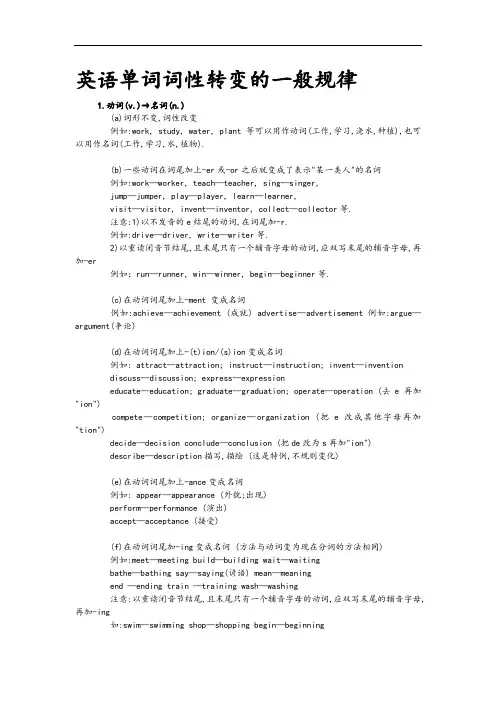
英语单词词性转变的一般规律1.动词(v.)→名词(n.)(a)词形不变,词性改变例如:work, study, water, plant等可以用作动词(工作,学习,浇水,种植),也可以用作名词(工作,学习,水,植物).(b)一些动词在词尾加上-er或-or之后就变成了表示"某一类人"的名词例如:work—worker, teach—teacher, sing—singer,jump—jumper, play—player, learn—learner,visit—visitor, invent—inventor, collect—collector等.注意:1)以不发音的e结尾的动词,在词尾加-r.例如:drive—driver, write—writer等.2)以重读闭音节结尾,且末尾只有一个辅音字母的动词,应双写末尾的辅音字母,再加-er例如:run—runner, win—winner, begin—beginner等.(c)在动词词尾加上-ment 变成名词例如:achieve—achievement (成就) advertise—advertisement例如:argue—argument(争论)(d)在动词词尾加上-(t)ion/(s)ion变成名词例如: attract—attraction; instruct—instruction; invent—inventiondiscuss—discussion; express—expressioneducate—education; graduate—graduation; operate—operation (去e再加"ion")compete—competition; organize—organization (把e改成其他字母再加"tion")decide—decision conclude—conclusion (把de改为s再加"ion")describe—description描写,描绘 (这是特例,不规则变化)(e)在动词词尾加上-ance变成名词例如: appear—appearance (外貌;出现)perform—performance (演出)accept—acceptance (接受)(f)在动词词尾加-ing变成名词 (方法与动词变为现在分词的方法相同)例如:meet—meeting build—building wait—waitingbathe—bathing say—saying(谚语) mean—meaningend —ending train —training wash—washing注意:以重读闭音节结尾,且末尾只有一个辅音字母的动词,应双写末尾的辅音字母,再加-ing如:swim—swimming shop—shopping begin—beginning(g)其他一些比较特殊的变化例如: Beg(乞讨)—beggar(乞丐) behave(行为举止)—behaviorknow(知道)—knowledge(知识) fly—flight (飞行)heat (加热)—heat(热量) hit (撞击)—hit( 轰动一时的人或物,碰撞)mix (混合)—mixture(混合物) press(按,压)—pressure(压力)sit(坐)—seat (座位) succeed—success(成功)tour—tour(旅游)/ tourist (游客)2.动词(v.)→形容词(adj.)(a)动词后面加able,以e结尾的动词则去e加able,表示具有此性质,特点或属性.例如: afford-affordable;love-lovable(b)动词后面加ed,以e结尾的动词则直接加d,表示被动性的属性或特点.例如: scatter-scattereduse-used(c)不规则的动词则必须记忆,记住其过去分词形式.规律不大,意义同(b).3.名词(n.)→形容词(adj.)(a)在名词后面加-y可以变成形容词(尤其是一些与天气有关的名词)例如: rain—rainy, cloud—cloudy, wind—windy, snow—snowy,health—healthy, luck—lucky, anger—angry guilt—guilty(内疚的)tourist—touristy(游客多的) , salt (盐)—salty (咸的)silk(丝绸)—silky(丝绸般的), sleep—sleepy (昏昏欲睡的)注意:1)如果以重读闭音节结尾,且词尾只有一个辅音字母,这时应双写辅音字母再加"-y".如: sun—sunny, fun—funny, fog—foggy(有雾的), fur—furry(毛皮的)2)少数以不发音的e结尾的名词变为形容词时,应去掉e再加"-y".如: noise—noisy, ice—icy, shine—shiny(发亮的), taste(口味)—tasty(甜的)(b)名词后面加-ed,以e结尾的直接加d.例如: spot(斑点)—spotted(有斑点的); talent—talented (有天赋的)organize—organized 有组织的; balance—balanced(平衡的)(c)一些抽象名词在词尾加-ful可以变为形容词例如:care—careful, thank—thankful, help—helpful,use—useful, meaning—meaningful(d)在名词后加-less构成含有否定意义的形容词例如:care—careless(粗心的), use—useless(无用的)hope—hopeless(没希望的),home—homeless(无家可归的)(e)一些以-ce结尾的名词,把-ce改为-t变成形容词例如: difference—different, silence—silent, confidence—confident(f).在名词后加-ly变为形容词例如: friend—friendly, love—lovely, live---lively(g).在名词后加-ous变为形容词例如: danger—dangerous(h)名词后面加-al变为形容词例如: music—musical; medicine—medical (这个比较特殊)(i)名词后面加-able变为形容词,如果以e结尾就去e再加"-able".例如: adjust—adjustable 可调整的value—valuable有价值的(j)名词后面加-en变成形容词例如: wood—wooden 木制的wool—woolen 羊毛的(k)一些表示国家的名词可以在词尾加-ese, -ish或-n构成表示国籍,语言的形容词例如:China—Chinese, Japan—Japanese, England—English,America—American, India—Indian, Australia —Australian(注意Canada—Canadian)4..形容词(adj.)→副词(adv.)▲一般在形容词的词尾加-ly可以变成副词例如: quick—quickly, slow—slowly, loud—loudly, sudden—suddenly 等但是,以下几点值得注意:(a) 一些以"辅音字母+y"结尾的形容词,要把y改为i再加-ly例如: happy—happily, angry—angrily, lucky—luckily, heavy—heavily, noisy—noisily(b) 有些以-ble或-le结尾的形容词,去掉e加-y例如:possible—possibly, terrible—terribly(c)少数以e结尾的形容词,要去掉e再加-ly例如: true—truly但绝大多数以e结尾的形容词仍然直接加-ly 例如: polite—politely, wide—widely(d)以-l结尾的形容词变为副词时要在词尾加-ly,以--ll结尾的才在词尾只加-y.例如: usual—usually, careful—carefully, useful—usefullyfull—fully (以-ll结尾的才只加y)英语词汇后缀系列(一)——形容词后缀able以“-able”结尾的形容词一般有两种情况:(1)v.+able→adj. 以这种方式构成的形容词其意义为“能……的”、“可以(被)……的”、“适合于……的”、“值得……的”等,即有被动含义。
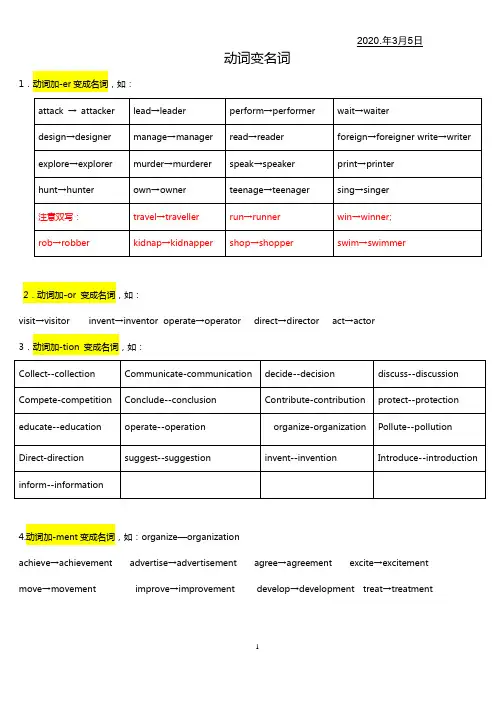
2020.年3月5日动词变名词1.动词加-er变成名词,如:2.动词加-or 变成名词,如:visit→visitor invent→inventor operate→operator direct→director act→actor3.动词加-tion 变成名词,如:4.动词加-ment变成名词,如:organize—organizationachieve→achievement advertise→advertisement agree→agreement excite→excitement move→movement improve→improvement develop→development treat→treatment5.动词加-ance变成名词。
如:appear→appearance perform→performance enter→entrance6.动词加-ing变成名词。
如:注意动词变名词的特殊形式:形容词与副词的原级、比较级和最高级类1.形容词和副词的比较级、最高级构成(1)单音节词与部分双音节词规则变变化:(2)部分双音节词或以形容词加-ly变成的副词和多音节词,在其前加more, most 变成比较级和最高级。
如:(3)不规则变化:2.原型:as+形容词或副词的原型+as “和……一样……”,not as / so+形容词或副词的原型+as “和……不一样……”。
基数词变序数词类主要掌握好1-12和20、30、40、50、60、70、80、90及21、22、23这几个序数词的形式:注意次数的表达:one-once two-twice three-three time否定前缀人称代词变化类要熟练掌握和运用主格、宾格、形容词性物主代词及名词性物主代词。
见下面表格:常见的反义词1.动词2.形容词常考的句式结构3.既可以跟动词不定式又可以跟动名词:4. 类型1)表示提建议的2) 特殊疑问词+动词不定式,如:注意:以上几点一般考查动词形式。
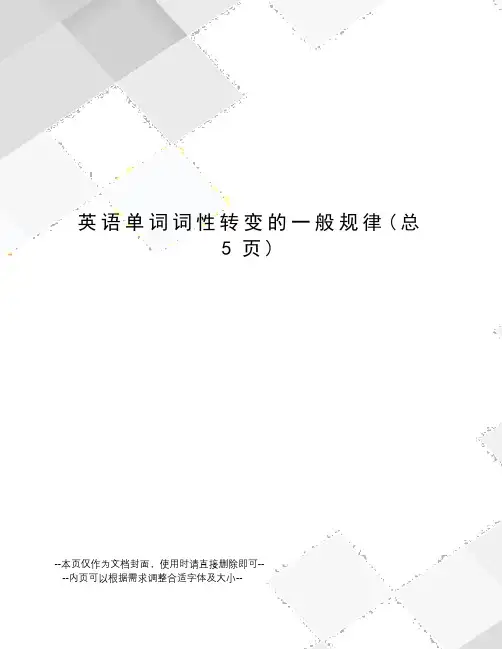
英语单词词性转变的一般规律(总5页)--本页仅作为文档封面,使用时请直接删除即可----内页可以根据需求调整合适字体及大小--英语单词词性转变的一般规律1.动词(v.)→名词(n.)(a)词形不变,词性改变例如:work, study, water, plant等可以用作动词(工作,学习,浇水,种植),也可以用作名词(工作,学习,水,植物).(b)一些动词在词尾加上-er或-or之后就变成了表示"某一类人"的名词例如:work—worker, teach—teacher, sing—singer,jump—jumper, play—player, learn—learner,visit—visitor, invent—inventor, collect—collector等.注意:1)以不发音的e结尾的动词,在词尾加-r.例如:drive—driver, write—writer等.2)以重读闭音节结尾,且末尾只有一个辅音字母的动词,应双写末尾的辅音字母,再加-er例如:run—runner, win—winner, begin—beginner等.(c)在动词词尾加上-ment 变成名词例如:achieve—achievement (成就) advertise—advertisement例如:argue—argument(争论)(d)在动词词尾加上-(t)ion/(s)ion变成名词例如: attract—attraction; instruct—instruction; invent—inventiondiscuss—discussion; express—expressioneducate—education; graduate—graduation; operate—operation (去e再加"ion")compete—competition; organize—organization (把e改成其他字母再加"tion")decide—decision conclude—conclusion (把de改为s再加"ion")describe—description描写,描绘 (这是特例,不规则变化)(e)在动词词尾加上-ance变成名词例如: appear—appearance (外貌;出现)perform—performance (演出)accept—acceptance (接受)(f)在动词词尾加-ing变成名词 (方法与动词变为现在分词的方法相同)例如:meet—meeting build—building wait—waitingbathe—bathing say—saying(谚语) mean—meaningend —ending train —training wash—washing注意:以重读闭音节结尾,且末尾只有一个辅音字母的动词,应双写末尾的辅音字母,再加-ing如:swim—swimming shop—shopping begin—beginning(g)其他一些比较特殊的变化例如: Beg(乞讨)—beggar(乞丐) behave(行为举止)—behaviorknow(知道)—knowledge(知识) fly—flight (飞行)heat (加热)—heat(热量) hit (撞击)—hit( 轰动一时的人或物,碰撞)mix (混合)—mixture(混合物) press(按,压)—pressure(压力)sit(坐)—seat (座位) succeed—success(成功)tour—tour(旅游)/ tourist (游客)2.动词(v.)→形容词(adj.)(a)动词后面加able,以e结尾的动词则去e加able,表示具有此性质,特点或属性.例如: afford-affordable;love-lovable(b)动词后面加ed,以e结尾的动词则直接加d,表示被动性的属性或特点.例如: scatter-scattereduse-used(c)不规则的动词则必须记忆,记住其过去分词形式.规律不大,意义同(b).3.名词(n.)→形容词(adj.)(a)在名词后面加-y可以变成形容词(尤其是一些与天气有关的名词)例如: rain—rainy, cloud—cloudy, wind—windy, snow—snowy,health—healthy, luck—lucky, anger—angry guilt—guilty(内疚的) tourist—touristy(游客多的) , salt (盐)—salty (咸的)silk(丝绸)—silky(丝绸般的), sleep—sleepy (昏昏欲睡的)注意:1)如果以重读闭音节结尾,且词尾只有一个辅音字母,这时应双写辅音字母再加"-y".如: sun—sunny, fun—funny, fog—foggy(有雾的), fur—furry(毛皮的)2)少数以不发音的e结尾的名词变为形容词时,应去掉e再加"-y".如: noise—noisy, ice—icy, shine—shiny(发亮的), taste(口味)—tasty(甜的)(b)名词后面加-ed,以e结尾的直接加d.例如: spot(斑点)—spotted(有斑点的); talent—talented (有天赋的) organize—organized 有组织的; balance—balanced(平衡的)(c)一些抽象名词在词尾加-ful可以变为形容词例如:care—careful, thank—thankful, help—helpful,use—useful, meaning—meaningful(d)在名词后加-less构成含有否定意义的形容词例如:care—careless(粗心的), use—useless(无用的)hope—hopeless(没希望的),home—homeless(无家可归的)(e)一些以-ce结尾的名词,把-ce改为-t变成形容词例如: difference—different, silence—silent, confidence—confident(f).在名词后加-ly变为形容词例如: friend—friendly, love—lovely, live---lively(g).在名词后加-ous变为形容词例如: danger—dangerous(h)名词后面加-al变为形容词例如: music—musical; medicine—medical (这个比较特殊)(i)名词后面加-able变为形容词,如果以e结尾就去e再加"-able".例如: adjust—adjustable 可调整的value—valuable有价值的(j)名词后面加-en变成形容词例如: wood—wooden 木制的wool—woolen 羊毛的(k)一些表示国家的名词可以在词尾加-ese, -ish或-n构成表示国籍,语言的形容词例如:China—Chinese, Japan—Japanese, England—English,America—American, India—Indian, Australia —Australian(注意Canada—Canadian)4..形容词(adj.)→副词(adv.)▲一般在形容词的词尾加-ly可以变成副词例如: quick—quickly, slow—slowly, loud—loudly, sudden—suddenly 等但是,以下几点值得注意:(a) 一些以"辅音字母+y"结尾的形容词,要把y改为i再加-ly例如: happy—happily, angry—angrily, lucky—luckily, heavy—heavily, noisy—noisily(b) 有些以-ble或-le结尾的形容词,去掉e加-y例如:possible—possibly, terrible—terribly(c)少数以e结尾的形容词,要去掉e再加-ly例如: true—truly但绝大多数以e结尾的形容词仍然直接加-ly 例如: polite—politely, wide —widely(d)以-l结尾的形容词变为副词时要在词尾加-ly,以--ll结尾的才在词尾只加-y.例如: usual—usually, careful—carefully, useful—usefullyfull—fully (以-ll结尾的才只加y)英语词汇后缀系列(一)——形容词后缀able以“-able”结尾的形容词一般有两种情况:(1)v.+able→adj. 以这种方式构成的形容词其意义为“能……的”、“可以(被)……的”、“适合于……的”、“值得……的”等,即有被动含义。