新概念第一册Lesson31-40重点笔记
- 格式:docx
- 大小:14.48 KB
- 文档页数:5
Monday , July 21,2014
By Chen
新概念第一册 重点笔记
Lesson 31-32
基础语法 Grammar in use
现在进行时
( 1)定义: 表示此刻正在进行的动作或事件。
(2)结构:①肯定式:主语+ be的现在时形式(am, is, are ) +现在分词(V-ing )。
如课文中的 Shes sitting under the tree 和 Hes climbing the tree 等句子均为现在进行时。
② 否定式 :主语+ be 的现在时形式( am, is, are )+ not+ 现在分词 ( V-ing )。
如: The dog is drinking its milk. The dog is not drinking its milk. 豿没在喝它的那份牛奶。
③ 一般疑问句式 : be( am, is, are )+ 主语 + 现在分词。如:
He is reading a magazine. Is he reading a magazine? 他正在看一本杂志吗?
④ 特殊疑问句 :疑问词 + be
的现在时形式( am, is, are )+现在分词( V-ing )。 如: What are you doing? 你正在做什么? What
is he/she doing? 他 /她正在干什么?
(3)动词加 ing 的变化规则 ( 这点一定要牢记,很重要 )
① 一般情况:在动词后面直接加 -ing ,如 doing, climbing 。
② 以-e结尾的动词:要去掉 -e,再加-ing,女口 making。
③ 如果动词只有一个元音字母而其后跟了一个辅音字母时,即词末是元音 +辅音的,
需将与辅音字母双写,再加 -ing ,如 running, sitting 。
Lesson 33-34
1. It is a fine day today. 今天天气好。
句中的 it 是指天气。又如: Is it cold today? 今天冷吗? No, it isn't. 不,不冷。
2. some clouds ,几朵云。
some 既可修饰可数名词,也可修饰不可数名词。
如: some tables 一些椅子(可数名词), some milk 一些牛奶(不可数名词)。
3. There are some clouds in the sky, but the sun is shining. 天空中飘着几朵云,但
阳光灿烂。
这句是并列句, 由两个分句构成, 连词 but 表明分句之间存在着对比及转折关系。 两分句 之间大多要用逗号,有时可不用逗号。
4.Mr. Jones is with his family. 琼斯先生同他的家人在一起。
句中with是介词,表示 和 ..... 一起” family是指家里的人"或家庭成员”
5. They are walking over the bridge. 他们正在过桥。
⑴句中的 over 有“穿过 ”的意思。又如:
The aeroplane is flying over the river. 飞机正在河上飞过。 The birds are flying over the house. 鸟儿在屋上飞过。
⑵over还可表不 在 ..... 上方”(不接触表面),如:
The sky is over our heads. 天空在我们头顶上。
6. There are some boats on the river. 河上有几艘船。
句中on意为在 ...... 上面”(接触表面)。又如:
There is a book on the table. 桌上有一本书。
7. The ship is going under the bridge. 那船正从桥下驶过。
句中under意为在 ...... 下面(或下方)”。女口:
There is a dog under the tree. 树下有只豿。
8. 区别 :ship 和 boat
Ship :一般指海洋中行驶的大船。
boat 一词指河中行驶的小船。
9. “飞机”的表达
正式用语: aeroplane (英国英语), airplane (美国英语) 非正式用语: plane
语法 Grammar in use 现在进行时的形式是由 be 的现在时形式 +现在分词形式构成。(前面已提到) 有一点须 注意的是: 当句中主语名词为复数或者人称代词为第 2人称或第 3 人称复数时, be 的现在时形式应为 are 。
Lesson 35-36
1. This is a photograph of our village. 这是我们村庄的一张照片。
句中of是介词,表示“……的”。又如:
the windows of a room 房间的窗户
2.It is between two hills. 我们的村庄坐落在一个山谷之中。 句中 It 指 village 。 between 是介词 ,表示 “在…… (两者)之间 ”。又如:
The man is standing between two policemen. 这个男人正站在两名警察之间。
3.along the banks of the river, 沿着河岸。
along 为介词 ,表示 “沿着 ”。
4. He is swimming across the river. 他正横渡小河。
across 为介词,表示 “通过 ”某个平面。
5. beside a park ,位于公园旁边。
beside 为介词,表示 “在…… 旁边 ”。
语法 Grammar in use ——短语动词 短语动词:通常是指后面常跟一个介词或副词短语的动词,即:动词 +介词
如听到敲门声,我们会说 Come in 而不会用 Enter 来表达。 最常见的短语动词有 :
1. go into
( 1 )走进;进入: He is going into a shop. 他正走进一家商店。
(2)进入;介入:
They're going into the bus in ess world. 他们正步入商界。
2. sit on
(1) 坐在……上:
The childre n are sitti ng on the grass. 孩子们正坐在草地上。
(2) < 口 >拖延;压下:
They are trying to sit on the bad n ews as long as possible.
他们正试图尽可能拖延时间不把这个坏消息讲出去。
3. run along
(1) 沿着……跑:
The dogs are running along the river ban ks. 狗正沿着河岸奔跑。
(2) 离开;走开:
It's gett ing dark, we must run along. 天黑了,我们得走了。
4. jump off 从.....跳下来
The childre n are jumpi ng off the bran ch. 孩子们正从树枝上跳下来。
Lesson 37-38
1. What are you going to do now, George? 你现在准备干什么,乔治?
be going to,是打算、准备、按计划在最近做某事,表示将来。请参见本课语法部分。
2. It's for my daughter, Susan. 是为我的女儿苏珊做的。
Susan 作 my daughter 的同位语。
语法 Grammar in use ------------ 将来时 be going to
(1) 将来时be going to 的形式由am/is/are going to + 动词原形构成。
(2) 将来时be going to的用法
A表示 打算” 准备”在最近做某事。(在非正式语体中,一般多用 be going to ,
will。)
I am goi ng to put it on the floor. 我打算把它放在地板上。
He is going to paint the bookcase tomorrow.
B表示按计划、安排要发生的事:
The meeti ng is going to begi n at nine.
Where are you going to build the road?
C表示预言一件事即将发生:
The meeti ng is going to begi n at nine.
It's going to rain! 天要下雨了!
She's goi ng to faint! 她要晕倒了!
(3) be going to 的疑问式与否定式 而不用
他准备明天给书架刷漆。
会议将在9点开始。
你们将在什么地方筑路?
会议将在9点开始。 将助动词be提至句首可将陈述句变为一般疑问句。如:
George is going to paint it pink. 乔治打算把它刷成粉红色。
Is George going to paint it pink? 乔治打算把它刷成粉红色吗? 在助动词后面加上 not 可以得到否定句。如上句可变为: George is not going to point it pink. 乔治不打算把它刷成粉红色。
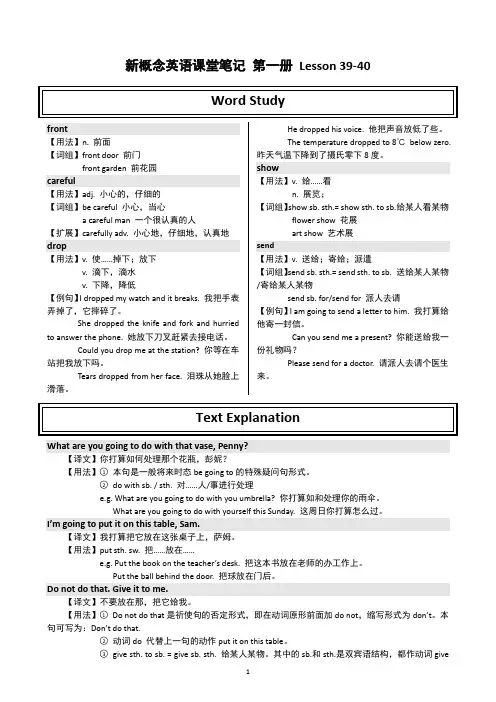
Lesson 39-40
1. Don't do that. 不要放在那儿。 在英文中需用祈使语气来表示直接的命令、建议等多种意图。
而祈使句的否定式则由 Don't (或 Do not ) +动词原形构成,又如: 课文中的 Don't drop it! (别摔了!)等句子。(请参见本课语法部分。) 2. Give it to me. 把它给我。
在第 21 课有 give me a book 这样的句型,在本课中又出现了 give it to me 的句型。 在动词 give 后面可以有两个宾语:即 直接宾语 (指物,如 a book, it )和间接宾语 (指人 , 如me)。如果直接宾语置于动词 give之后,间接宾语之前则带 to。再比较一下下列句式:
Show her the magazine. 给她那本杂志。
Show it to her. 把它给她。
Give me that knife. 给我那把小刀。
Give it to me. 把它给我。
3.区别: in front of 和 in the front of
in front of :在 ..... (外部)的前面。 比如:
The tree is in front of our house. 我们房子前面有棵树(即树在房子外面的前面)
in the fro nt of :在 ..... (里部)的前面。比如:
I sit in the front of my mom's car. (即我坐在车子里面的前面) 4. There we are! 就放在那里 !
在这里表示说话人的满意心情,可理解为 “好了 ”、“行了”等。
语法 Grammar in use
祈使句的否定缩略式:形式为Don't (或Do not ) +动词原形,如:
Don't wait! 别等了!
Don't speak to me like that! 别那样跟我讲话! 使用祈使句时,重音、语调、手势和面部表情,尤其是情境和上下文,都说明这种形式用 于表示是否友好、不客气、愤怒、不耐烦、有说服性等。一般而言,祈使句的否定式通常用