
6.4 、大写英文语句转换为首字母大写
- 格式:xlsx
- 大小:10.13 KB
- 文档页数:1
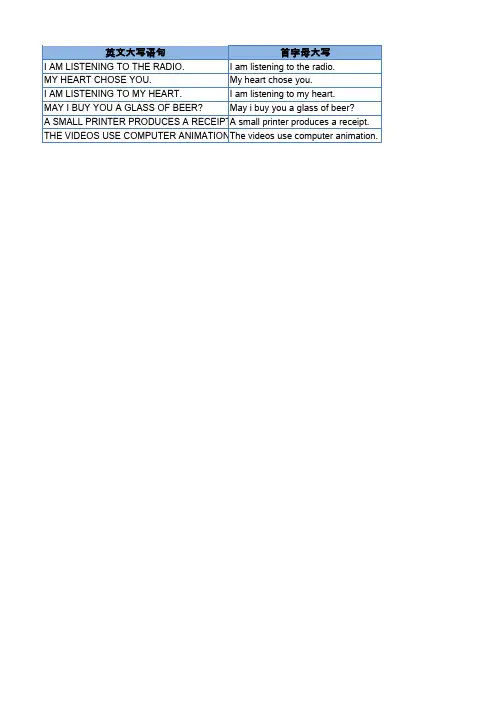

小写转大写公式范文小写字母转换为大写字母的公式如下:大写字母=小写字母ASCII值-32其中,ASCII是一种用于表示文本字符的编码方案,其中每个字符都有一个对应的数值。
在ASCII编码中,小写字母的数值范围为97到122,大写字母的数值范围为65到90。
通过将小写字母的ASCII值减去32,可以得到对应的大写字母的ASCII值,从而得到大写字母。
以下为示例代码,将输入的小写字符串转换为大写字符串:```pythondef lowercase_to_uppercase(input_str):uppercase_str = ""for char in input_str:char_code = ord(char)if 97 <= char_code <= 122:uppercase_char_code = char_code - 32uppercase_char = chr(uppercase_char_code)uppercase_str += uppercase_charelse:uppercase_str += charreturn uppercase_strinput_str = input("请输入一个小写字符串:")uppercase_str = lowercase_to_uppercase(input_str)print("转换为大写字符串:", uppercase_str)```这段代码首先定义了一个名为 `lowercase_to_uppercase` 的函数,输入参数为一个小写字符串。
然后,使用一个循环遍历输入字符串的每个字符。
对于每个字符,使用内置函数 `ord` 获取其 ASCII 值,如果该字符的 ASCII 值在小写字母的范围内,则将其减去32得到对应的大写字母的 ASCII 值,并使用内置函数 `chr` 将 ASCII 值转换为字符,并将其添加到一个新的字符串 `uppercase_str` 中。

小写转换成大写的公式小写字母转换成大写字母可以使用ASCII码来实现。
ASCII码是一种字符编码标准,其中包含了256个不同的字符,包括大写和小写字母、数字、标点符号等。
在ASCII码中,小写字母的编码范围是97到122,而对应的大写字母的编码范围是65到90。
因此,可以通过减去32来将小写字母转换成大写字母。
以下是一个示例代码,用于将一个字符串中的小写字母转换成大写字母:```pythondef convert_to_uppercase(string):result = ""for char in string:if ord('a') <= ord(char) <= ord('z'):result += chr(ord(char) - 32)else:result += charreturn resultinput_string = "hello world"output_string = convert_to_uppercase(input_string)print(output_string)```运行上述代码,将会输出字符串"HELLOWORLD"。
上述代码通过遍历输入字符串的每个字符,如果字符是小写字母,则将其转换成大写字母并追加到结果字符串中;如果字符不是小写字母,则直接追加到结果字符串中。
需要注意的是,上述代码仅适用于包含英文字母的情况。
如果输入字符串中包含其他字符,如数字、标点符号或非英文字母等,则需要进一步处理。
你可以根据需要进行修改或添加适当的处理逻辑。

把单元格中数字快速转化为中文大写的方法将单元格中数字快速转化为中文大写的方法介绍在Excel中,有时我们需要将数字转化为中文大写,例如将12345转化为一万二千三百四十五。
本文将介绍几种快速将单元格中数字转化为中文大写的方法。
方法一:使用Excel自带函数Excel自带了一个函数=TEXT(value, "[$-0804][DBNum2]G/通用格式"),可以将数字转化为中文大写形式。
使用步骤: 1. 在一个空白单元格中输入=TEXT(A1, "[$-0804][DBNum2]G/通用格式"),其中A1为要转化的数字所在的单元格。
2. 按下Enter键即可看到转化后的中文大写数字。
方法二:使用VBA宏如果需要频繁使用该功能,可以使用VBA宏将其封装为一个函数,以便更加方便地调用。
使用步骤: 1. 按下ALT + F11打开VBA编辑器。
2. 在VBA编辑器中,选择要添加宏的工作簿。
3. 在模块中,插入以下VBA代码:Function ChineseNumber(ByVal Value As Variant) As S tringDim MyNumber As CurrencyDim DecimalPlace As IntegerDim Count As IntegerDim DecimalSeparator As StringDim Temp As StringDim DecimalValue As StringDim DecimalWords As StringDim ReturnValue As StringDecimalSeparator = "点"ReDim Place(9) As StringPlace(2) = "十"Place(3) = "百"Place(4) = "千"Place(5) = "万"Place(6) = "十"Place(7) = "百"Place(8) = "千"Place(9) = "亿"' Convert MyNumber to string, separate integral and decimalMyNumber = Trim(CStr(Value))DecimalPlace = InStr(MyNumber, ".")If DecimalPlace > 0 ThenDecimalValue = GetTens(Left(Mid(MyNumber, Decima lPlace + 1) & "00", 2))MyNumber = Trim(Left(MyNumber, DecimalPlace - 1)) End IfCount = 1Do While MyNumber <> ""Temp = GetHundreds(Right(MyNumber, 3))If Temp <> "" Then ReturnValue = Temp & Place(Co unt) & ReturnValueIf Len(MyNumber) > 3 ThenMyNumber = Left(MyNumber, Len(MyNumber) - 3) ElseMyNumber = ""End IfCount = Count + 1LoopSelect Case ReturnValueCase ""ReturnValue = "零"Case "一十"ReturnValue = "十"End SelectChineseNumber = ReturnValue & DecimalSeparator & Dec imalValueEnd FunctionFunction GetHundreds(ByVal MyNumber)Dim Result As StringIf Val(MyNumber) = 0 Then Exit FunctionMyNumber = Right("000" & MyNumber, 3)' Convert the hundreds place.If Mid(MyNumber, 1, 1) <> "0" ThenResult = GetDigit(Mid(MyNumber, 1, 1)) & "百"End If' Convert the tens and ones place.If Mid(MyNumber, 2, 1) <> "0" ThenResult = Result & GetTens(Mid(MyNumber, 2))ElseResult = Result & GetDigit(Mid(MyNumber, 3))End IfGetHundreds = ResultEnd FunctionFunction GetTens(TensText)Dim Result As StringResult = "" ' Null out the temporary funct ion value.If Val(Left(TensText, 1)) = 1 Then ' If value betw een 10-19...Select Case Val(TensText)Case 10: Result = "十"Case 11: Result = "十一"Case 12: Result = "十二"Case 13: Result = "十三"Case 14: Result = "十四"Case 15: Result = "十五"Case 16: Result = "十六"Case 17: Result = "十七"Case 18: Result = "十八"Case 19: Result = "十九"Case ElseEnd SelectElse ' If value betw een 20-99...Select Case Val(Left(TensText, 1))Case 2: Result = "二十"Case 3: Result = "三十"Case 4: Result = "四十"Case 5: Result = "五十"Case 6: Result = "六十"Case 7: Result = "七十"Case 8: Result = "八十"Case 9: Result = "九十"Case ElseEnd SelectResult = Result & GetDigit _(Right(TensText, 1)) ' Retrieve ones place. End IfGetTens = ResultEnd FunctionFunction GetDigit(Digit)Select Case Val(Digit)Case 1: GetDigit = "一"Case 2: GetDigit = "二"Case 3: GetDigit = "三"Case 4: GetDigit = "四"Case 5: GetDigit = "五"Case 6: GetDigit = "六"Case 7: GetDigit = "七"Case 8: GetDigit = "八"Case 9: GetDigit = "九"Case Else: GetDigit = ""End SelectEnd Function4.按下CTRL + S保存宏。

数字转为大写的方法
1. 确定数字的整数部分和小数部分。
如果有小数部分,需要分别处理整数部分和小数部分。
2. 将整数部分按照数位进行分割,从个位开始,分别对每个数位进行大写数字的转换。
例如,将个位数字转为大写,然后转为"十"、"百"、"千"等单位对应的大写形式。
3. 对于小数部分,可以将小数点后的数字依次转为大写形式,例如"点"、"分"等。
4. 在转换过程中,需要注意特殊情况的处理,如零的处理、连续零的处理、单位的添加等。
5. 最后将整数部分和小数部分的大写形式连接起来,得到最终的结果。
需要注意的是,不同语言和地区对数字的大写表示可能略有差异,因此在实际应用中需要根据具体的要求进行相应的处理。
总之,将数字转为大写需要考虑整数部分和小数部分的处理,以及特殊情况的处理,最终得到符合规范的大写形式。