
六年级英语课件Unit3第一课时 A Let's learn
- 格式:ppt
- 大小:4.13 MB
- 文档页数:32

Unit 3 Where did you go ?Hello, everyone. Today I’m very pleased to have an opportunity to talk about some of my teaching ideas. My topic is Part A Let’s learn from Unit 3 Where did you go ,Grade 6. It is made up of four parts.Part 1 My understanding of this lessonThe analysis of the teaching material:This lesson talks about verbs. It plays a very important part in the English teaching of this unit. By studying this, Ss can learn more new verbs. At the same time, we should get the students to understand some difficult sentences better. The Ss should do some listening, speaking and writing, too. Of course, the Ss should receive some moral education. Let the Ss understand the verbs better,.Teaching aims:1. Knowledge aim: Understand the words and expressions.2. Ability aim: Make new conversations.3. Emotional aim: Make the Ss care about themselves, and study hard to make better life.Key points / Teaching important points:How to use the verbs to make new conversations..Teaching difficult points:1. Use your own words to make new conversations..2. Discuss where they went and what they did.Something about the Ss:1.The Ss have known something about what sb did in the past.2. They don’t often use English to express themselves and communicate with others.3. Some Ss are not active in the class because they are afraid of making mistakes.Part 2 My teaching theories, methods and aidsBefore dealing with this lesson, I’ll do my best to carry out the following theories: Make the Ss the real masters in class while the teacher himself acts as director;Combine the language structures with the language functions; Let the students receive some moral education while they are learning the English language.Teaching method:Double activities teaching methodQuestion-and-answer activity teaching methodWatch-and-listen activityFree discussion methodTeaching aids:1.some cards2.some objects3. a tape recorder4. the blackboardPart 3. Teaching steps / proceduresI have designed the following steps to train their ability of listening, speaking, reading and writing.The entire steps are:Greetings, Revision, Lead-in and reading, Preparation for details of the lesson, Consolidation, Discussion, Homework.Step 1 GreetingsGreet the whole class as usual.Step 2. Revision1. T: Act,let the Ss guess.2.Ask students some questions to revise the last lesson(show them on the screen).a. What did you do last Saturday?b. What did he do last Sunday?c. What did he do yesterday?d.What did you do last Monday?Step 3. Lead-in and preparationShow them some pictures and let them talk each other, and then use the pictures about places and the things we or they did in the past .Purpose: Arouse the students’interest of study.Bring in new subject: Where we or they went and what we or they did there. Method: Talk about the pictures , read the words and expressions and act. Purpose: Help the Ss remember the words and expressions best.Step 5. Play a game.Look, act and guess.Purpose: Make the Ss learn the expressions best and feel interesting. Step 6. ConsolidationRead the words and expressions , finish the conversation. Purpose: Let the Ss can communicate better.Step 7. DiscussionShow them some words and expressions, let the Ss talk freely. Purpose: Give the Ss much ,they can give us more.Step 8. Listening and exercise.Purpose:Improve the Ss listening and writing ability .Step 9. SummaryLet the Ss make a summary.Purpose:Let the Ss remember the lesson better.Step 10. HomeworkRead the words and expressions and make new conversations.Part 4. Blackboard designUnit 3 Where did you go?A: Where did you go_____? go went camping / fishing B: I went to ____________. ride rode a horseA:What did you do there? rode a bikeB: I ___________________. hurt hurt my footThat’s all , Thank you for listening!。


第一课时课时内容A Let’s learn; Listen, answer and write课时分析本课时是人教版六年级上册第三单元第一课时。
围绕Chen J ie’s weekend plan这一话题展开,主要通过对话学习词组visit my grandparents, see a film, take a trip, go to the supermarket, this morning, this afternoon, this evening, tonight, tomorrow, next week 及句型What are you going to do ...? I’m going to...的表达。
持续培养学生学习英语的兴趣,激发学生学习英语的热情,树立学好英语的自信。
第一课时是本单元的基础,学会了本课时所要掌握的知识,为学习其他课时做好铺垫。
本课时的重点是词组的掌握以及能够运用核心句型谈论周末计划。
本课时包括Let’s learn 和Make a plan 两个版块。
Let’s learn 通过Sarah和陈杰对话的情景,呈现单词和词组的词形和意义。
此版块呈现的对话情境是Sarah和陈杰谈论陈杰的周末计划,自然的引出“你打算去干什么?我打算……”的句型。
谈论周末是学生们感兴趣的话题,很贴近学生的生活,也更能激发学生学习的兴趣。
Make a plan版块是一个综合性的语用活动,可以通过本活动结合自己的实际情况,巩固 A Let’s learn所学的词汇和句型。
本课时的单词和词组visit grandparents, see, take, neorning,afternoon, evening, tomorrow,虽然没有集中涉及过,但是学生曾经学生,有一定的基础。
在设计教学过程时,先用游戏、简笔画猜一猜的活动激活旧知,然后结合教材设置的情境学习新知,运用听、说、读、写、玩等多种教学手段帮助学生理解和巩固所学新知,全面调动学生的积极参与,让学生在快乐的氛围中学会知识。
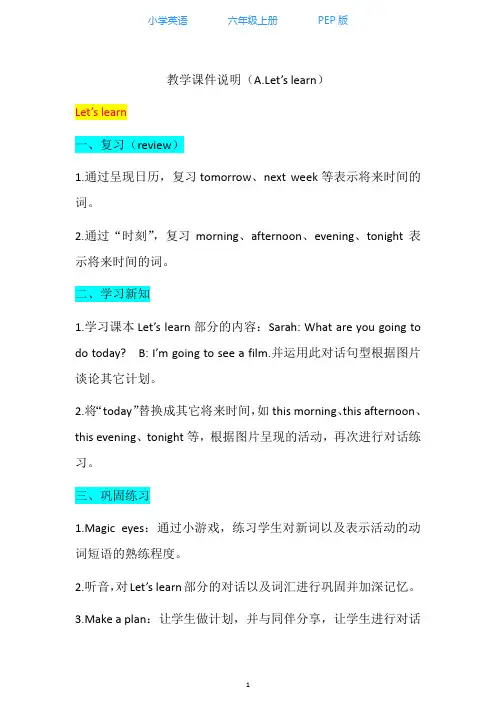
教学课件说明(A.Let’s learn)Let’s learn一、复习(review)1.通过呈现日历,复习tomorrow、next week等表示将来时间的词。
2.通过“时刻”,复习morning、afternoon、evening、tonight表示将来时间的词。
二、学习新知1.学习课本Let’s learn部分的内容:Sarah: What are you going to do today? B: I’m going to see a film.并运用此对话句型根据图片谈论其它计划。
2.将“today”替换成其它将来时间,如this morning、this afternoon、this evening、tonight等,根据图片呈现的活动,再次进行对话练习。
三、巩固练习1.Magic eyes:通过小游戏,练习学生对新词以及表示活动的动词短语的熟练程度。
2.听音,对Let’s learn部分的对话以及词汇进行巩固并加深记忆。
3.Make a plan:让学生做计划,并与同伴分享,让学生进行对话操练。
四、归纳总结总结本课学习的内容:“be going to + 动词原形”表示将要或即将发生某种状况;this morning/afternoon/evening、next year/month/Sunday等表示将来时间的词;“be going to + 地点”五、巩固练习给出动词,让学生用适当形式填空,通过练习题的形式,巩固复习本节课所学的内容。
六、Homework课外作业的布置。
让学生回归课本,通过作业的形式,巩固本次课所学内容,并为下次课的学习做准备。
PEP小学英语六年级上册重点单词和句型练习一、重点单词Unit 1:by ( ) foot( ) bike( ) bus( ) train( ) how( )go to school() traffic()traffic light()traffic rule()stop()wait() get to()Unit 2library( ) post office( ) hospital( ) cinema( ) turn( ) bookstore( ) where( ) please( )next to( ) right ( ) left( ) straight( )then ( )Unit 3next week( ) this morning( ) this afternoon( )this evening ( ) comic book( ) post card( )newspaper( ) buy( )Unit 4hobby( ) ride a bike--riding a bike( ) dive--diving( )play the violin—playing the violin( ) make kites—making kites( ) collect stamps—collecting stamps( ) live –lives( ) teach--teaches( ) go--goes( ) watch--watches( ) read--reads( ) does doesn’t=does notUnit 5singer( ) writer( ) actor( ) actress( ) artist( ) TV reporter( ) engineer( ) accountant( ) policeman( ) salesperson( ) cleaner( ) where() work()Unit 6rain( ) cloud ( ) sun( ) stream( ) come from( ) seed( ) soil( ) sprout ( ) plant( )should ( ) then( )Unit 1: ▁▁(经,乘) ▁▁(脚) ▁▁(自行车) ▁▁(公共汽车) ▁▁(火车)▁▁(怎样) ▁▁▁▁(上学)▁▁▁▁(交通)▁▁▁▁▁▁(交通灯)▁▁▁▁▁▁(交通规则)▁▁(停,停车站)▁▁(等待)▁▁▁▁(到达)Unit 2 ▁▁▁▁(图书馆) ▁▁▁▁(邮局) ▁▁▁▁(医院) ▁▁▁▁(电影院)▁▁(转弯) ▁▁▁▁(书店) ▁▁▁(在哪里,到哪里) ▁▁▁(请)▁▁▁(与…相邻) ▁▁▁ (右边) ▁▁(左边) ▁▁▁(成直线地) ▁▁▁(然后)Unit 3 ▁▁▁▁▁(下周) ▁▁▁▁▁(今天上午) ▁▁▁▁▁(今天下午)▁▁▁▁ (今天晚上) ▁▁▁▁(漫画书) ▁▁▁▁(明信片) ▁▁▁▁ (报纸) ▁▁▁(购买)Unit 4▁▁▁(爱好) ▁▁▁▁▁--▁▁▁▁▁▁(骑自行车) ▁▁▁--▁▁▁(跳水) ▁▁▁▁▁▁—▁▁▁▁▁▁▁(拉小提琴) ▁▁▁▁▁—▁▁▁▁▁▁▁(制作风筝) ▁▁▁▁▁▁—▁▁▁▁▁▁(集邮) ▁▁▁–▁▁▁(居住)▁▁▁▁--▁▁▁▁(教) ▁▁--▁▁▁(去) ▁▁▁--▁▁▁(看)▁▁--▁▁▁(读,看) does doesn’t=▁▁▁▁Unit 5▁▁▁▁(歌唱家,歌手) ▁▁▁▁(作家) ▁▁▁▁(男演员) ▁▁▁▁(女演员) ▁▁▁▁(画家) ▁▁▁▁(电视台记者) ▁▁▁▁(工程师) ▁▁▁(会计) ▁▁▁▁(男警察) ▁▁▁▁▁▁(销售员) ▁▁▁(工作)▁▁▁▁(清洁工) ▁▁▁▁(在哪里,到哪里)Unit 6▁▁▁(雨) ▁▁▁ (云) ▁▁▁(太阳) ▁▁▁▁(河,溪) ▁▁▁▁(来自,从…来) ▁▁▁(种子) ▁▁▁(土壤) ▁▁▁ (苗,芽) ▁▁▁(植物,种植) ▁▁▁(应该) ▁▁▁▁(然后)二、单词分类1)交通方式:by bus, by train, by subway, by ship, by plane, by car, on foot2)文具书籍:dictionary, newspaper, comic book, post card3)职业:singer, writer, TV reporter, actor, actress, engineer, accountant, salesperson, policeman, policewoman,artist, cleaner4)V-ing形式:riding a bike, collecting stamps, diving, making kites, playing the violin5)第三人称单数形式:lives,teaches, watches, goes, does, doesn’t6)公共场所:library,post office, cinema, hospital, science museum, bookstore7)方位:east, west, south, north, turn left, turn right, go straight8)交通灯; red light, yellow light, green light9)自然:sun, cloud, rain, vapour, stream六年级上册四会句子1.你是怎样去上学的?▁▁▁▁▁▁▁▁2.通常我走路去上学。