水的物理性质表
- 格式:xls
- 大小:83.00 KB
- 文档页数:9
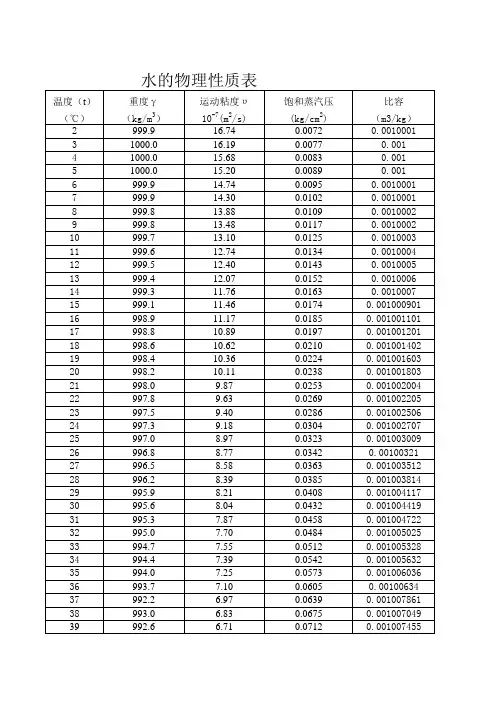


水的粘度计算表水的黏度表(0~40℃)温度T粘度μPa·s或N·s·m-2温度T粘度μPaN·K ℃K273.16 1.7921 1.7921×10-320.2 293.36 1.00001.000010-3274.16 1.7313 1.7313×10-321 294.16 0.98100.981010-3275.16 1.6728 1.6728×10-322 295.16 0.95790.957910-3276.16 1.6191 1.6191×10-323 296.16 0.93580.935810-3 1.5674×0.9142281.16 1.3860 1.3860×10-328 301.16 0.83600.836010-3282.16 1.3462 1.3462×10-329 302.16 0.81800.818010-3283.16 1.3077 1.3077×10-330 303.16 0.80070.800710-3284.16 1.2713 1.2713×10-331 304.16 0.78400.784010-3285.16 1.2363 1.2363×10-332 305.16 0.76790.767910-3286.16 1.2028 1.2028×10-333 306.16 0.75230.752310-3水的物理性质12.31 988.1 209.30 4.174 64.78 54.94 4.49 67.7 19.932 983.2 251.12 4.178 65.94 46.88 5.11 66.2 31.164 977.8 292.99 4.178 66.76 40.61 5.70 64.3 47.379 971.8 334.94 4.195 67.45 35.65 6.32 62.6 70.136 965.3 376.98 4.208 67.98 31.65 6.95 60.7 101.33 958.4 419.10 4.220 68.04 28.38 7.52 58.8 143.31 951.0 461.34 4.238 68.27 25.89 8.08 56.9 198.64 943.1 503.67 4.250 68.50 23.73 8.64 54.8 270.25 934.8 546.38 4.266 68.50 21.77 9.17 52.8 361.47 926.1 589.08 4.287 68.27 20.10 9.72 50.7 476.24 917.0 632.20 4.312 68.38 18.63 10.3 48.62320.88 840.3 943.70 4.614 64.55 12.46 14.8 33.8 2798.59 827.3 990.18 4.681 63.73 11.97 15.9 31.6 3347.91 813.6 1037.49 4.756 62.80 11.47 16.8 29.1 3977.67 799.0 1085.64 4.844 61.76 10.98 18.1 26.7 4693.75 784.0 1135.04 4.949 60.84 10.59 19.7 24.2 5503.99 767.9 1185.28 5.070 59.96 10.20 21.6 21.9 6417.24 750.7 1236.28 5.229 57.45 9.81 23.7 19.5 7443.29 732.3 1289.95 5.485 55.82 9.42 26.2 17.2 8592.94 712.5 1344.80 5.736 53.96 9.12 29.2 14.7 9877.96 691.1 1402.16 6.071 52.34 8.83 32.9 12.3 11300.3 667.1 1462.03 6.573 50.59 8.53 38.2 10.0F3Viscosity decreases with pressure(at temperatures below 33°C)Viscous flow occurs by molecules moving through the voids that exist between them. As the pressure increases, the volume decreases and the volume of these voids reduces, so normally increasing pressure increases the viscosity.Water's pressure-viscosity behavior [534] can be explained by the increased pressure (up to about 150 MPa) causing deformation, so reducing the strength of the hydrogen-bonded network, which is also partially responsible for the viscosity. This reduction in cohesivity more than compensates for the reduced void volume. It is thus a direct consequence of the balance between hydrogen bonding effects andthe van der Waals dispersion forces [558] in water; hydrogen bonding prevailing at lower temperatures and pressures. At higher pressures (and densities), the balance between hydrogen bonding effects and the van der Waals dispersion forces is tipped in favor of the dispersion forces and the remaining hydrogen bonds are stronger due to the closer proximity of the contributing oxygen atoms [655]. Viscosity, then, increases with pressure. The dashed line (opposite) indicates the viscosity minima.The variation of viscosity with pressure and temperature has been used as evidence that the viscosity is determined more by the extent of hydrogen bonding rather than hydrogen bonding strength.Self-diffusion is also affected by pressure where (at low temperatures) both the translational and rotational motion of water anomalously increase as the pressure increases.。