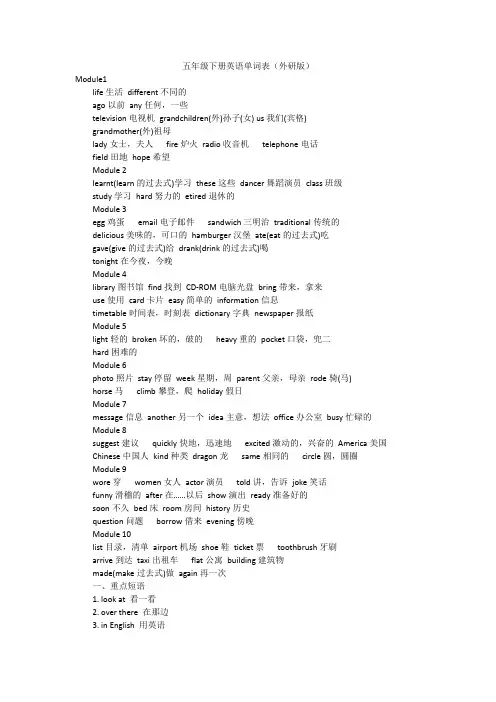
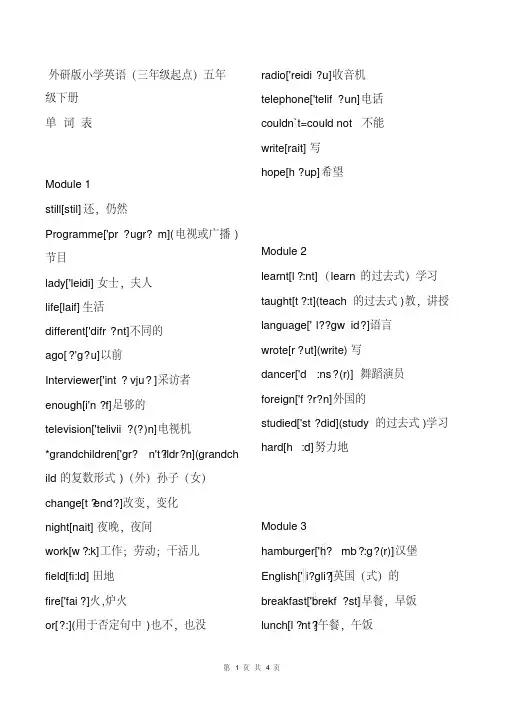
五年级下册外研版第一模块英语单词
- 格式:docx
- 大小:15.21 KB
- 文档页数:10
五年级下册外研版第一模块英语单词
全文共3篇示例,供读者参考
篇1
English Vocabulary Odyssey: Conquering Unit 1 Words
Hey there, fellow fifth-graders! As we embark on our journey
through the second semester of English class, let me share my
epic tale of conquering the vocabulary words from Unit 1 of our
trusty FLTRP textbook. Brace yourselves for an adventure filled
with challenges, triumphs, and perhaps a few laughs along the
way.
It all began when our English teacher, Ms. Wilson,
introduced us to the first set of words. Little did I know that these
seemingly innocent combinations of letters would soon become
the bane of my existence. Words like "upset," "quarrel," and
"argument" danced mockingly before my eyes, daring me to
remember their meanings and spellings.
At first, I tried the age-old technique of rote memorization. I
would repeat the words like a mantra, hoping they would
somehow engrave themselves into my brain. Alas, it was a futile effort. The words slipped through my mind like water through a
sieve, leaving me frustrated and discouraged.
But then, a stroke of genius hit me! I decided to create vivid
mental images and stories to associate with each word. For
instance, when I saw the word "upset," I pictured my little brother
knocking over a table and spilling my favorite juice all over the
floor. Needless to say, I would be quite "upset" in that situation.
Suddenly, the words took on a whole new dimension, becoming
more than just random combinations of letters.
As I delved deeper into the unit, I encountered words like
"predict," "forecast," and "expect." These words seemed to taunt
me with their abstract nature. How does one conjure up a mental
image for something as intangible as a prediction? But fear not,
my creative juices were flowing, and I came up with ingenious
associations. For "predict," I imagined a fortune-teller gazing
into a crystal ball, foretelling the future. For "forecast," I
envisioned a weatherperson dramatically pointing at a map,
warning of impending storms. And for "expect," I pictured myself
eagerly awaiting the arrival of a long-awaited package.
As the days went by, my vocabulary arsenal grew stronger
and more formidable. I found myself effortlessly incorporating
words like "encourage," "inspire," and "motivate" into my daily conversations. My parents were puzzled by my newfound
eloquence, unaware of the mental gymnastics I had been
performing to conquer these linguistic challenges.
But alas, no journey is complete without a few bumps in the
road. There were times when I struggled to differentiate between
words like "borrow" and "lend," or "lose" and "miss." In these
moments of confusion, I turned to my trusty dictionary, scouring
its pages for the subtle nuances that separated these word pairs.
And then, just when I thought I had conquered it all, our
teacher introduced us to the dreaded "phrasal verbs." Words like
"put off," "look up," and "make up" seemed to mock me with
their idiomatic complexity. But fear not, my friends, for I
embraced the challenge with open arms. I created elaborate
scenarios in my mind, acting out each phrasal verb to truly
understand its meaning.
As the end of the unit approached, I felt a sense of pride and
accomplishment. I had persevered through the trials and
tribulations of vocabulary acquisition, emerging victorious on
the other side. No longer did words like "accept," "admit," and
"agree" hold any fear for me. I had conquered them all, one
mental image at a time. And so, my fellow fifth-graders, as you embark on your own
vocabulary odyssey, remember this: Words are not mere
combinations of letters; they are gateways to a world of
understanding and expression. Embrace them, play with them,
and make them your own. For when you truly understand the
vocabulary, the world of English becomes your oyster, ready to
be explored and conquered.
Now, let us move on to the next unit, armed with our
newfound vocabulary prowess and a thirst for linguistic
adventure!
篇2
English Vocabulary: My Journey Through Module 1
Hey there, fellow students! As we dive into the exciting world
of fifth-grade English, I can't help but feel a mix of excitement
and trepidation. The first module of our textbook is like a
gateway to a whole new realm of vocabulary, and let me tell you,
it's quite an adventure!
One of the first words that caught my eye was "hobby." I
mean, who doesn't love talking about their favorite pastimes?
Whether it's collecting stamps, playing video games, or
practicing origami, hobbies are like little pockets of joy in our