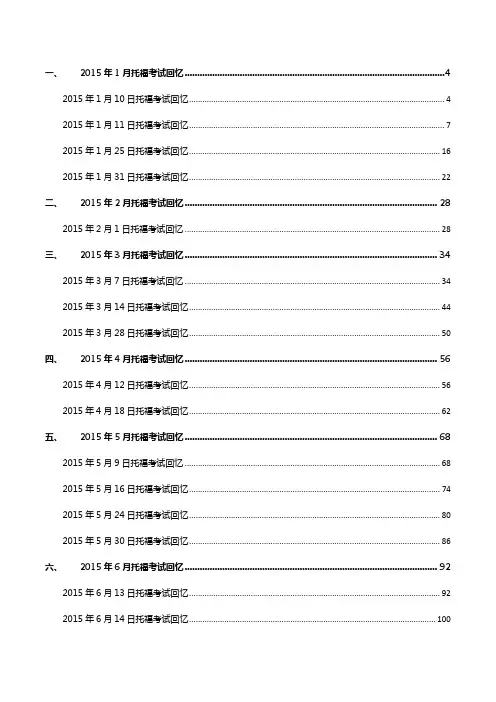
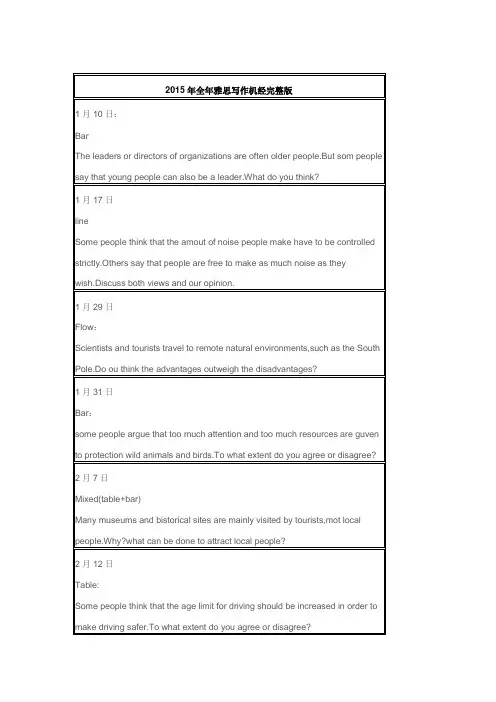
2015年2月28日阅读机经by FloraFlora温馨分享:新旧文方面:一篇旧文章两篇新文章文章题材方面:人物传记类、心理类、经济类各一篇题型分布方面:判断题共11题、填空题共15题、选择题共4题、配对题10题总体来说,本次阅读考试难度中等。
题型分布仍然以填空题和判断题为主;配对题均分布于第二篇文章中,分别是段落信息配对题和人名观点配对,其中人名观点配对题难度并不大。
填空题中以摘要题为主,建议考生们加强这类题目的练习。
Flora友情建议:针对1季度前两个月的考试,Flora建议考鸭们继续加强判断题和填空题的复习,将方法技巧和真题练习紧密结合,记得填写阅读错题自查表(集齐7张召唤Flora)!对于选择题和配对题,记得“以不变应万变”,在套题中搭配训练即可。
Flora真题速递:Passage One标题:女考古学家身赴柬埔寨探索人类部分答案回忆:判断题:1. F2.NG3.T填空题:University Funding Map ArcheologyPassage Two标题:Multitasking Debate— Can you do them at the same time?类似题目链接:Talking on the phone while driving isn't the only situation where we're worse at multitasking than we might like to think we are. New studies have identified a bottleneck in our brains that some say means we are fundamentally incapable of truemultitasking. If experimental findings reflect real-world performance, people who think they are multitasking are probably just underperforming in all - or at best, all but one - of their parallel pursuits. Practice might improve your performance, but you will never be as good as when focusing on one task at a time.The problem, according to RenéMarois, a psychologist at Vanderbilt University in Nashville, Tennessee, is that there's a sticking point in the brain. To demonstrate this, Marois devised an experiment to locate it. V olunteers watch a screen and when a particular image appears, a red circle, say, they have to press a key with their index finger. Different coloured circles require presses from different fingers. Typical response time is about half a second, and the volunteers quickly reach their peak performance. Then they learn to listen to different recordings and respond by making a specific sound. For instance, when they hear a bird chirp, they have to say "ba"; an electronic sound should elicit a "ko", and so on. Again, no problem. A normal person can do that in about half a second, with almost no effort.The trouble comes when Marois shows the volunteers an image, then almost immediately plays them a sound. Now they're flummoxed. "If you show an image and play a sound at the same time, one task is postponed," he says. In fact, if the second task is introduced within the half-second or so it takes to process and react to the first, it will simply be delayed until the first one is done. The largest dual-task delays occur when the two tasks are presented simultaneously; delays progressively shorten as the interval between presenting the tasks lengthens (See Diagram).There are at least three points where we seem to get stuck, says Marois. The first is in simply identifying what we're looking at. This can take a few tenths of a second, during which time we are not able to see and recognise a second item. This limitation is known as the "attentional blink": experiments have shown that if you're watching out for a particular event and a second one shows up unexpectedly any time within this crucial window of concentration, it may register in your visual cortex but you will be unable to act upon it. Interestingly, if you don't expect the first event, you have no trouble responding to the second. What exactly causes the attentional blink is still a matter for debate.A second limitation is in our short-term visual memory. It's estimated that we can keep track of about four items at a time, fewer if they are complex. This capacity shortage is thought to explain, in part, our astonishing inability to detect even huge changes in scenes that are otherwise identical, so-called "change blindness". Show people pairs of near-identical photos - say, aircraft engines in one picture have disappeared in the other - and they will fail to spot the differences. Here again, though, there is disagreement about what the essential limiting factor really is. Does it come down to a dearth of storage capacity, or is it about how much attention a viewer is paying?A third limitation is that choosing a response to a stimulus - braking when you see a child in the road, for instance, or replying when your mother tells you over the phone that she's thinking of leaving your dad - also takes brainpower. Selecting a response to one of these things will delay by some tenths of a second your ability to respond to the other. This is called the "response selection bottleneck" theory, first proposed in 1952.Last December, Marois and his colleagues published a paper arguing that this bottleneck is in fact created in two different areas of the brain: one in the posterior lateral prefrontal cortex and another in the superior medial frontal cortex (Neuron, vol 52, p 1109). They found this by scanning people's brains with functional MRI while the subjects struggled to choose among eight possible responses to each of two closely timed tasks. They discovered that these brain areas are not tied to any particular sense but are generally involved in selecting responses, and they seemed to queue these responses when presented with multiple tasks concurrently.Bottleneck? What bottleneck?But David Meyer, a psychologist at the University of Michigan, Ann Arbor, doesn't buy the bottleneck idea. He thinks dual-task interference is just evidence of a strategy used by the brain to prioritise multiple activities. Meyer is known as something of an optimist by his peers. He has written papers with titles like "Virtually perfect time-sharing in dual-task performance: Uncorking the central cognitive bottleneck" (Psychological Science, vol 12, p 101). His experiments have shown that with enoughpractice - at least 2000 tries - some people can execute two tasks simultaneously as competently as if they were doing them one after the other. He suggests that there is a central cognitive processor that coordinates all this and, what's more, he thinks it uses discretion: sometimes it chooses to delay one task while completing another.Even with practice, not all people manage to achieve this harmonious time-share, however. Meyer argues that individual differences come down to variations in the character of the processor - some brains are just more "cautious", some more "daring". And despite urban legend, there are no noticeable differences between men and women. So, according to him, it's not a central bottleneck that causes dual-task interference, but rather "adaptive executive control", which "schedules task processes appropriately to obey instructions about their relative priorities and serial order".Marois agrees that practice can sometimes erase interference effects. He has found that with just 1 hour of practice each day for two weeks, volunteers show a huge improvement at managing both his tasks at once. Where he disagrees with Meyer is in what the brain is doing to achieve this. Marois speculates that practice might give us the chance to find less congested circuits to execute a task - rather like finding trusty back streets to avoid heavy traffic on main roads - effectively making our response to the task subconscious. After all, there are plenty of examples of subconscious multitasking that most of us routinely manage: walking and talking, eating and reading, watching TV and folding the laundry.But while some dual tasks benefit from practice, others simply do not. "Certain kinds of tasks are really hard to do two at once," says Pierre Jolicoeur at the University of Montreal, Canada, who also studies multitasking. Dual tasks involving a visual stimulus and skeletal-motor response (which he dubs "in the eye and out the hand") and an auditory stimulus with a verbal response ("in the ear and out the mouth") do seem to be amenable to practice, he says. Jolicoeur has found that with enough training such tasks can be performed as well together as apart. He speculates that the brain connections that they use may be somehow special, because we learn to speak by hearing and learn to move by looking. But pair visual input with a verbal response, or sound to motor, and there's no dramatic improvement. "It looks like no amount ofpractice will allow you to combine these," he says.For research purposes, these experiments have to be kept simple. Real-world multitasking poses much greater challenges. Even the upbeat Meyer is sceptical about how a lot of us live our lives. Instant-messaging and trying to do your homework? "It can't be done," he says. Conducting a job interview while answering emails? "There's no way you wind up being as good." Needless to say, there appear to be no researchers in the area of multitasking who believe that you can safely drive a car and carry on a phone conversation. In fact, last year David Strayer at the University of Utah in Salt Lake City reported that people using cellphones drive no better than drunks (Human Factors, vol 48, p 381). In another study, Strayer found that using a hands-free kit did not improve a driver's response time. He concluded that what distracts a driver so badly is the very act of talking to someone who isn't present in the car and therefore is unaware of the hazards facing the driver.“No researchers believe it's safe to drive a car and carry on a phone conversation”It probably comes as no surprise that, generally speaking, we get worse at multitasking as we age. According to Art Kramer at the University of Illinois at Urbana-Champaign, who studies how ageing affects our cognitive abilities, we peak in our 20s. Though the decline is slow through our 30s and on into our 50s, it is there; and after 55, it becomes more precipitous. In one study, he and his colleagues had both young and old participants do a simulated driving task while carrying on a conversation. He found that while young drivers tended to miss background changes, older drivers failed to notice things that were highly relevant. Likewise, older subjects had more trouble paying attention to the more important parts of a scene than young drivers.It's not all bad news for over-55s, though. Kramer also found that older people can benefit from practice. Not only did they learn to perform better, brain scans showed that underlying that improvement was a change in the way their brains become active. While it's clear that practice can often make a difference, especially as we age, the basic facts remain sobering. "We have this impression of an almighty complex brain," says Marois, "and yet we have very humbling and crippling limits." For most of ourhistory, we probably never needed to do more than one thing at a time, he says, and so we haven't evolved to be able to. Perhaps we will in future, though. We might yet look back one day on people like Debbie and Alun as ancestors of a new breed of true multitaskers.Question 28-32Which paragraph contains the following information?28 A theory explained delay happens when selecting one reaction29 Different age group responds to important things differently30 Conflicts happened when visual and radio elements emerge simultaneously31 An experiment designed to demonstrate the critical part in brain for multitasking32 An viewpoint favors optimistic side of multitask performanceQuestion 33-35Choose the correct letter A, B, C or D33 Which one is correct about experiment conducted by Rene Marois?A participants performed poorly on listening task solelyB volunteers press different key on different colorC participants need use different fingers on different colored objectD they did a better job on Mixed image and sound information34 Which statement is correct about the first limitatio n of Marois’ experiment?A “attentional blink ” takes about ten secondsB lag occurs if we concentrate on one object while second one appearsC we always have trouble in reacting the second oneD first limitation can be avoided by certain measures35 Which one is Not correct about Meyer’s experiment and statements?A just after failure in several attempts can people execute dual-taskB practice can overcome dual-task interferenceC Meyer holds a different opinion on Marois’ theoryD an existing processor decides whether delay another task or notQuestion 36-40Do the following statement agree with the information given in the Reading Passage? (True, False or Not Given)36 Longer gap between two presenting tasks means shorter delay toward the second one.37 Incapable in human memory cause people sometimes miss the differences when presented two similar images.38 Marois has different opinions on the claim that training removes bottleneck effect.39 Art Kraner proved there is a correlation between multi-tasking performance and genders.40 The author doesn’t believe that effect of practice could bring any variation.部分答案回忆:人名观点配对题1. 做事速度快不意味着效率高2. 有些外界因素影响环境3 人们在面临很多选择的时候,也只能专注很少部分的事情填空题V oice mailPassage Three文章大意:由香港机构举办的企业家培训课程部分答案回忆:填空题:Venture workshops session training判断题:Y N NG Y(顺序待定)选择题A待补充。