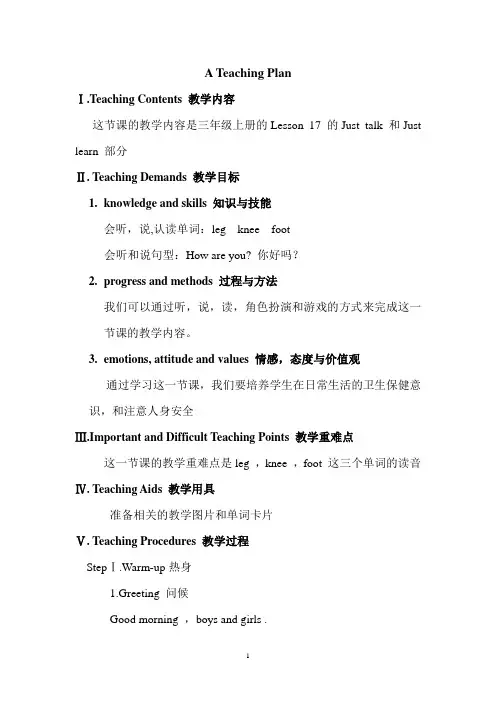
teaching plan
- 格式:doc
- 大小:61.50 KB
- 文档页数:9
外国语学院2007届毕业生教学实习教案班级:学号:姓名:指导老师:Unit 1Teaching Objective1. Master the important vocabulary and structure2. Master the writing technique of a paragraph of cause and effect.3. Master the reading skill of finding out word meanings.4. Understand the audio materials of this unit5. Able to discuss about how to learn a foreign language well.Teaching ContentSection A: Learning a Foreign Language1. Important Points:◆Learning English brings me benefits: the value of hard work, insights into other cultures, newways of seeing things, ability to bridge the gap between different cultures.◆Key words & phrases: reward, positive, opportunity, access, virtual, commitment, discipline,minimum, embarrass, reap, insight, be well worth, far from, feel like, come across, trade for, reach out to, bridge the gap◆Structure: not only (using inverted order)◆Writing technique: A paragraph of cause and effect2. Difficult Points:◆Learning a foreign language has been a most trying experience.◆Some long and difficult sentencesSection B: Keys to Successful Online Learning1.Reading Skills: Finding out Word Meanings2.Key Words and Phrases: community, expand, unique, visual, hinder, critical, perspective,arise, absolutely, explicit, reinforce, assimilate, play in a role, be aware of, reflect on, allow forListening & Speaking1.Understand statements, conversations & passages of this Unit2.Discuss the topic of the text: Learning a Foreign LanguageTime AllotmentSection A: 4 periodsSection B: 2 periodsListening Comprehension: 2 periodsUnit 1 (8 periods)Section A: Learning a Foreign Language(4 periods)Period 1-2I.Warm-up Questions / Activities1.How many years have you learned English so far?2.What’s your experiences of learning English in the past years?3.What problems do you have in learning English in your middle school? Have you thought outany ways to solve them? And how?(Reference words: be faced with, pronunciation, grammar rules, cultural background, frustrating, spoken English, memorize words)4.Do you think the computer can help you in learning English? Why?(Reference words: allow us access to sth., have more freedom to set the pace of study, select the material to one’s taste, exchange ideas with native speakers)Students are asked to discuss the above questions in groups.II.Text Structure.1.Deal with the comprehension of the text on Page 7.2.Divide the text into four parts and find the topic sentence in every part.Part I (Para. 1) IntroductionMain idea: Learning a foreign language was one of the most difficult yet most rewarding experiences of my life.Part II (Para.2-7) Main body: Four different stages of my language learning experiences.Para.2: Junior middle school learning experiencePara.3: Senior middle school learning experiencePara.4: College English learning experiencePara. 5~7: Online learning experiencePart III (Para. 8) ConclusionMain idea: Learning English brings me benefits: the value of hard work, insights into other cultures, new ways of seeing things, ability to bridge the gap between different cultures.III.Background Information1. Online learningOnline learning, a form of distance education, refers to learning and other supportive resources that are available through a networked computer. With the development of the Internet, online learning often takes place on the Internet. In an online lesson, the computer displays material (often in web browsers) in response to a learner's request. The computer asks the learner for more information and presents appropriate material based on the learner’s input. The material can be as simple as traditional lessons and their tests that are transcribed into a computer program. The material can also be a complex system that tracks users' input and suggests learning material as a result. Or the material can be a work session that occurs through a real time chat; learning occurs through the interaction. The material can be presented as text, graphics, animated graphics, audio, video, or a combination of these that are displayed in web browsers or other multimedia players such as Windows Media Player.2. American Educational SystemMany Americans believe that their educational system is or should be based on the American dream: equal chance for everyone. Most of them believe that good education is indispensable to democracy and social progress. All the children before the age of 16 are required to attend school by law.School education in America can be divided into three stages: elementary education, secondary education and higher education. Elementary, or primary, education begins at the age of five or six, ending at the age of 11 or 12. Secondary education is conducted by high schools which in nature are secondary schools. They can be divided into senior high schools and junior high schools. They may be combined in the same school, but in some places with a large population, the senior high schools are separated from the junior high schools. Secondary education ends at the age of 17 or 18.Education before the age of 18 is free for all American children, so there is no problem about gaining admission to a school before that age. As a matter of fact, there is no admission exam for primary and secondary schools. Most of the universities and colleges do not have entrance examination either. The best of the elementary and high schools are the expensive, private boarding schools which are also called “prep” schools. They are financed by the rich who want to prepare their children for the best universities.The higher education in America is done at universities or colleges. The difference between them is that a university includes a number of colleges. Even colleges are divided into two kinds. One provides four-year degrees. The other awards two-year degrees in vocational training such as computer programming, hotel and restaurant management, or practical nursing. Different states run their own state universities. These universities are founded by the state and no admission examination is requires for the residents within the state. They grant both undergraduate and graduate degrees.Most prestigious of all are the older, private Ivy League schools such as Harvard, Yale, Princeton and Columbia. Since these universities are private ones and do not enjoy tax support, students have to pay a high tuition which may amount to several thousand dollars for each student each year. Good remarks are also very import for entrance into these universities. Since they enjoy high prestige and have better qualified professors and extremely good equipment, many American youths are eager to contest for admission.American schools lay emphasis on cultivating a student’s mind rather require him to memorize facts. Students are encouraged to learn by doing, by expressing themselves and by discussing. This is to make students more adaptable to their future work.Period 3-4IV.Intensive Reading1.Learning a foreign language was one of the most difficult yet most rewardingexperiences of my life. (Para.1)Meaning: Learning a foreign language was one of the most difficult things to do but it was most worth doing in my life.rewardvt. give sth. in return for good and valuable doings报答,酬谢,奖励----The father rewarded the little boy for cleaning the room.n. 1) sth. as a return for good and valuable doings报答,奖赏----As a reward for passing the exams, she got a new bike from her parents.2) some money given to someone for his good doings报酬,酬金----I hear there is a big reward for the seizing of the thief.2.Although at times, learning a language was frustrating, it was well worth the effort.(Para.1)Meaning: Although sometimes learning a language is disappointing, it was rewarding enough to spend the time and effort on it.be well worth + noun/ doing sth.: rewarding enough for the time or effort----This report about the effect of modernization on human nature is well worth reading.----He's decided to have a look at the house for it is well worth buying.3.Because of the positive method, I eagerly answered all the questions I could, neverworrying about making mistakes. (Para.2)positivea. 1) leading to a practical action积极的,肯定的----positive advice /positive thinking2) sure, having no doubt确实的,明确的----Are you positive that he's the man you saw yesterday?4.I was at the top of my class for two years. (Para.2)Meaning: I was one of the excellent students in my class for two years.5.It didn't take me long to lose my eagerness to answer questions. (Para3)Meaning: Before long I was no longer eager to answer questions.6.Not only did I lose my joy in answering questions, but also I totally lost my desire to sayanything at all in English. (Para.3)Meaning: I not only didn't feel happy answering questions, but also I didn't want to say anything in English.Note: With "not only" or "only" placed at the beginning of a sentence, the sentence order should be inverted (倒装).----Only in this way can you hope to finish the work at the end of this month.----Not only did we enjoy the film, but we also had a wonderful time.7.Unlike my senior middle school teacher, ... (Para.4)unlike: prep. different; not like, not the same----Her recent report is quite unlike her earlier work.---Unlike me, my son likes to get up early.Compare: unlike & dislike8.However, the situation was far from perfect. (Para.4)far from: not ... at all; rather than,----Far from (being) angry, he's very happy.----Her husband is far from (being) handsome; he is somewhat ugly.9.As our classes were very large, I was only able to answer a couple of questions in eachclass period. (Para.4)Meaning: Because there were many students in our classes, I could only answer two or three questions in each class period.a couple of: two or three----I saw a couple of children playing in the garden.----Could you please lend me a couple of dollars?Compare: a couple of & a pair of10.I began to feel intimidated. (Para.4)Meaning: I began to feel frightened and lack confidence.intimidate: vt. make one frightened by threats----The thieves intimidated the general manager by saying that they would kill him.----John intimidated his brother into not telling their parents the truth.11.when I was offered an opportunity to study English through an online course. (Para.5)opportunity: n. a good chance, a favorable moment----The month of May offers a wonderful opportunity to go traveling.Compare: opportunity & chance12.I soon got access to the necessary equipment, learned the technology from a friend andparticipated in the virtual classroom 5 to 7 days a week. (Para.5)Meaning: I soon got the necessary equipment and learned how to use the equipment from a friend. Then I could take online courses 5 to 7 days a week.access: n. way of entering; right of using, reaching, or entering----The only access to that building was guarded by the soldiers.----He was not allowed access to his young brother who was in prison.---- The people in the school have access to that computer lab for free.----People living here get access to that swimming pool for free.virtual: a. almost what is stated; made-up----The king was so much under the control of his wife that she was the virtual ruler of the country.----With the use of the Internet, many virtual communities are set up.13.... it requires much time, commitment and discipline to keep up with the flow of thecourse. (Para. 6)Meaning: ... and online learning requires that we give much time and attention to it and learn or work in a controlled way, so that we can keep up with the progress of the course.commitmentn. 1) devotion to信奉,献身----The online course would not have succeeded without the commitment of all the teachers.2) a promise to follow certain beliefs or action承诺,许诺,保证----Come and look round our shop without commitment to buy anything.disciplinen. 1) a state of order and control; self control纪律; 控制----He did not like the army because of the strict discipline.----It takes a lot of discipline to eat less and lose weight.要做到少吃减肥得遵守许多清规戒律。