人教版高中英语选修8 unit 5《meeting your ancestors》优秀教案(重点资料).doc
- 格式:doc
- 大小:4.99 MB
- 文档页数:68
1 Unit 5 Meeting your ancestors
【美文阅读】
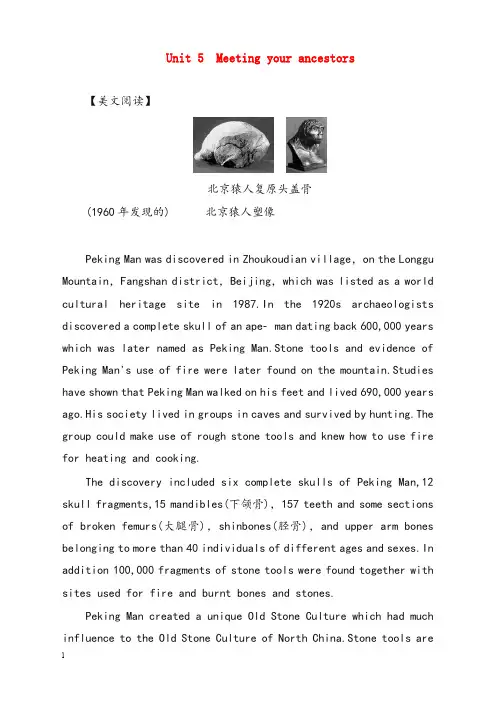
北京猿人复原头盖骨
(1960年发现的) 北京猿人塑像
Peking Man was discovered in Zhoukoudian village,on the Longgu
Mountain,Fangshan district,Beijing,which was listed as a world
cultural heritage site in 1987.In the 1920s archaeologists
discovered a complete skull of an apeman dating back 600,000 years
which was later named as Peking Man.Stone tools and evidence of
Peking Man's use of fire were later found on the mountain.Studies
have shown that Peking Man walked on his feet and lived 690,000 years
ago.His society lived in groups in caves and survived by hunting.The
group could make use of rough stone tools and knew how to use fire
for heating and cooking.
The discovery included six complete skulls of Peking Man,12
skull fragments,15 mandibles(下颌骨),157 teeth and some sections
of broken femurs(大腿骨),shinbones(胫骨),and upper arm bones
belonging to more than 40 individuals of different ages and sexes.In
addition 100,000 fragments of stone tools were found together with
sites used for fire and burnt bones and stones.
Peking Man created a unique Old Stone Culture which had much
influence to the Old Stone Culture of North China.Stone tools are 2 the principal relics of this remote culture.Also discovered in
Zhoukoudian are stone points,a new production tool then,and bone
articles made and used by Peking Man.Found in the caves were such
tools as the larger end of an antler(鹿角,茸角) that had been used
as a hammer and the sharp end of an antler used as a digging tool.
The use of fire was a milestone of the development of
civilization and the discovery of Peking Man has pushed back the
time that man first used it by tens of thousands of years.The largest
ash pile discovered in the caves is six metres thick.Fire allowed
people to eat cooked food instead of raw food and promoted the
development of the brain and improved health.With his rough tools
and simple living conditions,Peking Man created a unique and very
ancient culture.
【诱思导学】
1.When was Peking Man Site at Zhoukoudian listed as a world
cultural heritage?
______________________________________________
2.According to the studies,when did Peking Man live?
______________________________________________
3.What kind of tools did Peking Man use?
______________________________________________
【答案】 1.In 1987. 2.About 690,000 years ago.
3.Stone tools.
Period ⅠPreviewing
3
(教师用书独具)
●教学目标
本课时主要是通过学生对学案所给出的内容的学习,了解本课文中所出现的词汇,初步了解课文以及相关的背景知识,为下一堂课对课文的全面理解起到一个铺垫作用。
●教学地位
本单元的主题是考古学,涉及到历史和人类学,语言知识和语言技能都是围绕这一主题设计的。具体涉及“周口店遗址的北京猿人”、“早期人类生活方式”、“如何判断遗址年份”、“秦始皇兵马俑”和“埃及金字塔”等,帮助学生增长考古学知识,更好地了解早期人类的生活方式和人类文明的发展进程。
(教师用书独具)
●新课导入建议
根据教材P37“读前”(prereading)呈现的北京猿人的头盖骨图片,让学生通过谈论我们今天使用的生活用品及生活方式猜测几十万年前北京猿人可能使用的生活用品和生活方式,将学生的思维引入“史前人类生活”,为下文阅读做好铺垫。
●教学流程设计 4 导入新课。⇒学生阅读“话题美文导读”与“诱思导学”(见学案第74页)。⇒学生就“话题美文导读”进行讨论,统一答案。⇓
学生再次阅读课文(课本第38-39页)并完成“语篇理解”(见学案第75页)。⇐师生共同讨论并统一答案。⇐让学生快速阅读课文(课本第38-39页)并完成“篇章结构”(见学案第75页)。
⇓
学生共同讨论,并让学生发表各自见解,最后统一答案。⇒学生再次仔细阅读课文(课本第38-39页),进行深度理解,并完成“课文缩写”(见学案第76页)。⇒老师指导学生讨论,共同找出答案。
⇓
让学生根据所给出的表格进行自我评估(见学案第77页)。⇐学生讨论,并让学生代表发表他们讨论得出的答案。老师予以更正。⇐让学生完成“知识初探”部分(见学案第76页)。
⇓
老师布置作业,让学生看课本第38-39页并完成课本第39页1、2、3 题,预习学案Period Ⅱ(见学案第77页),写一篇描述考古发现的短文。
Ⅰ.篇章结构
阅读P38-39Reading部分,然后完成下列表格
Some of the earliest
people lived in 1.
________ Evidence Conclusion
How could they live ★Human and animal They lived in caves. 5 there? bones
★Tools and
2. ________
How did they keep
warm?
Fireplaces in the
center of the caves They used fire to 3.
________,cook the
food and scare wild
animals away.
4.________ They kept the fire
burning all winter.
No doors They hung animal
skins at the cave
mouth to keep out
the cold.
What 5.________
were there? Bones of tigers and
bears Tigers and bears
were their most
dangerous enemies.
How did they make
clothes? 6.________ made of
animal bones ★They used
7.________ stone
tools to cup up
animals and remove
their skin.
★They used
8.________ to 6 remove the fat and
meat from the skin.
★They rubbed an
ample amount of salt
onto the skin to
9.________.
What did they use to
make ornaments? Animal bones and
10.________ ★Perhaps there was
trade between early
peoples or they
travelled to the
seaside.
【答案】 1.the Zhoukoudian caves 2.other objects
3.keep warm yers of ash 5.wild animals 6.Needles
7.sharpened 8.smaller scrapers 9.made it soft 10.seashells
Ⅱ.语篇理解
阅读P38-39Reading部分,选择最佳答案
1.The main idea of the text is about the ________ of the earliest
people in the Zhoukoudian caves.
A.life and habits
B.food and clothing
C.homes and fishing
2.The primitive necklace found in the cave shows that ________.
A.our ancestors made ornaments and sold them for money
![人教版高中英语【选修八】[重点题型巩固练习] Unit 5 Meeting your ancestors语言点](https://imgs-1438308264.cos.ap-hongkong.myqcloud.com/c53a645ecaaedd3383c4d3fc.webp)