在马克思墓前的讲话原文及翻译
- 格式:doc
- 大小:31.00 KB
- 文档页数:3
Frederick Engels
Karl Marx's Funeral
Der Sozialdemokrat, March 22, 1883
On Saturday, March 17, Marx was laid to rest in Highgate Cemetery, in the same
grave in which his wife had been buried fifteen months earlier.
At the graveside Gottlieb Lemke laid two wreaths with red ribbons on the coffin in
the name of the editorial board and dispatching service of the Sozialdemokrat and in
the name of the London Communist Workers' Educational Society.
Frederick Engels then made the following speech in English:
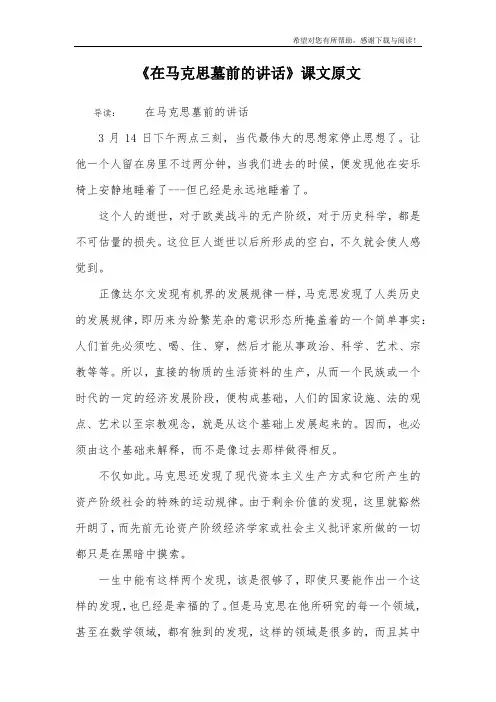
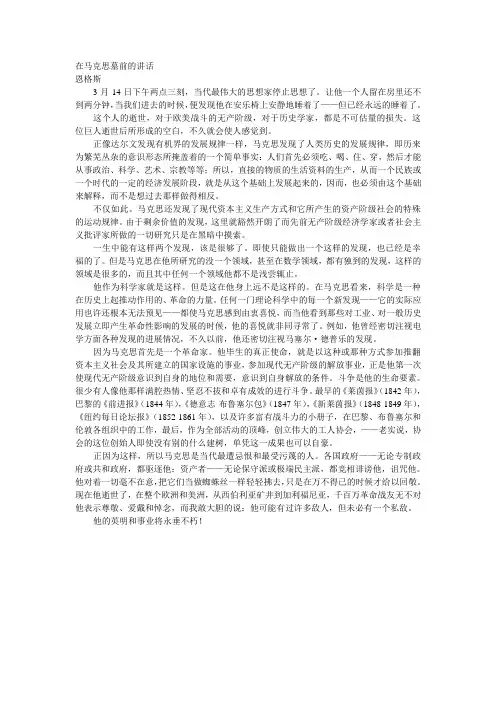
"On the 14th of March, at a quarter to three in the afternoon, the greatest living
thinker ceased to think. He had been left alone for scarcely two minutes, and when we
came back we found him in his armchair, peacefully gone to sleep-but forever.
"An immeasurable loss has been sustained both by the militant proletariat of Europe
and America, and by historical science, in the death of this man. The gap that has been
left by the departure of this mighty spirit will soon enough make itself felt.
"Just as Darwin discovered the law of development of organic nature, so Marx
discovered the law of development of human history: the simple fact, hitherto
concealed by an overgrowth of ideology, that mankind must first of all eat, drink, have
shelter and clothing, before it can pursue politics, science, art, religion, etc.; that
therefore the production of the immediate material means of subsistence and
consequently the degree of economic development attained by a given people or
during a given epoch form the foundation upon which the state institutions, the legal
conceptions, art, and even the ideas on religion, of the people concerned have been
evolved, and in the light of which they must, therefore, be explained, instead of vice
versa, as had hitherto been the case.
"But that is not all. Marx also discovered the special law of motion governing the
present-day capitalist mode of production and the bourgeois society that this mode of
production has created. The discovery of surplus value suddenly threw light on the
problem, in trying to solve which all previous investigations, of both bourgeois
economists and socialist critics, had been groping in the dark.
"Two such discoveries would be enough for one lifetime. Happy the man to whom it
is granted to make even one such discovery. But in every single field which Marx
investigated -- and he investigated very many fields, none of them superficially -- in
every field, even in that of mathematics, he made independent discoveries.
"Such was the man of science. But this was not even half the man. Science was for
Marx a historically dynamic, revolutionary force. However great the joy with which
he welcomed a new discovery in some theoretical science whose practical application
perhaps it was as yet quite impossible to envisage, he experienced quite another kind
of joy when the discovery involved immediate revolutionary changes in industry and
in historical development in general. For example, he followed closely the
development of the discoveries made in the field of electricity and recently those of
Marcel Deprez.
"For Marx was before all else a revolutionist. His real mission in life was to
contribute, in one way or another, to the overthrow of capitalist society and of the
state institutions which it had brought into being, to contribute to the liberation of the
modern proletariat, which he was the first to make conscious of its own position and
its needs, conscious of the conditions of its emancipation. Fighting was his element.
And he fought with a passion, a tenacity and a success such as few could rival. His
work on the first ‘Rheinische Zeitung’ (1842), the Paris ‘Vorwärts’ (1844),
‘Brüsseler Deutsche Zeitung’ (1847), the ‘Neue Rheinische Zeitung’ (1848-49), the
‘New York Tribune’ (1852-61), and in addition to these a host of militant pamphlets,
work in organisations in Paris, Brussels and London, and finally, crowning all, the
formation of the great International Working Men's Association -- this was indeed an
achievement of which its founder might well have been proud even if he had done
nothing else.
"And, consequently, Marx was the best-hated and most calumniated man of his time.
Governments, both absolutist and republican, deported him from their territories.
Bourgeois, whether conservative or ultra-democratic, vied with one another in
heaping slanders upon him. All this he brushed aside as though it were cobweb,
ignoring it, answering only when extreme necessity compelled him. And he died
beloved, revered and mourned by millions of revolutionary fellow-workers -- from the