
M3U4 Space Exploration Space Exploration Grammar
- 格式:pptx
- 大小:1.44 MB
- 文档页数:19
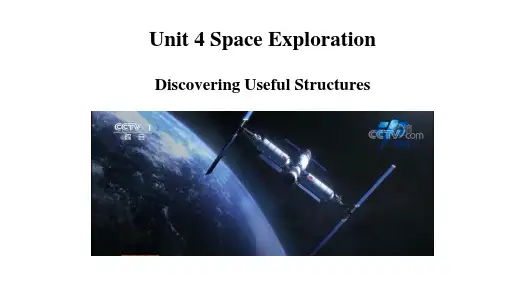
Unit 4 Space Exploration
Reading and Thinking
【教学目标】
1. Read quickly to get detailed information according the timeline; read carefully
to summarize the main idea.
2. Learn the reading skills—finding the timeline and summarizing the main idea
by finding the words or ideas.
3. Have a passion for our country and be proud of the space exploration.
4. Learn to think critically about the space exploration.
【教学重难点】
1. Read quickly to get detailed information according the timeline; read carefully
to summarize the main idea.
2. Learn the reading skills—finding the timeline and summarizing the main idea
by finding the words or ideas.
【教学过程】
Step 1 Lead in—Small talk
Watch a video about Space experiment and discuss what you have learnt from it.
Step 2 Before reading—Predict the content
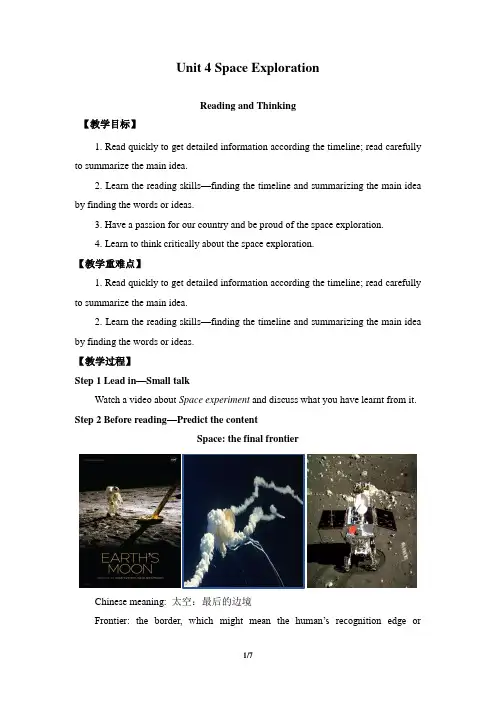
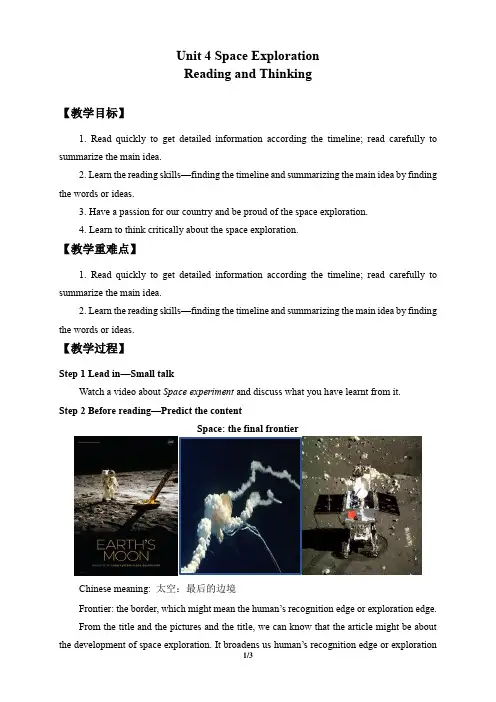
Space: the final frontier

Reading and Thinking
SPACE: THE FINAL FRONTIER
太空:最后的边境
“Are we alone? What’s out there?” Looking up at the stars, people have always
wanted to learn more about space, and scientists work hard to find answers. They make
vehicles to carry brave people into space to find out the secrets of the universe. They
also really wish to discover other planets that are suitable enough to support life.
“我们是否孤独?太空以外是什么?”
仰望星空,人们一直想更多地了解太空,科学家们也在努力寻找答案。他们制造运载勇敢的人儿进入太空的交通工具来探索宇宙的秘密。他们也非常希望发现其他适合生命存在的行星。
Before the mid-20th century, most people felt travelling into space
was an
impossible dream. However, some scientists were determined to help humans realise
their dream to explore space. After many experiments, they succeeded
in
making
rockets that could escape Earth’s gravity. On 4 October 1957, the Sputnik 1 satellite
Unit 4 Space Exploration
Reading and Thinking
【教学目标】
1. Read quickly to get detailed information according the timeline; read carefully to
summarize the main idea.
2. Learn the reading skills—finding the timeline and summarizing the main idea by finding
the words or ideas.
3. Have a passion for our country and be proud of the space exploration.
4. Learn to think critically about the space exploration.
【教学重难点】
1. Read quickly to get detailed information according the timeline; read carefully to
summarize the main idea.
2. Learn the reading skills—finding the timeline and summarizing the main idea by finding
the words or ideas.
【教学过程】
Step 1 Lead in—Small talk
Watch a video about Space experiment and discuss what you have learnt from it.
Step 2 Before reading—Predict the content
Space: the final frontier
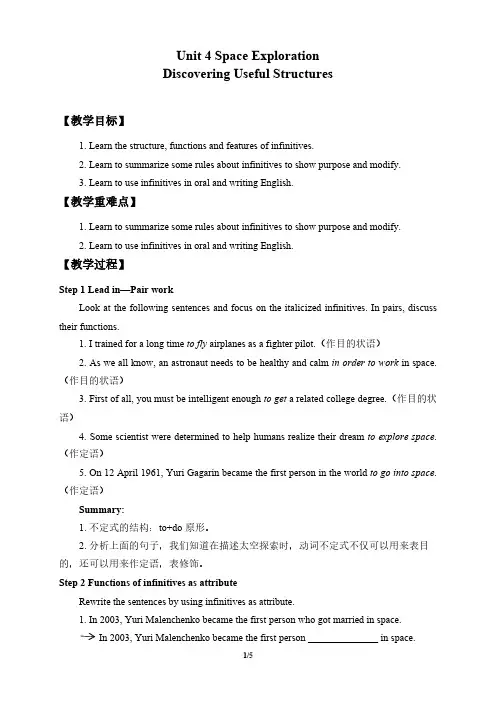
Unit 4 Space Exploration
Discovering Useful Structures
【教学目标】
1. Learn the structure, functions and features of infinitives.
2. Learn to summarize some rules about infinitives to show purpose and modify.
3. Learn to use infinitives in oral and writing English.
【教学重难点】
1. Learn to summarize some rules about infinitives to show purpose and modify.
2. Learn to use infinitives in oral and writing English.
【教学过程】
Step 1 Lead in—Pair work
Look at the following sentences and focus on the italicized infinitives. In pairs, discuss
their functions.
1. I trained for a long time
to fly
airplanes as a fighter pilot.
(作目的状语)
2. As we all know, an astronaut needs to be healthy and calm
in order to
work
in space.
(作目的状语)
3. First of all, you must be intelligent enough
to get
a related college degree.
(作目的状
语)
4. Some scientist were determined to help humans realize their dream