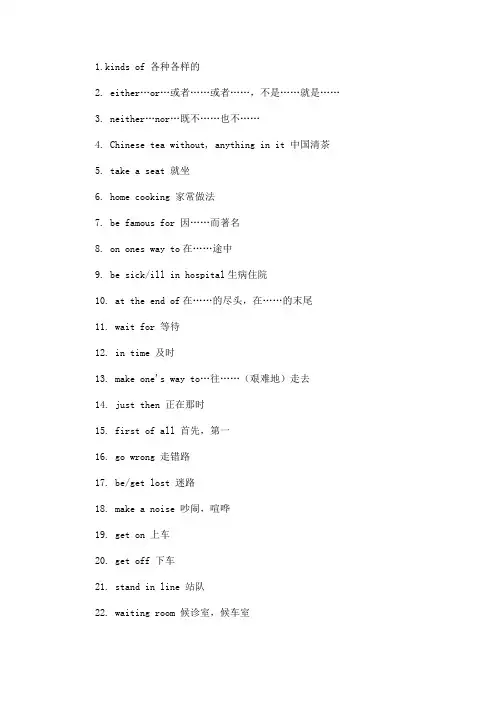
初一英语短语积累
- 格式:doc
- 大小:46.50 KB
- 文档页数:2
☆☆☆☆☆☆☆☆☆时态:一般现在时态:含意:表示经常发生的或习惯性的动作.(常用主谓宾结构)常用句型结构:主语+谓语+宾语(用来表述主语做了某件事)【谓语动词是由一个能表示出一个具体动作的实意动词来表示的】谓语动词通常用原型,当主语是单数第三人称时,谓语动词+s/es;【当句子中有usually(通常) often(经常) always(一直,总是) every day(每天)】例:I have three baseballs and a basketball.I like bananas and strawberries.She has hamburgers and French fries for breakfast.He often does homework after supper.Unit 5 Do you have a soccer ball ?1、动词have 的用法(have 有示拥有某个物体,后面跟名词)①说明拥有某物就用陈述句:I have a computer .My brother has a new bike and my sister has a new skirt .②没有某物就用否定句(就是将陈述句变成否定句.在谓语have 前加don’t 或doesn’t)→I don’t have a computer.→My brother doesn’t have a new bike.(使用了助动词do/ does 动词变回原形) ③询问某人是否有某物就用一般疑问句(就是将陈述句变为一般疑问句:在句首加助动词Do / Does; 当主语是单数第三人称时,助动词选Does,谓语动词变回原形)→Do you have a computer ? Yes ,I do . No , I don’t .→Does your brother have a new bike ? Yes ,he does . No, he doesn’t.2、关于have 句型的用法(向别人建议搞某项活动)例: A: Let’s play soccer ball . (提个建议)B: I don’t have a soccer ball . (否定该建议)A: Do you have a basketball ? (询问是否有某物)B: Yes , I do .I have a new basketball.A: Well . Let’s play basketball . (再提建议)B: That sounds good . (同意)①提建议所用句型: Let’s do sth.= Let us do sth.(让我们做某事)Let 后面接动词用原形.Let’s go .(我们去)→Let’s +动词(原形)②同意所提意见,常用这样句形:That’s a good idea .= A good idea .(好主意.)That sounds good (听起来很棒!).That sounds interesting.(听起来很有趣!) That sounds fun.(听起来很好玩!)③不同意可以说That sounds boring.(听起来很无聊.) That sounds difficult.(听起来很难)Unit 6 Do you like bananas ?1、动词like (喜欢) 表示一个人的习惯和爱好(就用一般现在时).一般用原形,当主语为单数第三人称时,like 加S !例: I like oranges . They like salad . she likes bananas.We like Friday because we have PE that day .My sister really likes apples ,so she often eats an apple after lunch.(like 后面接的是水果和食物时,这些词应用复数.英语常用复数来表示某一个种类.)①谈论一个人的喜好就用陈述句:I like apples but I don’t like strawberries.The boys like salad and they also like broccoli.My sister likes ice cream but she doesn’t like French fries.(肯定句变否定句就是在like 前加上don’t 或doesn’t;使用了do/ does , likes就要变回like.)②询问别人的爱好就用一般疑问句(就是将肯定句变为一般疑问句,在句首加助动词Do /Does.)→Do you like apples ? Yes , I do . No, I don’t.→Do the boys salad ? Yes ,they do . No, they don’t.→Does your sister like ice cream ? Yes ,she does. No,she doesn’t.③当要说明喜欢做某件事就要用到句型:like to do sth.(因为like 本身是动词,后再用动词,中间就用to 连接.)I like to watch TV at home .(我喜欢在家看电视.)My brother likes to play computer games (我的兄弟喜欢打电子游戏)2、☆☆☆☆关于名词的分类:名词根据其性质可分为可数名词和不可数名词.①可数名词的数量是1时用单数(单数名词前加冠词a /an),复数名词以s/es结尾.②不可数名词指的是没法数得清的名词:如broccoli, chicken, salad (I不可数名词没有复数形式,就当单数对待,用it 替换)3、关于吃饭: 所用动词have /eat (吃)Have breakfast = eat breakfast eat dinner = have dinner问:What do you eat for breakfast ? 答: I eat a hamburger for breakfast.问:What does your mother eat for lunch ? She often eats rice for lunch.( have + 食品for breakfast /lunch /dinner 表示早/午/晚饭吃)【若三顿饭吃什么,三顿饭breakfast/ lunch/ dinner前加介词for 】【蔬菜vegetables 水果fruits 可以加S 用作复数.但食物food 不能用复数】Unit 7 How much are these pants ?1.提问物品的价钱就用句型:How much + 系动词(is /are ) +商品?答:It’s +价钱/They’re +价钱.【商品由名词来充当,前面可以有修饰词the ,物主代词或指示代词this /that these/those】(this/that后面接名词的单数形式, these/ those 后接名词的复数形式.)How much is the blue sweater ? It is 42 dollars.How much are these black pants ? They are 88 yuan.2.买东西常用口头语:①售货员打招呼用语:Can I help you ?= What can I do for you ?答句: Yes ,please. I want a +物品.(肯定回答) No, thanks.(否定)②Here you are (给你.) 递东西时用语③问颜色:What color do you like ?/ What color do you want ?④购买: I’ll take it .(我会买上的)3.介绍商品的颜色和价钱是所用的介词:颜色:We have T-shirts in red, green and white.= We have red ,green and white T-shirts.(因为表示颜色的词既可以当名词,又可以当作形容词对待.)价钱:We have great bags for only$12.(我们有只售12美元的包.)You can buy socks for only $5 each.(你可以买到5元一双的袜子)Unit 8 When is your birthday ?☆☆☆☆日期的表示法:先说月份(由专有名词表示),现说日期(用序数词表示)【序数词是由基数词变化而来的.序数词一般都以th 结尾.】变化规则:1.一般直接在基数词后加th;( nine 除外. 【nine是去掉e再加th】)2.以ve 结尾的为ve 为f再加th .five→fifth, twelve →twelfth.3.以y结尾的基数词变y 为I 再加eth. Thirty →thirtieth4.多位数的基数词只需要将个位变成序数词,其它位不变.twenty-two→1twenty-second.☆☆☆☆提问活动的时间: When + 系动词(is / are ) + 活动名称?When is your birthday ? My birthday is January twenty- ninth.When is the School Day ? It’s October second.☆☆☆☆提问人的年龄: How old +系动词+ 主语(人)?答:主语+ 系动词+数字.How old are you ? I am thirteen (years old).How old is your grandfather ? He is seventy .☆☆☆☆提问日期和星期几所用句型:提问日期:What’s the date ,today ?答:It’s + 日期。
提问星期几:What day is it ,today ? 答:It’s +星期几。
(星期几是由专有名词表示。
)Unit 9 Do you want to go to a movie?1.常见的电影的种类: comedy(喜剧) action movie(武打片)thriller(恐怖片) documentary(纪录片)2.谈论对电影的喜好:I like comedies but I don’t like thrillers .(变成单数第三人称)→He likes comedies but he doesn’t like thrillers .(谓语动词加s/es)What kind of movies do you like ? I like thrillers .Why do you like thrillers ? Because they are exciting.【一般各个电影所具备的基本特征:】Action movies →exciting ; comedies →funny /fun ;documentaries→boring ; Thrillers →interesting but scary; Beijing Opera →relaxing3.对电影发表的看法: I think +句子. 【这个句子有完整的结构:主系表/ 主谓宾.】I like action movies . I think they are very exciting.June doesn’t like thrillers .She thinks they are scary.Unit 10 Can you play the guitar ?一.关于乐器的名词:guitar(吉它) piano(钢琴) violin(小提琴) trumpet(喇叭) drum (鼓)所有的乐器使用的动词都是play .例: play the guitar, play the trumpet.Play 的用法:①play 直接加球名;play basketball, play volleyball ,play baseball.③play +the 乐器.play the violin ,play the piano, play the drum.③play with sb.(与某人一起玩) play with my friends play chess二.关于对能力的讨论:1.表示能力要使用情态动词can .can 后面必须接实意动词,才能表示出具体的能力.使用主谓宾结构: 主语+ can +实意动词.(若变否定句,只需在can 后加not即可can not =can’t;变一般疑问句,只需要将can 提到主语之前即可.)例:We can speak some English now.(现在我们能讲一些英语了.)【情态动词can只有过去式could 和原形两种,它不会有其它变化,因而不能加s /es】2.实意动词:能表示一个具体动作的动词.常见的有:look(看) listen (听) swim(游泳) dance(跳舞) run(跑步) sing(唱歌) speak(讲话) tell(告诉) ask(问) eat(吃) like(喜欢) play(玩) want(想要) join (加入)用法:这些实意动词常用在句子中做谓语动词,表示主语做了某个动作.三.关于can 的综合运用:①中心话题(通过询问参加某个俱乐部来提问人的能力)例:A: What club do you want to join ? A: What club do you want to join ?B: I want to join the music club. B: I want to join the swimming clubA: Can you sing or dance ? A: Can you swim ?B: Yes , I can . B: No, I can’t.②书写招聘启事可以将所招人员的条件用can 来表示:Musicians Wanted for the Rock BandWe want two musicians for our band .Can you play the guitar ? Can you play the Drums ? Can you sing ?Please call us at 6715274.(联系方式)Unit 11 What time do you go to school?一.表示一些日常活动的动词短语:Get up (起床) take a shower= have a shower (洗澡)eat breakfast(吃早饭)have English(上英语课)run(跑步)go to school(去上学)go to work(去上班)take a bus(乘公交车)go home =get home(回家)listen to music(听音乐)watch TV(看电视)do homework(做作业) go to bed (上床睡觉)二.提问日常活动时间:What time +助动词+ 主语+ 谓语动词?答:主语+谓语+时间短语。