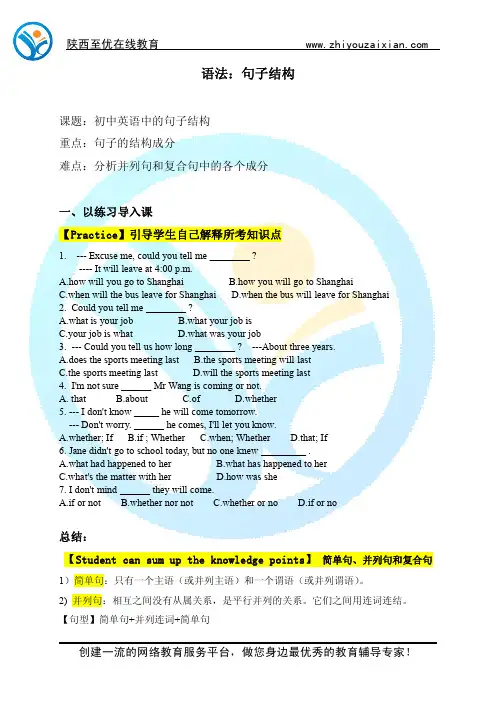
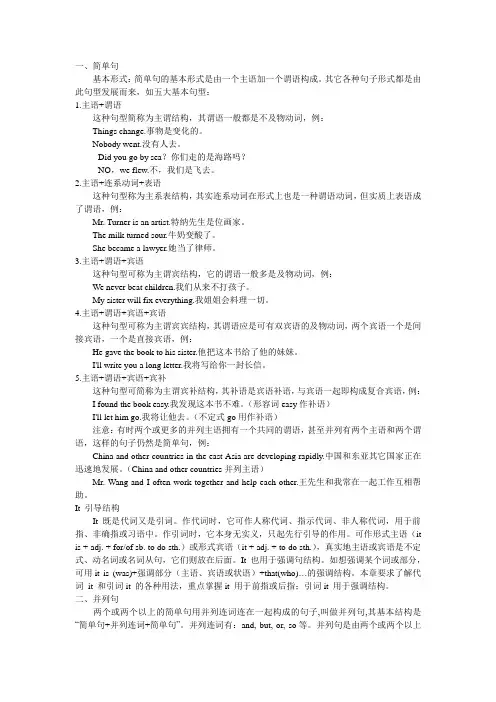
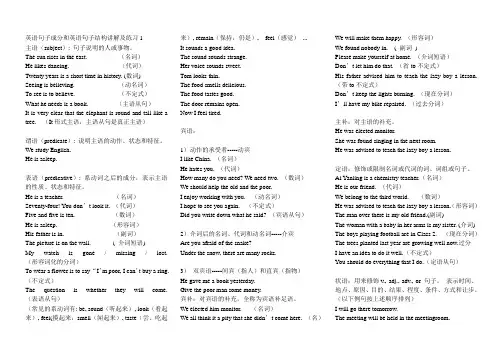
英语语法句子结构大全
- 格式:pdf
- 大小:152.09 KB
- 文档页数:7
【 导语】在世界经济全球化及中国加⼊WTO的形势下,社会需要⼤量能够⽤英语在国际上进⾏科技、经贸、法律和⽂化等⽅⾯交流的专业⼈才。以下是由⽆忧考精⼼收集了英语语法句⼦结构,供⼤家欣赏学习!
【篇⼀】英语语法句⼦结构 句⼦的成分
1.定义:组成句⼦的各个部分叫做句⼦的成分,即:主语、谓语、表语、宾语、宾语补⾜语、定语和状语。主语和谓语是句⼦的主体部分。表语、宾语、宾语补⾜语都是谓语⾥的组成部分。
句⼦成分 意 义 例 句
主 语 表⽰句⼦所说的是"什么⼈"或"什么事物",⼀般由名词、代词或相当于名词的词或短语等充当。 Lucy is anAmerican girl .
We study in No.1 Middle School .
谓 语 说明主语"做什么"、"是什么"或者"怎么样"。谓语(谓语部分⾥主要的词)⽤动词。谓语和主语在"⼈称"和"数"两⽅⾯必须⼀致 We love China . / She is singing .
Mike hopes to be a doctor . / His parents are farmers .
表 语 说明主语是什么或者怎么样,由名词、形容词或相当于名词或形容词的词或短语等充当,和连系动词⼀起构成谓语。 Her aunt is a driver . / Are you ready ?
We were at home last night .
句⼦成分 意 义 例 句
宾 语 表⽰动词、⾏为的对象,由名词、代词或相当于名词的词、短语等充当,和及物动词⼀起说明主语做什么。 Heoften helps me . / We study English at school.( 励志天下 www.lizhi123.net )
Did you see him yesterday ?
定 语 ⽤来修饰名词或代词。作定语的除形容词外,还有代词、数词、名词、介词短语或相当于形容词的词或短语等。The black bike is mine. / What's your name, please ?
We have four lessons in the morning ? 状 语 ⽤来修饰动词、形容词或副词。⼀般表⽰⾏为发⽣的时间、地点、⽬的、⽅式、程度等意义,通常由副词、介词短语或相当于副词的词或短语等来表⽰。 People are all working hard. / It is very nice.
We had a meeting this afternoon .
宾语补⾜语 英语中有些及物动词,除有⼀个直接宾语以外,还有⼀个宾语补语,才能使句⼦的意义完整。这类词有:make, consider, cause, see, find, call, get, have, let等。 He made me very angry.
I find him a good boy .
【篇⼆】英语语法句⼦结构 ⼀、名词复数规则
1.⼀般情况下,直接加-s,如:book-books, bag-bags, cat-cats, bed-beds
2.以s。 x。 sh。 ch结尾,加-es,如:bus-buses, box-boxes, brush-brushes, watch-watches
3.以“辅⾳字母 y”结尾,变y为i, 再加-es,如:family-families, strawberry-strawberries
4.以“f或fe”结尾,变f或fe为v, 再加-es,如:knife-knives 〕
Leaf--leaves
5.不规则名词复数:
man-men, woman-women, policeman-policemen, policewoman-policewomen,
child-children
foot-feet。tooth-teeth
fish-fish, people-people, Chinese-Chinese, Japanese-Japanese 写出下列各词的复数
I _________him _________this ___________her ______
watch _______child _______photo ________diary ______
day________ foot________ book_______ dress ________
tooth_______ sheep ______box_______ strawberry _____
peach______ sandwich ______dish_______bus_______
man______ woman_______
⼆、⼀般现在时
⼀般现在时基本⽤法介绍
【No。 1】⼀般现在时的功能
1。表⽰事物或⼈物的特征、状态。如:The sky is blue。天空是蓝⾊的。
2。表⽰经常性或习惯性的动作。如:I get up at six every day。我天天六点起床。
3。表⽰客观现实。如:The earth goes around the sun。地球绕着太阳转。
⼀般现在时的构成
1。 be动词:主语 be(am,is,are) 其它。如:
I am a boy。我是⼀个男孩。
2。⾏为动词:主语 ⾏为动词( 其它)。如:
We study English。我们学习英语。 当主语为第三⼈称单数(he, she,it)时,要在动词后加“-s”或“-es”。如:Mary likes Chinese。玛丽喜欢汉语。
【No。 2】⼀般现在时的变化
1。 be动词的变化。
否定句:主语 be not 其它。
如:He is not a worker。他不是⼯⼈。
⼀般疑问句:Be 主语 其它。
如:-Are you a student?
-Yes。 I am。 / No, I‘m not。
⾮凡疑问句:疑问词 ⼀般疑问句。如:Where is my bike?
2。⾏为动词的变化。
否定句:主语 don’t( doesn‘t ) 动词原形( 其它)。如:
I don’t like bread。
当主语为第三⼈称单数时,要⽤doesn‘t构成否定句。如:
He doesn’t often play。
⼀般疑问句:Do( Does ) 主语 动词原形 其它。如:
- Do you often play football?
- Yes, I do。 / No, I don‘t。 当主语为第三⼈称单数时,要⽤does构成⼀般疑问句。如:
- Does she go to work by bike?
- Yes, she does。 / No, she doesn’t。
动词 s的变化规则
1.⼀般情况下,直接加-s,如:cook-cooks, milk-milks
2.以s。 x。 sh。 ch。 o结尾,加-es,如:guess-guesses, wash-washes, watch-watches, go-goes
3.以“辅⾳字母 y”结尾,变y为i, 再加-es,如:study-studies
【篇三】英语语法句⼦结构 倒装有两种:
将主语和谓语完全颠倒过来,叫做完全倒装(Complete Inversion)。如:In came a man with a white beard.
只将助动词(包括情态动词)移⾄主语之前,叫做部分倒装(Partial Inversion)。如:Only once was John late to class.
英语句⼦的倒装⼀是由于语法结构的需要⽽进⾏的倒装,⼆是由于修辞的需要⽽进⾏的倒装。前⼀种情况,倒装是必须的,否则就会出现语法错误;后⼀种情况,倒装是选择性的,倒装与否只会产⽣表达效果上的差异。下⾯本⽂就拟从其修辞功能谈谈倒装句的⽤法。
⼀、 表⽰强调:
倒装句最突出、最常见的修辞效果就是强调,其表现形式如下:
1. only +状语或状语从句置于句⾸,句⼦⽤部分倒装。
eg.Only in this way can you solve this problem. 只有⽤这种⽅法,你才可以解决这个问题。
eg.Only after he had spoken out the word did he realize he had made a big mistake.只有当他已经说出那个字后才意识到⾃⼰犯了个⼤错误。 2. not, little, hardly, scarcely, no more, no longer, in no way, never, seldom, not only, no sooner等具有否定意义的词或词组位于句⾸,句⼦⽤部分倒装。
eg. No sooner had I got home than it beg.an to rain. 我刚到家就下起了⾬。
eg. Seldom do I go to work by bus. 我很少乘公共汽车上班。
3. so / such...that结构中的so或such位于句⾸可以构成部分倒装句,表⽰强调so /such和that之间的部分。
eg.So unreasonable was his price that everybody startled. 他的要价太离谱,令每个⼈都瞠⽬结⾆。
eg.To such length did she go in rehearsal that the two actors walked out. 她的彩排进⾏得那么长,以致于那两个演员都⾛出去了。
以上各例⼦都⽤倒装语序突出了句⾸成分,其语⽓较⾃然语序强烈,因⽽具有极佳的修辞效果。
⼆、 承上启下
有时倒装可把前⼀句说到的⼈或物,或与前⼀句有联系的⼈或物在下⼀句紧接着先说出来,从⽽使前后两句在意思上的关系更加清楚,衔接更加紧密,起到承上启下的作⽤。
eg.They broke into her uncle's bedroom and found the man lying on the floor, dead. Around his head was a brownsnake. 他们破门进⼊她叔叔的卧室,发现他躺在地板上死了。⼀条棕褐⾊的蛇缠在他头上。
eg. We really should not resent being called paupers. Paupers we are, and paupers we shall remain. 我们确实不应因为被称作穷光蛋⽽愤愤不平。我们的确是穷光蛋,⽽且还会继续是穷光蛋。
三、 制造悬念,渲染⽓氛
在新闻或⽂学创作中,有时为了内容的需要,或是为了强调,作者常常运⽤倒装来制造悬念,渲染⽓氛。如:
Hanging on the wall was a splendid painting. 墙上挂着⼀幅精美的图画。
再如朗费罗(Longfellow)《雪花》中的⼀节:
Out of the bosom of the Air,