
tooeitheralsoaswell辨析及测试题
- 格式:doc
- 大小:13.50 KB
- 文档页数:2
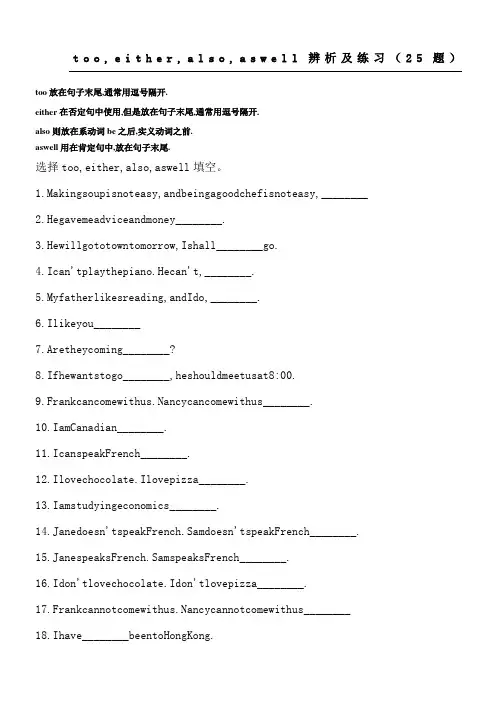
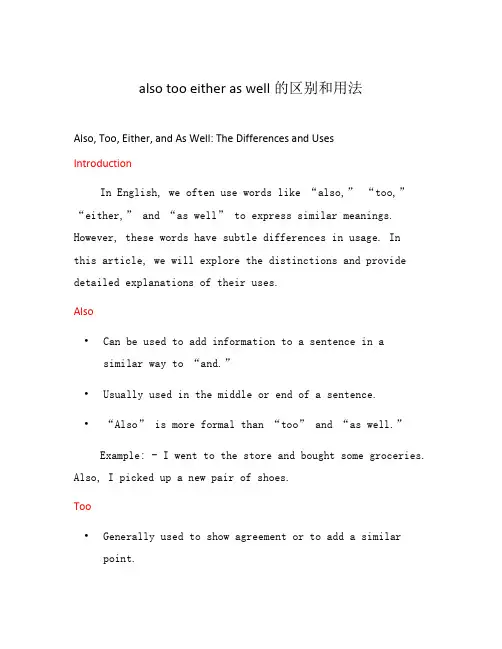
also too either as well的区别和用法Also, Too, Either, and As Well: The Differences and UsesIntroductionIn English, we often use words like “also,” “too,” “either,” and “as well” to express similar meanings. However, these words have subtle differences in usage. Inthis article, we will explore the distinctions and provide detailed explanations of their uses.Also•Can be used to add information to a sentence in a similar way to “and.”•Usually used in the middle or end of a sentence. •“Also” is more formal than “too” and “as well.”Example: - I went to the store and bought some groceries. Also, I picked up a new pair of shoes.Too•Generally used to show agreement or to add a similar point.•Used at the end of a sentence, following the subject. •Has a less formal tone compared to “also” and “as well.”Example: - She is going to the party tonight. I’m going too.Either•Used in a negative or alternative context.•Followed by “or” when presen ting a choice between two options.•Used when presenting options that are mutually exclusive.Example: - I don’t eat chocolate. I don’t like it either.As Well•Similar to “also” and “too” in meaning but is less commonly used.•Usually used at the end of a sentence.•Has a more formal tone than “too.”Example: - He plays the guitar. He sings as well.Summary•“Also” is formal, used to add information.•“Too” shows agreement or similarity.•“Either” presents negative or alternative op tions. •“As well” is a formal alternative to “also” and “too.”Remember, understanding the nuances of these words will help you convey your thoughts more accurately and effectively in English. Practice using them in various contexts to become more proficient in their usage.Additional Uses and ExamplesNow, let’s delve deeper into the uses of “also,” “too,” “either,” and “as well” by providing more examples and explanations.Also•“Also” can be used to add information to a sentence, similar to “and.”–Example: She loves to dance. She also enjoyspainting.•It is often used in the middle or end of a sentence.–Example: He studied hard for the exam. He also attended review classes.•“Also” is more formal than “too” and “as well.”–Example: She is not only talented but alsohardworking.Too•“Too” is used to show agreement or to add a similar point.–Example: Sarah is coming to the party. I’m coming too.•It is usually used at the end of a sentence, following the subject.–Example: I like ice cream too.•“Too” has a less formal tone compared to “also” and “as well.”–Example: He loves football too.Either•“Either” is used in a negative or alternative context.–Example: I don’t eat meat. I don’t eat fisheither.•It is followed b y “or” when presenting a choice between two options.–Example: You can either go to the movies or stay at home.•“Either” is used when presenting options that are mutually exclusive.–Example: You can either come with us or stay here alone.As Well•“As well” is similar in meaning to “also” and “too,”but it is less commonly used.–Example: They are talented singers. They are actors as well.•It is usually used at the end of a sentence.–Example: We will be attending the conference. We will be presenting our research as well.•“As well” has a more formal tone than “too.”–Example: He can swim. He can dive as well.ConclusionIn conclusion, while “also,” “too,” “either,” and “as well” have similar meanings, they have distinct uses and nuances. Understanding their differences will enable you to express yourself more precisely in English. Remember to practice using these words in various contexts to enhance your fluency and accuracy in conveying your ideas.。

tooalsoaswelleither的区别too also as well either的区别:too作为副词,意为太、过于,用于形容词和副词前;also作为副词,意为而且、也,放在行为动词之前,特殊动词之后;as well意为也、还,常位于句末;either可作代词和副词,意为任何一个、要么要么,常用于否定句,且放句末。
一、too的基本含义及用法介绍too作为副词,意为(用于形容词和副词前)太,过于,过度;也;又;还;(评说某事物使情况更糟)而且。
例句:He's far too young to go on his own.他年纪太小,不能独自一人去。
Can I come too?我也可以来吗?She broke her leg last week─and on her birthday too!她上星期把腿摔断了,而且还是在她生日那一天!I'm not too sure if this is right.这是否正确,我没有太大把握。
二、also的基本含义及用法介绍also作为副词,意为而且;此外;也;同样。
例句:She was not only intelligent but also very musical.她不仅聪明,而且极具音乐天分。
I didn't like it that much. Also, it was much too expensive. 我并不怎么喜欢它。
再说它太贵了。
She's fluent in French and German. She also speaks a little Italian.她的法语和德语讲得流利,也会说一点意大利语。
三、as well的基本含义及用法介绍as well意为也、还。
例句:They sell books as well as newspapers.他们既卖报也卖书。

also too either as well的区别和用法(实用版)目录1.引言2.also, too, either 和 as well 的含义和用法的区别3.also 和 too 的用法4.either 的用法5.as well 的用法6.总结正文一、引言在英语中,副词"also", "too", "either"和"as well"经常被用来表示不同的意思。
尽管它们在某些情况下可以互换使用,但它们之间仍然存在一些关键的差异。
在本文中,我们将详细讨论这些差异以及如何正确使用这些副词。
二、also, too, either 和 as well 的含义和用法的区别1.also:也,用于表示某个观点或行为也适用于另一个观点或行为。
例句:I like apples and I also like oranges.(我喜欢苹果,我也喜欢橙子。
)2.too:也,用于表示强调,通常放在句尾。
例句:I am very tired, too.(我也非常累。
)3.either:(两者之中)任何一个,用于表示两者之间的选择。
例句:You can choose either a book or a magazine.(你可以选择一本书或一份杂志。
)4.as well:也,用于表示某个观点或行为同样适用于另一个观点或行为。
通常放在句尾。
例句:She is a great dancer and a great singer as well.(她是一名优秀的舞者,同时也是一名优秀的歌手。
)三、also 和 too 的用法1.also:用于句中,表示两个观点或行为之间的联系。
例句:He is a talented artist and he also plays the piano.(他是一名有才华的艺术家,而且他也会弹钢琴。
)2.too:用于句尾,表示强调。

also too either as well的区别和用法(一)Also, Too, Either, As well的区别和用法1. Also•用法一:位于句首的also–用于强调一个陈述句,并提供额外的信息,相当于汉语中的“还有”–例如:Also, I will need your help with this project. •用法二:位于句中的also–用于强调句中的某个词或短语,强调方式更为突出–例如:I love hiking, and also swimming.•用法三:位于句尾的also–用于加强某个陈述句,并给出相似的事实–例如:She loves reading, also.2. Too•用法一:位于句尾的too–用于表示与前面陈述相同的情况或意见,相当于汉语中“也是”–例如:I am tired, too.•用法二:位于句中的too–用于强调句中某人或某物和其他人或物一样–例如:He, too, has a dog.3. Either•用法一:位于句尾的either–用于在否定句中表示两种选择中的任何一种–例如:I don’t like tea, either.•用法二:either…or…–用于表示两种选择之间的关系,相当于汉语中的“要么…要么…”–例如:You can either study or play games.4. As well•用法一:位于句尾的as well–用于表示除了前面提到的情况之外,还有另外一项–例如:I like cooking and gardening as well.•用法二:as well as–用于列举一系列事物时,表示“还有…以及…”–例如:He is good at playing soccer as well asbasketball.以上是also, too, either, as well的常见用法及区别。
通过合理运用这些词语,可以使你的表达更加准确明确。