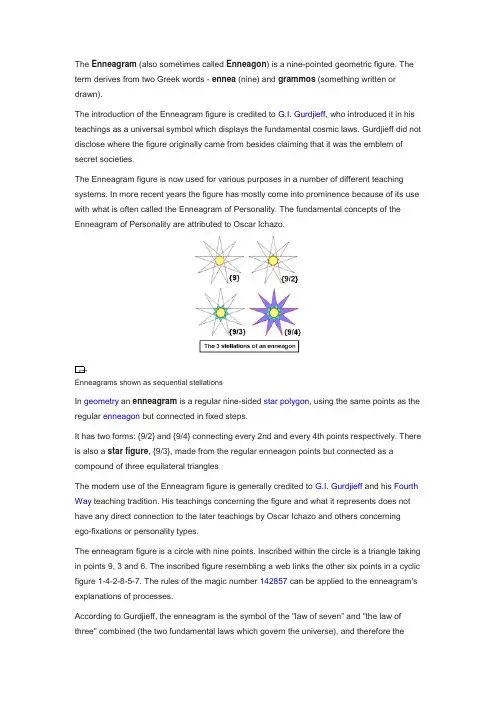
The Enneagram (also sometimes called Enneagon) is a nine-pointed geometric figure. The term derives from two Greek words - ennea(nine) and grammos (something written or drawn).The introduction of the Enneagram figure is credited to , who introduced it in his teachings as a universal symbol which displays the fundamental cosmic laws. Gurdjieff did not disclose where the figure originally came from besides claiming that it was the emblem of secret societies.The Enneagram figure is now used for various purposes in a number of different teaching systems. In more recent years the figure has mostly come into prominence because of its use with what is often called the Enneagram of Personality. The fundamental concepts of the Enneagram of Personality are attributed to Oscar Ichazo.Enneagrams shown as sequential stellationsIn an enneagram is a regular nine-sided , using the same points as the regular but connected in fixed steps.It has two forms: {9/2} and {9/4} connecting every 2nd and every 4th points respectively. There is also a star figure, {9/3}, made from the regular enneagon points but connected as a compound of three equilateral trianglesThe modern use of the Enneagram figure is generally credited to and his teaching tradition. His teachings concerning the figure and what it represents does not have any direct connection to the later teachings by Oscar Ichazo and others concerning ego-fixations or personality types.The enneagram figure is a circle with nine points. Inscribed within the circle is a triangle taking in points 9, 3 and 6. The inscribed figure resembling a web links the other six points in a cyclic figure 1-4-2-8-5-7. The rules of the magic number can be applied to the enneagram's explanations of processes.According to Gurdjieff, the enneagram is the symbol of the "law of seven" and "the law of three" combined (the two fundamental laws which govern the universe), and therefore the enneagram can be used to describe any natural whole phenomenon, cosmos, process in life, or any other piece of knowledge.A basic example of the possible usage of the enneagram is that it can be used to illustrate Gurdjieff's concept of the evolution of the three types of ‘food’ necessary for a man: ordinary food, air and impressions. Each point on the enneagram in this case wouldrepresent the stage and the possibility of further evolution of food at a certain stage in the human body.Most processes on the enneagram are represented through octaves where the points serve as the notes; a concept which is derived from Gurdjieff’s idea of the law of seven. In a n octave the developing process comes to a critical point (one of the triangle points) at which help from outside is needed for it to rightly continue. This concept is best illustrated on the keys of the piano where every white key would represent an enneagram web point. The adjacent white keys which are missing a black key (half note) in between represent the enneagram web points which have a triangle point in between.In order that this point would pass onto the next, an external push is required.In the enneagram a process is depicted as going right around the circle beginning at 9 (the ending point of a previous process). The process can continue until it reaches point 3. At point three an external aid is needed in order that the process continues. If it doesn't receive the ‘help’, the process will stop evolving and will devolve back into the form from which it evolved. The process continues until point 6, and later 9, where a similar "push" is needed. If the process passes point 9, the initial process will end, while giving birth to a new one.The line of development associated with the Fourth Way developed from the writings of Gurdjieff's students - principally , , and . Theydeveloped Gurdjieff's ideas and left their own accounts. There is an extensive bibliography devoted to the Gurdjieff-Ouspensky tradition.A Gurdjieff foundation exists which claims an authority based on a line of succession directly through Mr Gurdjieff. The foundation preserves Gurdjieff's music and movements and continues its own work with the Enneagram figure.The enneagram as a structured process was studied by and his associates. Bennett showed how it applied to something as mundane as a restaurant as well as to something as spiritual as the Beatitudes. It is currently being used to explicate the idea of self-organization in management.The Enneagram of Personality is derived from (established in . Court 970 F.2d 1067, 1075. 2nd Circuit, 1992) partial understandings of the insights of Oscar Ichazo., the Bolivian-born founder of the (established in 1968). No evidence has appeared before Ichazo's offerings for using the Enneagram figure with concepts such as "ego fixations" or "personality types" or indeed in any way where each point is described in a way that can be viewed as a typology. All historical documentation of this kind of terminology appears only after Ichazo's original teachings.Ichazo claims that sometime in the 1950s he received insight into how certain mechanistic and repetitive thought and behavior patterns can be understood in connection with the Enneagram figureand with what he called Trialectic logic as part of a complete and integrated model of the human psyche. The purpose of Ichazo's teachings was to help people transcend their identification with - and the suffering caused by - their own mechanistic thought and behavior patterns.The theory was founded upon the basic premise that all life seeks to continue and perpetuate itself and the human psyche must follow the same common laws of reality as such. From this, Ichazo defined three basic human instincts for survival (Conservation, Relations and Adaptation) and two poles of attraction to self-perpetuation (Sexual and Spiritual). With a baseline of a psyche in a state of unity as a prototypical model, the Fixations were defined as aberrations from this baseline, much as the DSM is an observationally based tool for recognizing personality disorders. In fact, Ichazo has related the Fixations with the DSM categories to show that Fixations are the precursor to mental illness. Each Fixation is diagnosed from the particular experience of psychological trauma a child suffers when the child's expectations are not met in each respective Instinct. Since a child is completely self-centered in its expectations, it is inevitable that the child will experience disappointment of expectation viewed by the child as a matter of one of the three fundamental attitudes (attracted, unattracted or disinterested are the only possible attitudes), and thus experience trauma and begin to form mechanistic thought andbehavior patterns in an attempt to protect itself from experiencing a recurrence of the trauma.This basic, irrefutable understanding of three fundamental Instincts and three possible attitudes along with the understanding that a human being can be in a state of unity, analyzed with Trialectic logic forms a solid foundation upon which the theory of Fixations is based. As such, the theory of ego Fixations has a particular foundation which can be tested. The idea of "Personality Types" is an invention of intuition without any particular foundation beyond the theory of ego Fixations, and as such can be interpreted to mean whatever any of the Enneagram of Personality proponents chooses it to mean whenever they choose to so interpret it. Thus we understand why there is no specific, solid agreement among the various proponents of "Personality" as something objective and anything more than a proposition to obfuscate human suffering.By understanding one's Fixations and through self observation, the hold on the mind, and suffering caused by the Fixations, is reduced and even transcended. There was never an intention or purpose in Ichazo's original work to use this knowledge to reinforce or manipulate what is essentially a source of human suffering. Therefore almost all later interpretations of the Enneagram of Personality are viewed by Ichazo as unfounded and therefore misguided and psychologically harmful as well as spirituallyharmful (in the sense of coming to see one's process as such) in light of his original intentions. In other words, the Enneagram Movement can be considered, in most cases, to actually be promoting the strengthening of the basis for the personality disorders we find expositions of in the DSM.From the 1970s Ichazo's partial and misunderstood Enneagram teachings were adapted and developed by a number of others, first by the Chilean-born psychiatrist, , who was a member of a training program in Arica, Chile with Ichazo for some months in 1969. Naranjo taught his understanding of the Enneagram of Personality to a number of his American students, including some Jesuit priests who then taught it to seminarians.It is believed by Enneagram theorists that the points of the Enneagram figure indicate a number of ways in which nine principal ego-archetypal forms or types of human personality (also often called "Enneatypes") are psychologically connected. These nine types are often given names that indicate some of their more distinctively typical characteristics. Such names are insufficient to capture the complexities and nuances of the types which require study and observation to understand in depth.Some brief descriptions of the Enneatypes are as follows:: Reformer, Critic, Perfectionist- This type focuses on integrity. Ones can be wise, discerning and inspiring in their quest for thetruth. They also tend to dissociate themselves from their flaws or what they believe are flaws (such as negative emotions) and can become hypocritical and hyper-critical of others, seeking the illusion of virtue to hide their own vices. The One's greatest fear is to be flawed and their ultimate goal is perfection. The corresponding "deadly sin" Ones is Anger and their "holy idea" or essence is Holy Perfection. Under stress Ones express qualities of Fours and when relaxed qualities of Sevens.: Helper, Giver, Caretaker- Twos, at their best, are compassionate, thoughtful and astonishingly generous; they can also be prone to behavior, clinginess and manipulation. Twos want, above all, to be loved and needed and fear being unworthy of love. The corresponding "deadly sin" of Twos is Pride and their "holy idea" or essence is Holy Will. Under stress Twos express qualities of Eights and when relaxed qualities of Fours.: Achiever, Performer, Succeeder- Highly adaptable and changeable. Some walk the world with confidence and unstinting authenticity; others wear a series of public masks, acting the way they think will bring them approval and losing track of their true self. Threes are motivated by the need to succeed and to be seen as successful. The corresponding "deadly sin" of Threes is Deceit and their "holy idea" or essence is Holy Law. Under stress Threes express qualities of Nines and when relaxed qualities of Sixes.: Romantic, Individualist, Artist- Driven by a desire to understand themselves and find a place in the world they often fear that they have no identity or personal significance. Fours embrace individualism and are often profoundly creative and intuitive. However, they have a habit of withdrawing to internalize, searching desperately inside themselves for something they never find and creating a spiral of depression. The corresponding "deadly sin" of Fours is Envy and their "holy idea" or essence is Holy Origin. Under stress Fours express qualities of Twos and when relaxed qualities of Ones.: Observer, Thinker, Investigator - Fives are motivated by the desire to understand the world around them, specifically in terms of facts. Believing they are only worth what they contribute, Fives have learned to withdraw, to watch with keen eyes and speak only when they can shake the world with their observations. Sometimes they do just that. However, some Fives are known to withdraw from the world, becoming reclusive hermits and fending off social contact with abrasive cynicism. Fives fear incompetency or uselessness and want to be capable and knowledgeable above all else. The corresponding "deadly sin" of the Five is and their "holy idea" or essence is Holy Omniscience. Under stress Fives express qualities of Sevens and when relaxed qualities of Eights.: Loyalist, Devil's Advocate, Defender - Sixes long for stability above all else. They exhibit unwavering loyalty and responsibility,but once betrayed, they are slow to trust again. They are prone to extreme anxiety and behavior. Their greatest fear is to lack support and guidance. The corresponding "deadly sin" of the Six is Cowardice and their "holy idea" or essence is Holy Faith and Strength. Under stress Sixes express qualities of Threes and when relaxed qualities of Nines. There are two kinds of Sixes - phobic and counterphobic. Phobic Sixes have a tendency to run or hide from things they fear while counterphobic Sixes are more likely to confront their fears.: Enthusiast, Adventurer, Materialist, Epicure - Sevens are adventurous, and busy with many activities with all the energy and enthusiasm of the . At their best they embrace life for its varied joys and wonders and truly live in the moment; but at their worst they dash frantically from one new experience to another, too scared of disappointment to actually enjoy themselves. Sevens fear being unable to provide for themselves or to experience life in all of its richness. The corresponding "deadly sin" of Sevens is Gluttony and their "holy idea" or essence is Holy Wisdom". Under stress Sevens express qualities of Ones and when relaxed qualities of Fives.: Leader, Protector, Challenger - Eights value personal strength and they desire to be powerful and in control. They concern themselves with self-preservation. They are natural leaders, who can be either friendly and charitable or dictatorially manipulative, ruthless, and willing to destroy anything in their way. Eights seekcontrol over their own lives and destinies, and fear being harmed or controlled by others. The corresponding "deadly sin" of the Eight is Lust and their "holy idea" or essence is Holy Truth. Under stress Eights express qualities of Fives and when relaxed qualities of Twos.: Mediator, Peacemaker, Preservationist - Nines are ruled by their empathy. At their best they are perceptive, receptive, gentle, calming and at peace with the world. On the other hand, they prefer to dissociate from conflicts; they indifferently go along with others' wishes, or simply withdraw, acting via inaction. They fear the conflict caused by their ability to simultaneously understand opposing points of view and seek peace of mind above all else. The corresponding "deadly sin" of the Nine is Sloth and their "holy idea" or essence is Holy Love. Under stress Nines express qualities of Sixes and when relaxed qualities of Threes.Whilst a person's Enneatype is determined by only one of theego-fixations, their personality characteristics are also influenced and modified in different ways by all of the other eight fixations as well.Most Enneagram teachers and theorists believe that one of the principal kinds of influence and modification come from the two points on either side of their Enneatype. These two points are known as the 'Wings'.Observation seems to indicate, for example, that Ones will tend to manifest some characteristics of both Nines and Twos. Some Enneagram theorists believe that one of the Wings will always have a more dominant influence on an individual's personality, while others believe that either Wing can be dominant at any particular time depending on the person's circumstances and development.This aspect of Enneagram theory was originally suggested by Claudio Naranjo and then further developed by some of the Jesuit teachers. The lines of the triangle and hexagon are believed to indicate psychological dynamics between the points connected depending on whether a person is in a more stressed or secure and relaxed state. Therefore the connecting points on the lines are usually called the 'Stress Points' and 'Security Points'. In Don Riso's teachings these lines are also called the 'Directions of Integration' and the'Directions of Disintegration' as he believes that the security points also indicates the 'direction' towards greater psychological wellbeing and the stress points towards psychological breakdown. The more traditional understanding of the stress and security points is that when people are in a more secure or relaxed state they will tend to express aspects of the 'security' or 'integration' type associated with their main type and aspects of the other direction when stressed. Relaxed or secure Ones, for instance, will tend to manifest some more positive aspects of the Seven personality type, Ones tending to be highly self-inhibitory whereas Sevens givethemselves permission to enjoy the moment. On the other hand, stressed Ones will express some more negative aspects of the Four personality, particularly the obsessive introspection; they also share a certain amount of self-loathing and self-inhibition. Another emerging belief about these connections between points is that people may access and express the positive and negative aspects of both points depending on their particular circumstances.The connecting points are often indicated on Enneagram figures by the use of arrows and are sometimes also called 'Arrow Points'. The sequence of stress points is 1-4-2-8-5-7-1 for the hexagon and 9-6-3-9 for the triangle. The security points sequence is in the opposite direction ( and 9-3-6-9). These sequences are found in the repeating decimals resulting from division by 7 and 3, respectively, both of those numbers being important to 's system. (1/7 = ...; 1/3 = ..., 2/3 = ..., 3/3 = ...).Each type also has three main instinctual subtypes - theSelf-Preservation, Sexual and Social subtypes. Because each point is different, it may be perceived as having a tendency toward one subtype or another. It requires keen observation and understanding to discover a person's tendency toward a particular subtype.Self-Preservation subtypes pay most attention to physical survival needs.Sexual subtypes focus most on intimacy and one-to-onerelationships.Social subtypes care most about others, in groups andcommunities.These are very similar to the "need areas" of the -B instrument, called "Inclusion" "Control" and "Affection", except that the score in each area carries equal weight in the person's overal personality, and there is no "tendency" towards one or another.The Enneagram types have also been mapped to 's "Three Trends" (Moving Towards, Against, Away from), in two dimensions of "Surface Direction" and "Deep Direction" (which also roughly parallel FIRO's "Expressed" and "Wanted" behavior). Each type on the surface moves one way, but underneath can move a different way. This then determines their behavior and its motivations.SurfaceDirection→Deep Direction↓— Against(confronting)0 Away(withdrawing)+ Towards(embracing)+ Towards(ApprovalSeeking)3960 Away(Ideal147Seven of the Enneagram types can be correlated with thetraditional . Two additional 'sins', 'deceit' and 'fear', are also included.One – , as the frustration that comes from Ones working hard to do things right while the rest of the world doesn't care about doing things right and not appreciating the sacrifices and efforts Ones have made.Two – , as self-inflation of the ego, in the sense of Twos seeing themselves as indispensable to others and to having no needs whilst also being needed by others.Three – , in the misrepresentation of self by marketing and presenting an image valued by others rather than presenting an authentic self.Four – of someone else reminds Fours that they can never be what another person is, reawakening their sense ofself-defectiveness.Five – , as the hoarding of resources in an attempt to minimize their needs in the face of a world that takes more than it gives; thus isolating Fives from the world.Seeking)— Against(PowerSeeking)8 5 2Six –, often in the form of a generalized anxiety that can't find an actual source of fear. Sixes may wrongly identify a source of fear through projection, possibly seeing enemies and dangers where there are none.Seven – , not in the sense of eating too much but, rather, of sampling everything the world has to offer (breadth) and not taking the time for richer experience (depth).Eight – , in the sense of wanting more of what Eights find stimulating, to a point beyond which most people would feel overwhelmed and stop.Nine – , or laziness in discovering a personal agenda and instead choosing the less problematic strategy of just going along with other people's agendas.Because of differences among teachers in their understanding of the personality characteristics of the nine types and more theoretical aspects of Enneagram dynamics some skeptics argue that more research needs to be done to test the Enneagram as an empirically valid typology.While some believe that does not support the Enneagram's validity (especially regarding the concepts of Wings and the Stress and Security Points), others believe that because of its complex and 'spiritual' nature the Enneagram typology cannot be accurately evaluated by conventional empirical methods.Recently published research (2005) based on a type indicator questionnaire developed by Don Riso and Russ Hudson claims to have demonstrated that the nine Enneagram types are "real and objective". Katherine Chernick Fauvre also claims to have statistically validated research that indicates that the three Instinctual Subtypes are real and objective.Concerning the brain, at least three different models have been proposed for identifying a basis for the Enneagram in neuroscience: Asymmetry in PFC and amygdala activityTriune brainDifferential neurotransmitter activityConcerning the first brain model, a partially finished book entitled "" was posted for free download in December 2005. This book, written by a self-described "hacker", presents a model for linking the Enneagram to the current findings of neuroscience regarding (PFC) and asymmetry.Concerning the second brain model, offers a different theory on the neuroscience of Enneagram. This article was originally published in the October 2000 issue of the and links the Enneagram with Paul MacLean's theory.In his 1996 book The Emotional Brain: The Mysterious Underpinnings of Emotional Life (at pages 92-103 of the paperback version), neuroscientist rejected McLean's triune brain model to the extentthat this model limits emotional functions to what McLean called the "". LeDoux explains that emotional functions are not limited to the limbic system . areas of the also play various roles); conversely, the limbic system is not limited to emotional functions . that area also processes certain functions). If LeDoux's criticisms of the triune brain theory are correct this would obviate this second model as a useful basis for the Enneagram in neuroscience.Concerning the third brain model, the paper offers a theory that the different Enneagram types derive from different activity levels of the neurotransmitters , , and .Some psychologists and researchers regard the Enneagram as a that uses an essentially arbitrary set of personality dimensions to make its characterizations. Such critics assert that claims for the Enneagram's validity cannot be verified using the empirical as they lack and cannot be disproven. In this respect, the Enneagram is not considered to be any different from many other typological models, such as that of on which the is based.The Pontifical Council for Culture and the Pontifical Council for Interreligious Dialogue of the have also expressed concerns about the Enneagram when it is used in a religious context, because it is claimed that it "introduces an ambiguity in the doctrine and the life of the Christian faith".Some critics suspect that the claims for the Enneagram's validity may be attributed to the , the tendency for people to believe a supposedly tailored description of themselves even when the description has been worded in very broad terms.。