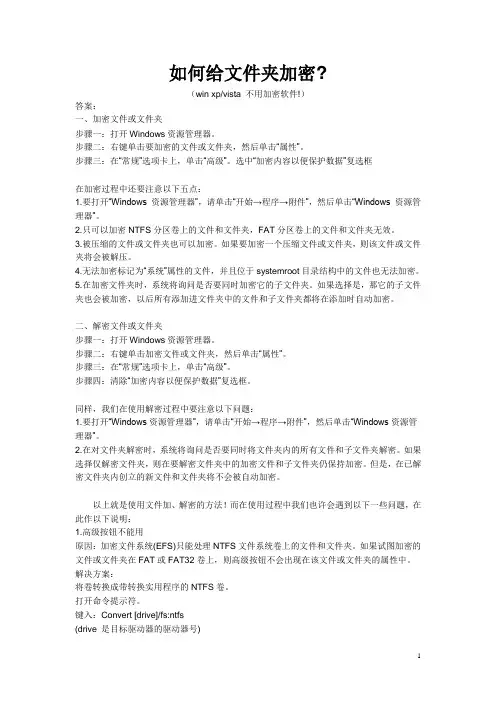
给文件加密的常用方法
- 格式:doc
- 大小:16.48 KB
- 文档页数:8
给文件加密的常用方法
English Answer:
Common Methods of File Encryption.
In today's digital world, protecting the
confidentiality and integrity of sensitive data is of
paramount importance. Encryption plays a crucial role in
securing data by transforming it into an unreadable format,
making it inaccessible to unauthorized parties. Here are
some of the most commonly used methods of file encryption:
1. Symmetric-Key Encryption:
In symmetric-key encryption, a single key is used
for both encryption and decryption.
This method is efficient and widely used, but the
security of the system relies solely on the secrecy of the
key.
Examples: AES, DES, Blowfish.
2. Asymmetric-Key Encryption:
Also known as public-key encryption, this method
uses a pair of keys: a public key and a private key.
The public key is used to encrypt the data, while
the private key is used to decrypt it.
This system provides enhanced security as the
private key remains secret and the public key can be shared
securely.
Examples: RSA, ECC, DSA.
3. Hashing:
Hashing is a one-way function that generates a
fixed-length output from a variable-length input.
It is often used to create digital signatures and
check the integrity of files.
Examples: MD5, SHA-1, SHA-256。
4. Hybrid Encryption:
This method combines symmetric-key and asymmetric-key encryption for improved security.
The symmetric key is used to encrypt the data, and
the public key is used to encrypt the symmetric key.
This approach offers the speed of symmetric-key
encryption with the enhanced security of asymmetric-key
encryption.
5. File-Level Encryption:
This method encrypts individual files on a disk or
file system.
The encryption is typically transparent to the user,
and the files are decrypted on the fly when they are
accessed.
Examples: BitLocker, FileVault, VeraCrypt.
6. Cloud-Based Encryption:
With the increasing use of cloud storage services,
cloud-based encryption has become important.
This involves encrypting data before it is uploaded
to the cloud, ensuring that it remains protected even in
the event of a data breach.
Examples: Amazon S3 Encryption, Microsoft Azure
Storage Encryption.
7. Hardware-Based Encryption:
This method uses dedicated hardware devices to
perform encryption and decryption.
It offers faster performance and enhanced security
compared to software-based encryption.
Examples: Self-encrypting drives, hardware security
modules.
Chinese Answer:
常用文件加密方法。
在当今数字世界中,保护敏感数据的机密性和完整性至关重要。加密通过将数据转换为无法读懂的格式在保护数据方面发挥着至关重要的作用,使其无法被未经授权的人员访问。以下是几种最常用的文件加密方法:
1. 对称密钥加密:
在对称密钥加密中,一个密钥同时用于加密和解密。
这种方法高效且广泛使用,但系统的安全性完全依赖于密钥的保密性。
例如,AES、DES、Blowfish.
2. 非对称密钥加密:
也称为公钥加密,这种方法使用一对密钥,公钥和私钥。
公钥用于加密数据,私钥用于解密数据。
这个系统提供了增强的安全性,因为私钥保密,公钥可以安全地共享。
例如,RSA、ECC、DSA.
3. 哈希:
哈希是将可变长度的输入转换为固定长度的输出的单向函数。
它通常用于创建数字签名和检查文件的完整性。
例如,MD5、SHA-1、SHA-256。
4. 混合加密:
这种方法结合了对称密钥和非对称密钥加密,以提高安全性。
对称密钥用于加密数据,公钥用于加密对称密钥。
此种方法提供了对称密钥加密的速度和非对称密钥加密的增强安全性。
5. 文件级加密:
这种方法加密磁盘或文件系统上的单个文件。
加密通常对用户透明,并且在访问文件时会实时解密文件。
例如,BitLocker、FileVault、VeraCrypt.
6. 基于云的加密:
随着云存储服务的日益普及,基于云的加密变得尤为重要。
这涉及在数据上传到云之前对其进行加密,确保即使在发生数据泄露的情况下,数据仍然受到保护。
例如,Amazon S3 Encryption、Microsoft Azure Storage
Encryption.
7. 基于硬件的加密:
这种方法使用专用硬件设备来执行加密和解密。
与基于软件的加密相比,它提供了更快的性能和更强的安全性。
例如,自加密驱动器、硬件安全模块。