
必修3 Module 5外研社高中英语必修三单元五各知识点
- 格式:ppt
- 大小:1.49 MB
- 文档页数:40

Unit 5 Learning from nature1.Nature has inspired many of the most fascinating designs around us,including those in architecture.大自然激发了我们周围许多令人着迷的设计,包含许多建筑。
(p.50)【词汇精讲】inspire为及物动词,表示“使产生某种感情或者反应;给人灵感”,同时它还有“鼓励,激励”之意。
名词为inspiration;形容词inspired表示“卓越的”,inspiring 表示“鼓舞人心的,启发灵感的”。
2.Shaped to resemble a lotus flower,it appears to float...被塑造成莲花的形状,它似乎漂浮……(p.51)3.To use biomimicry is to create structures based on natural forms and processes.利用仿生学就是创造建立在自然形式和进程上的结构。
(p.51)4.At night,the heat absorbed by the wall during the day warms the cool air,creating a comfortable temperature inside.晚上,墙在白天吸收的热量让屋子暖和,创造了内部的一种舒适的温度。
(p.51)5.The panels also capture heat from the sun and convert it into energy that powers the building.金属板也吸收太阳的热量并且把它转化成能源,供建筑使用。
(p.51)6.The building therefore not only responds to its environment and uses less energy,but also reduces damage to the environment by generating its own renewable energy.因此,建筑物不只对周围的环境做出反应,用较少的能源;并且通过产生它可以循环利用的能源来减少对环境的破坏。

英语必修三unit5和unit6单词笔记外研版Unit 5 and Unit 6 Vocabulary NotesUnit 5: Education and Society1. Academic (adj.) - Relating to education and scholarship. For example, "She received several academic awards during her time at university."2. Comprehensive (adj.) - Complete or thorough. For example, "The school offers a comprehensive range of subjects."3. Curriculum (n.) - The subjects included in a course of study. For example, "The school has recently updated its science curriculum."4. Enroll (v.) - To register or sign up for a course or program. For example, "He decided to enroll in a language course to improve his communication skills."5. Literacy (n.) - The ability to read and write. For example, "The literacy rate in the country has increased significantly over the years."6. Plagiarism (n.) - Using someone else's work or ideas without giving them proper credit. For example, "The student was accused of plagiarism and faced disciplinary action."7. Tutorial (n.) - A small class or study group led by a teacher. For example, "She attended a tutorial to get extra help with her math homework."8. Vocational (adj.) - Relating to a particular trade or profession. For example, "The college offers vocational training programs for students interested in practical skills."Unit 6: Global Issues1. Deforestation (n.) - The clearing or destruction of forests. For example, "Deforestation is a major concern for environmentalists."2. Emission (n.) - The release of gases or substances into the atmosphere. For example, "The emission of greenhouse gases contributes to climate change."3. Genetically Modified Organisms (GMOs) (n.) - Organisms whose genetic material has been altered in a laboratory. For example, "There is ongoing debate about the safety of consuming GMOs."4. Humanitarian (adj.) - Concerned with promoting human welfare and alleviating suffering. For example, "Many volunteers provide humanitarian aid to communities affected by natural disasters."5. Poverty (n.) - The state of being extremely poor. For example, "Efforts should be made to eliminate poverty and improve living conditions worldwide."6. Sustainability (n.) - The ability to be maintained or continued over time. For example, "Finding sustainable solutions is crucial for preserving our planet."7. Urbanization (n.) - The process of making an area more urban or developed. For example, "Rapid urbanization has led to overcrowding in many cities."8. Water scarcity (n.) - The lack of sufficient water resources to meet the needs of a population. For example, "Efficient water management is necessary to address water scarcity issues."In conclusion, the vocabulary terms covered in Unit 5 and Unit 6 of the English textbook highlight important concepts related to education and society, as well as global issues. These terms serve as a foundation for understanding and discussing these topics in English.。
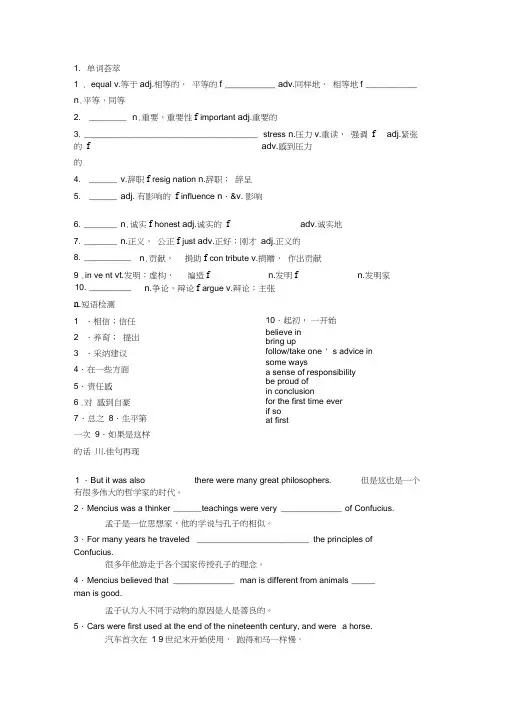
1. 单词荟萃1 . equal v .等于adj .相等的, 平等的f __________ adv .同样地, 相等地f ___________n .平等,同等2. ________ n .重要,重要性f important adj .重要的3. _____________________________________ stress n .压力v .重读, 强调 f adj .紧张的 f _________________________________ adv .感到压力 的4. ______ v .辞职f resig nation n .辞职; 辞呈5. ______ adj . 有影响的 f influence n .&v . 影响6. _______ n .诚实f honest adj .诚实的 f _____________ adv .诚实地7. _______ n .正义, 公正f just adv .正好;刚才 adj .正义的 n .贡献, 捐助f con tribute v .捐赠, 作出贡献9 .in ve nt vt .发明;虚构, 编造f __________ n .发明f _________ n .发明家有很多伟大的哲学家的时代。
2.Mencius was a thinker ______ t eachings were very _____________ of Confucius.孟子是一位思想家,他的学说与孔子的相似。
3.For many years he traveled ________________________ the principles of Confucius.很多年他游走于各个国家传授孔子的理念。
4.Mencius believed that _____________ man is different from animals _____ man is good.孟子认为人不同于动物的原因是人是善良的。