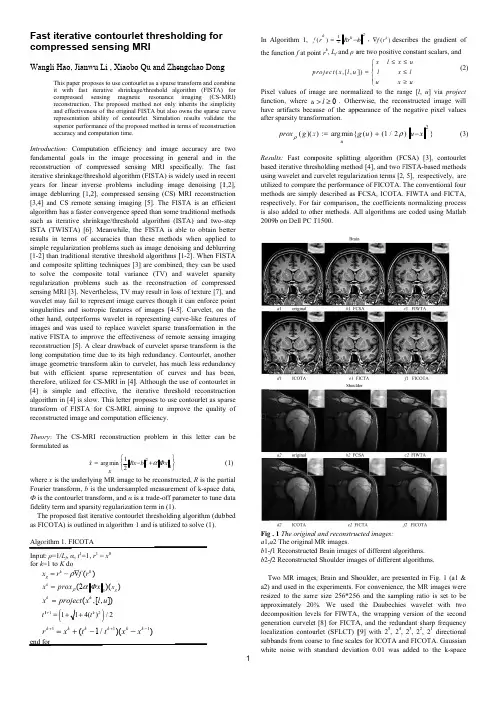
WAVELET TRANSFORM MOMENTS FOR FEATURE EXTRACTIONFROM TEMPORAL SIGNALSIgnacio Rodriguez CarreñoDepartment of Electrical and Electronic Engineering, Public University of Navarre, Arrosadia, Pamplona, SpainEmail: irodriguez@unavarra.esMarko VuskovicDepartment of Computer Science, San Diego State University, San Diego, California, USAEmail: marko@Keywords: Pattern recognition, EMG, feature extraction, wavelets, moments, support vector machinesAbstract: A new feature extraction method based on five moments applied to three wavelet transform sequences has been proposed and used in classification of prehensile surface EMG patterns. The new method has essentially ex-tended the Englehart's discrete wavelet transform and wavelet packet transform by introducing more efficientfeature reduction method that also offered better generalization. The approaches were empirically evaluated onthe same set of signals recorded from two real subjects, and by using the same classifier, which was the Vapnik'ssupport vector machine.1 INTRODUCTIONThe electromyographic signal (EMG), measured at the surface of the skin, provides valuable information about the neuromuscular activity of a muscle and this has been essential to its application in clinical diagno-sis, and as a source for controlling assistive devices, and schemes for functional electrical stimulation. Its application to control prosthetic limbs has also pre-sented a great challenge, due to the complexity of the EMG signals.An important requirement in this area is to accu-rately classify different EMG patterns for controlling a prosthetic device. For this reason, effective feature extraction is a crucial step to improve the accuracy of pattern classification, therefore many signal represen-tations have been suggested.Various temporal and spectral approaches have been applied to extract features from these signals. A comparison of some effective temporal and spectral approaches is given in (Du & Vuskovic 2004), where the authors have applied moments to short time Fou-rier transform (STFT), and short time Thompson transform (STTT) on prehensile EMG patterns.The wavelet transform-based feature extraction techniques have also been successfully applied with promising results in EMG pattern recognition by Englehart and others (1998).The discrete wavelet transform (DWT) and its generalization, the wavelet packet transform (WPT), were elaborated in (Englehart 1989a). These tech-niques have shown better performance than the oth-ers in this area because of its multilevel decomposi-tion with variable trade-off in time and frequency resolution. The WPT generates a full decomposition tree in the transform space in which different wavelet bases can be considered to represent the signal. The techniques were applied to feature extraction from surface EMG signals.However, these techniques produce a large amount of coefficients, since the transform space has very large dimension. This fact suggests the system-atic application of feature selection or projection methods and dimensionality reduction techniques to enable the methodology for real time applications.Englehart applied feature selection and feature pro-jection that yielded better classification results and improved time efficiency. Specifically, the principal component analysis (PCA) was used due to its ability to model linear dependencies and to reject irrelevant information in the feature set (Englehart etal. 1999).This paper continues the work described above by taking a different approach to feature reduction. Extending the idea of spectral moments suggested in (Du & Vuskovic 2004) the sequences of wavelet coefficients are further subjected to the calculation of their temporal moments. The main goal of this work is to propose and empirically compare two different novel feature extraction approaches based on simple two-scale DWT and WPT with the two best Engle-hart’s approaches using the DWT and the WPT in combination with principal component analysis (PCA).In this new approach, the first five raw moments were applied to DWT transformed prehensile EMG sequences, which has proven to be very advanta-geous in the classification stage. The methods em-ployed a simple DWT or WPT with only three trans-form sequences, instead of the full DWT or WPT used by Englehart. This has eliminated the tedious feature reduction procedures and PCA.The evaluation of the three approaches was car-ried out on the same set of data, and with an identical classifier based on Vapnik's support vector machines (SVM) with a linear kernel.2 PREHENSILE EMGSThe research presented here was motivated by the need for classification of prehensile electromiographic signals (EMG) for control of a multifunctional pros-thetic hand (Vuskovic etal. 1995). Since the hand-preshaping phase in an average object grasp takes about 500 ms, it is important to accomplish the feature extraction and classification in less than 400 ms, pref-erably in 200 ms. Such a difficult task requires very strong feature extractor and classifier.The mioelectric control of multifingered hand prostheses was studied in several papers, for example (Nishikava 1991), (Uchida 1992), (Farry 1996), and (Huang 1999). Most of the ideas in these efforts were inspired by Hudgins (Hudgins etal. 1991). In this work the concept of preshaping of multifunctional grasps was based on the recognition of a particular finger joint movement. In an earlier work done at San Diego State University, the approach was rather dif-ferent, based on grasp types, instead of hand configu-rations in joint space. Once a grasp type is recognized from the recorded EMGs, it can be then synergisti-cally mapped into the desired joint configuration (Vuskovic 1995) for any hand, with any number of degrees of freedom. We have considered four basic grasp types according to the Schlesinger classification (Schlesinger 1919): cylindrical grasp (C), spherical grasp (S), lateral grasp (L) and precision grasp (P), see figure 1.3 EXPERIMENTAL SETUPFour-channel surface EMG signals from two healthy subjects were recorded at 1000 Hz sampling fre-quency. The recording was done while the subject has repeatedly performed the four grasp motions. There were 216 grasp recordings evenly distributed across the four grasps types: 60 (subject 1) + 4 (sub-ject 2) for cylindrical grasp, 30+10 for precision grasp, 30+10 for lateral grasp and 60 + 12 for spheri-cal grasp. Three different EMG sequence lengths were used: 200 ms, 300 ms and 400 ms. The 200 and 300 ms sequences were obtained by truncating the recordings of 400 ms sequences. (The sequences of300 ms were not presented in this paper.)Figure 1: Four grasp types.4 DISCRETE WA VELET TRANS-FORMThe DWT is a transformation of the original tem-poral signal into a wavelet basis space. The time-frequency wavelet representation is performed byrepeatedly filtering the signal with a pair of filtersthat cut the frequency domain in the middle.Specifically, the DWT decomposes a signal into an approximation signal and a detail signal. The ap-proximation signal is subsequently divided into new approximation and detail signals. This process is carried out iteratively producing a set of approxima-tion signals at different detail levels (scales) and a final gross approximation of the signal.The detail Dj and the approximation Aj at level j can be obtained by filtering the signal with an L -sample high pass filter g , and an L -sample low pass filter h . Both approximation and detail signals are downsampled by a factor of two. This can be expressed as follows:1110[][][][2],L j j j k A n A n h k A n k −−−===∑Η− (1) 1110[][][][2],L j j j k D n D n g k A n k −−−===∑G − (2) where 0, n = 0,1,…N-1 is the original temporalsequence, while H and G represent the convolu-tion/down sampling operators. Sequences g[n] andh[n] are associated with wavelet function []A n ()ψt andthe scaling function through inner products:()ϕt[]((2),g n t t n =ψ− (3)[]((2).h n t t n =ϕ− (4)Operators H and G can be applied repeatedly in al-teration, for example: 0AA A =H H , DD=0A =G G , AD =0A G H ,DA =0The A and D sequences obtained as the result ofDWT are still massive in terms of the number ofsamples, which contributes to large dimensionality offeature space. Besides, the sequences have a highnoise component inherited from the original EMGsignal.A =H G , etc.A feature extraction approach based on DWTapplied by Englehart (1998, 1998a) consists of fourdifferentiated phases:1. Perform full DWT decomposition of the EMGsignals, until scale j = log2 (N), with the Coifletwavelet of order 4 (C4);2. Square the DWT coefficients;3. Apply PCA for dimensionality reduction tech-niques;4. Determine the optimal number of features perchannel based on the target classifier.An optimization phase is needed before selecting the adequate number of PCA features in order to maxi-mize the performance of the target classifier. The optimum number of features was 100 DWT coeffi-cients per channel of the EMG signal used in this work.5 WA VELET PACKET TRANS-FORMThe WPT is a generalization of DWT. It generates a full wavelet basis decomposition tree. In each scale,not only the approximation signal as in DWT, butalso the detail signals are filtered to obtain another two low and high frequency signals. Many different representations of a signal can be obtained by select-ing different wavelet packet basis. In this regardWPT is superior to DWT, as the chosen basis can be optimized with respect to frequency or time resolu-tion. Englehart (1999) generated a feature extraction method based on the WPT for EMG signals. In this method a previous phase must be applied to the set of training signals. The underlying idea is to select theWPT basis that best classifies all classes of signals. For this purpose, Englehart proposed a modified ver-sion of the local discriminant basis (LDB) algorithm(Englehart 1998a, 2001), to maximize the discrimi-nation ability of the WPT by using a class separabil-ity cost function (Saito & Coifman 1995). Once thebest basis for classification is defined (for differentchannels and different signal lengths), the followingsteps must be performed:1. Perform the full WPT decomposition untilscale j = log 2 (N), with the Symlet wavelet oforder 5 (S5);2. Square the WPT coefficients;3. Average energy maps within each subband;4. Select the WPT coefficients from a basis cho-sen previously for each channel and for differ-ent signal lengths;5. Extract the optimal number of features basedon the target classifier;6. Apply PCA transform to the feature space fordimensionality reduction (removing the eigen-vectors whose eigenvalues are zero);7. Extract the optimum number of features per channel for the target classifier;The optimal number of features for Englehart’s WPT based approach and for the support vector ma-chine as the target classifier (see section 7) was found to be three features per channel, per signal length.6 DWT AND WPT MOMENTS 1The new approach for feature extraction presented here is based on DWT and WPT, and on the calcula-tion of their temporal moments. The approach was first proposed in (Rodriguez & Vuskovic 2005) as an extension of the idea of spectral moments (Du & Vuskovic 2004).Specifically, we used two different wavelets suc-cessfully applied by Englehart on surface EMG sig-nals: C4 and S5In order to reduce the dimensionality and to smooth out the noise, we applied six moments to transformed signals (DWT and WPT):10[],0,1,2,...,5,j mN m n jnM S n m N −=⎛⎞==⎜⎟⎜⎟⎝⎠∑ (5) where represents sequences A, D, AA, DD, AD and DA used in algorithms described below, while N []S n j is number of samples at the corresponding level of decomposition.The new approach based on DWT consists of the following steps:1. Perform two-scale decomposition of the inputsignal;2. Compute moments for three transform se-quences (D, AA, AD);3. Apply logarithm transform to each feature,log(0.1+f);4. Normalize all features using mean value andstandard deviation computed for each feature across all samples.The choice of sequences D, AA and AD was made empirically; it has given the best results in av-1DWT and WPT moments should not be confused with wavelet vanishing moments.erage for the given set of data. Similar choice was made for WPT algorithm.The WPT-based method has the following steps:1. Perform two-scale decomposition of the inputsignal;2. Select basis obtained from previous applicationof the best basis Coifman algorithm; 3. Compute moments for three transform se-quences (A, DA, DD);4. Apply logarithm transform to each feature,log(0.1+f);5. Normalize all features using mean value andstandard deviation computed for each feature across all samples.The optimal basis selection in this method was based on a single channel. The same basis thus ob-tained was subsequently used for single and multiple channels, and for different sequence lengths.Log transformation was applied to moments as it effectively reduces the skewness and the kurtosis of data, consequently resulting in an estimated probabil-ity density that appears more like normal distribution (Vuskovic atal. 1995). The nonlinear transformation of features has significantly improved the classifier performance.7 THE SVM CLASSIFIERThe support vector machines ( Christianini & Shaw-Taylor 2000) are a family of learning algorithms based on the work of Vapnik (1998), which have recently gained a considerable interest in pattern rec-ognition community. The success of SVM comes from their good generalization ability, robustness in high dimensional feature spaces and good computa-tional efficiency.In this work, a standard SVM classifier with lin-ear kernel has been used for dichotomic (binary) clas-sification (Gunn 1997). The multiclass SVM can also be considered, but this is out of the scope of this pa-per.The previous work on the classification of pre-hensile EMG patterns (Vuskovic 1996) has shown that the most difficult is to discriminate cylindrical from spherical grasps (C/S), and then lateral from precision grasps (L/P). Therefore the SVM is applied to these pairs of grasp types and the feature extraction methods were evaluated accordingly.The classification tests were performed with leave-one-out method, where one sample was re-moved from the data set and the rest of the samples were used to train the SVM. The procedure was re-peated for each sample in the data set, and the aver-age hit rate was computed afterwards.8 COMPUTATIONAL COMPLEX-ITYApplication of WPT and calculation of J scales, 2log ≤J N , where N is the length of the original temporal signal, results in JN coefficients. Conse-quently, the computational cost of the full-scale WPT is in the order of 2 (Englehart 2001). Similarly, the computational complexity of full-scale DWT is half the computational complexity of the WPT, i.e.()≤O JN (log )O N N (2log 2O N N ). Since our new ap-decomposition, we can enumerate all the approaches with respect to their computational complexity in the increasing order: DWT(new) < WPT (new) < DWT (Englehart) < WPT (Englehart). The complexities are summarized in table 1.Table 1: Computational complexityNew approachEnglehartDWT WPT DWT WPTO(N)O(2N)O(N logN/2)O(N logN)9 EXPERIMENTAL EV ALUATIONIn this section we discuss the methodology for the experimental evaluation of DWT and WPT ap-proaches.9.1 Cluster VisualizationIn order to compare the effectiveness of a feature extraction method there is needed some method to compare the discrimination of clusters in feature space, either by 2D or 3D scatter plots, or by some distance measure between clusters. Both methods are normally based on the transformation of the feature space through PCA or Fisher-Rao transform, which both use the inverse of the cluster covariance matri-ces. Unfortunately the dimensionality of the feature space is often larger than the number of samples, which makes the methods inapplicable due to the singularity or ill-conditioning of the covariance ma-trices. However, the support vector machines offered new possibilities. SVM maximize the margin be-tween clusters and the separation hyperplane in the original or kernel-induced feature space without a need to use covariance matrices.We use in this work a projection of the original feature space onto the line perpendicular to the maximal-margin separation hyperplane: (6) ,T p X w =where X is N ×d sample (feature) matrix, w is unit, d -dimensional normal to the separation hyperplane, and p is N -vector of projected samples. In order to get a 2D plot of samples another projection vector is needed: (7) .T q X u =The d -dimensional projection vector u doesn't have to be orthonormal to w , but has to be unique in some way. Therefore we used the direction of the minimal variance of both clusters, which is nearly laying in the separation hyperplane. The vector coin-cides with the eigenvector that corresponds to the smallest non-zero eigenvalue of the pooled covari-ance matrix:11221212(1)(1)(,),2N S N S S pool S S N N −+−==+− (8) where N i (N 1+N 2 = N ) and S i are sizes and covari-ance matrices of the two clusters. An example of cluster diagrams, plot(p,q), is shown in figure 3, which will be discussed later.9.2 Hotelling DistanceA useful quantitative measure of cluster discrimina-tion in multidimensional space is Hotelling distance between cluster means (T 2 statistic). The T 2 can be computed for projected clusters:211212121212()()(,),T N N T c c C c N N C pool C C −=−+=,c − (9), where i and C c i are sample means and sample co-variance matrices of projected clusters respectively. In order to establish the significance of the distance under some confidence level, the T 2 distance needs to be compared with the corresponding critical value2c T . The critical value can be obtained if we assume that the quantity21212(1(2N N r T N N r+−−+−)) has F-distribution with degrees of freedom r and 121f N N r =+−−, where r = 2 in case of 2D pro-jections (Seber 1984). The above is true under the assumption that clusters have normal distributions with nearly equal sizes and covariance matrices. If this is not the case, a stronger statistic has to be used. In this work we used statistic suggested in (Yao 1965), where the cluster distance was computed as:()1212112212()//()T T c c C N C N c c −=−+−T . (10)The degrees of freedom for the F-distribution were estimated from the data (Seber 1984) (not pre-sented here due to limited space). The test works for unequal clusters that can have any bell-shaped distri-bution. The T 2 values are shown in tables 2 and 3, and in the scatter diagrams in figure 3. The critical values c were all below 11. The value of cluster distances as a quantitative measure of cluster dis-crimination is that they can be easily and quickly computed.29.3 Number of MomentsOnce the classification pairs are determined, the next step is to determine the optimal number of DWT and WPT moments, which will be used for feature reduction. This was done experimentally by extensive application of feature extractions and classiffications to different EMG signal lengths and different number of channels.Figure 2: Hotelling distances versus number of momentsfor WPT: (a) 200 ms, single channel, (b) 200ms, four channels, (c) 400 ms, single channel, (d) 400 ms, four channels (C/S grasps – lower bars, L/P grasps upper barBased on the bar graphs the selection of five mo-ments (M 0, M 1,…,M 4) was a clear choice.10 THE RESULTSThe comparison of four different approaches: the five-moment DWT and WPT as proposed in this paper, and the DWT and WPT of Englehart (1998a, 1999) have been measured by Hotteling distances and by the classification hit rates applied to two cluster pairs (C/S) and (L/P).The results are presented in tables 2 through 5. The feature extraction was performed for 200 and 400 ms time sequences recorded from a single channel and from four simultaneous channels. Each channel repre-sented one surface EMG electrode attached to the up-per-forehand of the subject. Several different wavelets were used in experiments, but only the two most suc-cessful ones were shown here: the fourth-order Coif-man wavelets (C4) and the fifth-order symlets (S5). The two tables show a roughly good correlation be-tween the Hotelling distances and the classification hit-rates. The small differences can be explained by the fact that the Hotelling distances point the goodness of clustering, while the hit rates stress the generaliza-tion of the trained SVM.An example of four different cluster scatter dia-grams is shown in figure 3.Figure 3: SVM-projected clusters, 200 ms, and four channels, WPT: (a) C/S - new approach, (b) L/P - new approach, (c) C/S - Englehart, (d) L/P - EnglehartThe results suggest clear advantage of our novel method over the Englehart’s approaches mainly due to the moments used for dimensionality reduction, instead of applying PCA. In addition, the application of log transformation on features has helped consid-erably. Our WPT novel method seems to behave bet-ter at classifying the 200 ms sequences. This is due to the WPT basis selection, which better characterizes the frequency structure of the transient signals.Table 2: Hotelling distances (C/S)New approach EnglehartWT WPT Sig. length /chnlsC4 S5 C4 S5 DWT C4WPT S5200/1 75 61 109 97 49 13200/4352 466 424 421 201 73 400/1 92 79 96 79 480 45 400/4 366 570 535 488 295 100Table 3: Hotelling distances (L/P)New approach Englehart DWT WPT Sig.length /chnls C4 S5 C4 S5 DWT C4 WPT S5 200/1 33 65 44 100 362 11 200/4 289 3462 1724 723 756 107 400/1 178 166 233 262 118 60 400/4 560 24680 1472 718 2388 168Table 4: Classification hit rates in % (C/S)New approach EnglehartWT WPT Sig. length /chnlsCO4 SY5 CO4 SY5 DWT C4WPT S5200/1 75.0 76.7 79.2 79.2 60.8 62.5 200/4 90.0 94.2 94.2 95.0 86.7 88.3 400/1 80.8 80.0 80.8 77.5 60.8 59.2 400/4 99.2 96. 7 98.3 97.5 88.3 93.3Table 5: Classification hit rates in % (L/P)New approach Englehart WT WPTSig. length /chnls CO4 SY5 CO4 SY5WT WPT200/1 73.3 81.7 81.7 83.3 56.7 53.3 200/4 91.7 96.7 90.0 98.3 80.0 93.3 400/1 96.7 95.0 93.3 91.7 56.7 63.3 400/4 99.9 99.9 99.9 99.9 88.3 95.011 CONCLUSIONSA new approach of wavelet-based feature extraction from temporal signals has been proposed. The ap-proach extends the Englehart's discrete wavelet trans-form and wavelet packet transform by subjecting the two-scale, three-sequence wavelet coefficients to temporal moment computation. This has helped re-duce significantly the dimensionality of the resulting feature vectors without loosing the essential informa-tion in the original patterns. It was found experimen-tally that first five raw moments represent a good compromise. The new methods are applied to prehen-sile EMG signals of various lengths and various amounts of input signals (surface EMG channels) and compared to the best approaches of Englehart, on the same set of signals. For the comparison are used two quantitative measures: Hotelling statistic and classifi-cation hit rates. The classifier applied to the extracted features was linear support vector machine, which has exceptionally good performance in case of large fea-ture spaces and fewer training samples. The results have shown superior performance of the new ap-proach. A brief complexity analysis also shows that the new approach is more efficient time wise.Although the methodology was demonstrated on EMG signals, we believe the methodology can equally successfully be applied to other temporal sig-nals.REFERENCESChristianini N., Shawe-Taylor, 2000. An Introduction toSupport Vector Machines . Cambridge Univ. Press. Du S. and Vuskovic M., 2004. Temporal vs. Spectral ap-proach to Feature Extraction from Prehensile EMG Sig-nals. In IEEE Int. Conf. on Information Reuse and Inte-gration (IEEE IRI-2004), Las Vegas, Nevada.Englehart K., Hudgins B., Parker P. and Stevenson M., 1998. Time-frequency representation for classification of the transient myoelectric signal. In ICEMBS’98.Proceedings of the 20th Annual International Confer-ence on Engineering in Medicine and Biology Society.ICEMBS Press.Englehart K., 1998a. Signal Representation for Classifica-tion of the Transient Myoelectric Signal. Doctoral The-sis. University of New Brunswick, Fredericton, New Brunswick, Canada.Englehart K., Hudgins B., Parker P. and Stevenson M., 1999. Improving Myoelectric Signal Classification us-ing Wavelet Packets and Principle Component Analy-sis. In ICEMBS’99. Proceedings of the 21st Annual In-ternational Conference on Engineering in Medicine and Biology Society, ICEMBS Press.Englehart K., Hudgins B., Parker P., 2001. A Wavelet –Based Continuous Classification Scheme for Multi-fucntion Myoelectric Control. In IEEE Transactions on Biomedical Engineering, vol. 48, No. 3, pp. 302-311. Farry, K. A., Walker I. D., Baraniuk R. G., 1996. Myoelec-tric Teleoperation of a Complex Robotic Hand. IEEE Trans On Robotic and Automation, Vol. 12, No.5. Gunn S.R., 1997. Support Vector Machines for Classifica-tion and Regression. Technical Report, Image Speech and Intelligent Systems Research Group, University of Southampton.Hannaford B. and Lehman S., 1986. Short Time Fourier Analysis of the Electromyogram: Fast Movements and Constant Contraction. In IEEE Transactions On Bio-medical Engineering. BME-33,Han-Pan Huang H-P, Chen C_Y., 1999. Development of a Myoelectric Discrimination System for Multi-Degree Prosthetic Hand. Proc. of the 1999 International Con-ference on Robotics and Automation, Detroit, May pp.2392-2397.Hudgins, P. Parker and R.N. Scott, 1991. A Neural Net-work Classifier for Multifunctional Myoelectric Con-trol. Annual Int. Conf. Of the EMBS, Vol. 13, No. 3, pp.1454-1455.Hudgins B., Parker P. and Scott R. N., 1993. A New Strat-egy for Multifunctional Myoelectric Control. In IEEE Transactions on Biomedical Engineering, vol. 40, No.1, pp. 82-94.Saito N. and Coifman R. R., 1995. Local Discriminant Basis and their applications. J. Math. Imag. Vis., Vol.5, no 4, pp. 337-358.Nishikawa D, Yu W. Yokoi H, and Kakazu Y, 1991. EMG Prosthetic Hand Controller using Real-Time Learning Method. In Proc. of the IEEE Conf. on SMC, Vol. 1, pp. I 153-158. Carreño I. R., Vuskovic M., 2005. Wavelet-Based Feature Extraction from Prehensile EMG Signals. In 13th Nor-dicBaltic on Biomedical Engineering and Medical Physics (NBC'05 UMEA), Umea, Sweden, 13-17. Schlesinger, D., 1919. Der Mechanische Aufbau der Kunstlishen Glieder. In Ersatzglieder und Arbeitshil-fen, Springer, Berlin.Seber G.A.F., 1984. Multivariate Observations, John Wiley & Sons, pp 102-117.Uchida N. U., Hiraiwa A., Sonehara N., Shimohara K., 1992. EMG Pattern Recognition by Neural Networks for Multi Fingers Control. Proc. of the Annual Int.Conf. of the Engineering in Medicine and Biology So-ciety. Vol 14, Paris, pp.1016-1018.Vapnik V. N., 1998. Statistical Learning Theory. John Wiley & Sons.Vuskovic M., Pozos A. L., Pozos R, 1995. Classification of Grasp Modes Based on Electromyographic Patternsof Preshaping Motions. Proc. of the Internat. Confer-ence on Systems, Man and Cybernetics. Vancouver,B.C., Canada, pp. 89-95, 1995.Vuskovic M., Schmit J., Dundon B. Konopka C., 1996.Hierachical Discrimination of Grasp Modes Using Sur-face EMGs. Proc. of the Internat. IEEE Conference on Robotics and Automation, Minneapolis, Minnesota, April 22-28. 2477-2483.Yao, Y., 1965. An Approximate Degrees of Freedom Solu-tion to the Multivariate Behrens-Fisher Problem, Biometrica, Vol. 52, 139-147.。