
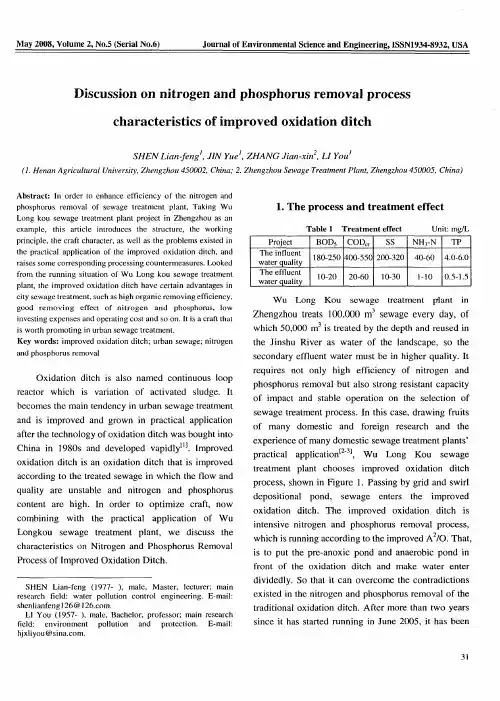
Discussion on nitrogen and phosphorus removal process characteristics of improved oxidation ditc
- 格式:pdf
- 大小:249.08 KB
- 文档页数:4
简论氮\磷循环特征对水体富营养化影响的论文摘要:通过对朱庄水库营养物质监测分析,氮含量比磷含量大几百倍。
氮和磷都是造成水体富营养化的主要因子。
由于受外界环境条件和水体性质的影响,外界污染源调查,氮污染源远远大于磷污染。
水库水体溶解氧较大,ph值呈碱性,硝化作用的结果使水体中硝酸盐氮累计;同样的条件,导致不溶性磷的积累,大部分沉积于库底。
水体富营养化条件是氮磷达到适合的比例,才会导致水华的爆发。
该水库水体磷含量低,是抑制水体富营养化的关键。
因此,该水库属于磷限制性水库。
控制水库上游磷的排入量,可有效控制水体富营养化。
关键词:氮磷营养物质;氮磷循环特征;富营养化形成机理;朱庄水库effect of nitrogen and phosphorus cycling characteristic on eutrophication of water bodywang zhen-qiang1,liu chun-guang1,qiao guang-jian 2(reservoir administrative,xingtai 054000,china; city hydrology & water resources survey bureau,xingtai 054000,china)abstract: analysis on nutrients monitoring of zhuzhuang reservoir shows that nitrogen content is hundreds of times more than and phosphorus are both major causes of water to external environmental conditions and water properties,investigations on pollution sources show that nitrogen caused pollutions is much more than water dissolves lots of oxygen,the ph value reflect on alkalescence,then by the reaction of nitrification,nitrate accumulated in water;in the same conditions,insoluble phosphorus is also accumulated,and most of them deposit at the bottom of nitrogen and phosphorus get to certain ratio in water,may cause the water eutrophication,then will lead to algae bloom the low phosphorus content in reservoir water is crucial to curb ,the reservoir is phosphorus restricted control the phosphorus quantity comes from upper reaches can effectively control the eutrophication.key words: nitrogen and phosphorus nutrients;cycling characteristic of nitrogen and phosphorus;eutrophication mechanism;zhuzhuang reservoir朱庄水库地表水资源是邢台市供水水源。

论述美国河湖氮磷标准摘要:美国EPA颁布的美国各营养物分区总氮、总磷基准标准推荐值没有考虑河、湖总氮、总磷衔接问题, EPA生态Ⅵ分区推荐的河流TP基准或标准为是湖泊TP的基准或标准的2倍左右;河流TN是湖泊TN基准或标准的2.79倍左右。
虽然美国EPA营养物基准未直接考虑河、湖氮磷水质衔接问题,但是EPA颁布的湖泊、水库营养物制定基准指南《Nutrient Criteria Technical Guidance Manual: Lakes and Reservoirs》却提出了基于美国清洁水法303(d),针对受损水体需要开展每日最大负荷计划(TMDLs)。
关键词:美国河湖氮磷标准衔接Abstract:America EPA issued by various nutrients partitioning the total nitrogen, total phosphorus, benchmark standards recommended value without considering the river, lake, total nitrogen, total phosphorus join problem, the EPA on ecological Ⅵ recommended rivers is TP benchmark or standard for lakes TP benchmark or standard about 2 times; River TN is about 2.79 times of lake TN datum or standard. Althoughthe U.S. EPA nitrogen and phosphorus nutrients benchmark does not directly consider the river, lake water quality problem, but the EPA issued Lakes and Reservoirs nutrients for benchmark guide the Nutrient Criteria Technical Guidance Manual: 'lakes and Reservoirs, are presented based on the clean water act of 303 (d), for the damagedwater (TMDLs) need to carry out the daily maximum load plan.Key words: American rivers and lakes; nitrogen and phosphorus; standard cohesion1 前言磷和氮是两种天然存在的生物活性元素,是所有生物组织的组成部分,它们是植物和动物生命所必需的营养物质,是维持湖泊生态系统健康的必要物质。
使用化肥种植的英语作文Title: The Impact of Fertilizer Usage in Agriculture。
In modern agriculture, the utilization of fertilizers has become commonplace, revolutionizing the way wecultivate crops. Fertilizers are essential nutrients that enhance soil fertility, leading to increased crop yields and improved food production. However, along with their benefits, the indiscriminate use of fertilizers also poses various challenges and concerns.First and foremost, fertilizers play a crucial role in providing plants with essential nutrients such as nitrogen, phosphorus, and potassium. These nutrients are vital for plant growth and development, as they contribute to processes like photosynthesis, root development, and fruit formation. By replenishing the soil with these nutrients, fertilizers ensure that crops have access to the elements necessary for optimal growth.Moreover, fertilizers enable farmers to achieve higher crop yields, thereby addressing the ever-growing demand for food worldwide. With the global population projected to reach nearly ten billion by 2050, the need to enhance agricultural productivity has never been more urgent. Fertilizers help maximize the yield potential of crops, allowing farmers to produce more food on the same amount of land.Furthermore, the use of fertilizers can contribute to environmental sustainability by improving soil health and reducing the need for expansion into natural habitats. By maintaining soil fertility, fertilizers support soil structure and prevent erosion, preserving valuable agricultural land. Additionally, higher yields obtained through fertilizer application can alleviate pressure on forests and other ecosystems, reducing deforestation and habitat destruction.However, despite these benefits, the excessive or improper use of fertilizers can have detrimental effects on the environment and human health. One significant concernis water pollution, as excess nutrients from fertilizers can leach into water bodies, leading to eutrophication. This process results in the overgrowth of algae, depleting oxygen levels in water and harming aquatic ecosystems.Moreover, the runoff of fertilizers into surface water or groundwater can contaminate drinking water sources, posing risks to human health. High levels of nitrates, for example, have been linked to health issues such as methemoglobinemia, or "blue baby syndrome," particularly in infants. Additionally, the presence of nitrogen and phosphorus in water bodies can contribute to the growth of harmful algal blooms, which produce toxins harmful to aquatic life and humans.Furthermore, the overreliance on fertilizers can lead to soil degradation and loss of biodiversity. Continuous application of synthetic fertilizers may disrupt the natural balance of soil microorganisms and decrease soil fertility over time. This can result in soil compaction, reduced water retention, and increased susceptibility to erosion, ultimately diminishing the long-term productivityof agricultural land.In conclusion, fertilizers play a vital role in modern agriculture by enhancing soil fertility and increasing crop yields. However, their indiscriminate use can have adverse effects on the environment and human health. To mitigate these impacts, it is essential to promote sustainable fertilization practices, including precision agriculture, nutrient management planning, and the use of organic alternatives. By balancing the benefits of fertilizers with environmental stewardship, we can ensure the continued prosperity of agriculture for future generations.。

英语作文-城镇污水处理与资源化利用方案Urban wastewater treatment and resource utilization have become critical issues in contemporary urban planning and environmental management. As cities grow in population and economic activities intensify, the volume of wastewater generated also increases, posing significant challenges to both public health and the environment. Effective strategies for wastewater treatment and resource recovery are essential for sustainable development and environmental protection.Wastewater contains a complex mixture of organic and inorganic pollutants that must be effectively removed before discharge into natural water bodies or reuse. Conventional wastewater treatment processes typically include primary treatment, where solid materials are separated, and secondary treatment, which involves biological processes to remove dissolved organic matter. Advanced treatment methods such as tertiary treatment and disinfection further improve water quality to meet specific reuse standards or environmental regulations.In recent years, the concept of resource-oriented wastewater management has gained traction. Instead of viewing wastewater as a mere waste product, it is now seen as a potential source of valuable resources such as nutrients (nitrogen and phosphorus), energy (biogas), and water itself through advanced treatment technologies. For instance, anaerobic digestion of organic matter in wastewater produces biogas, a renewable energy source that can be used for electricity generation or heating. Nutrient recovery from wastewater, particularly nitrogen and phosphorus, is crucial for sustainable agriculture and reduces dependency on chemical fertilizers.Technological advancements have significantly enhanced the efficiency and cost-effectiveness of wastewater treatment processes. Membrane bioreactors (MBRs), for example, combine biological treatment with membrane filtration to achieve high-quality effluent suitable for reuse in industrial processes or urban irrigation. Similarly, constructed wetlands mimic natural wetland ecosystems to treat wastewater throughbiological and physical processes, offering a sustainable and low-energy alternative to traditional treatment methods.Moreover, decentralized wastewater treatment systems are gaining popularity in urban areas, especially in developing regions where centralized infrastructure may be lacking. These systems treat wastewater closer to the source of generation, reducing the burden on centralized treatment plants and minimizing transportation costs and energy consumption associated with wastewater conveyance.In the context of urban planning, integrating wastewater treatment facilities with green infrastructure promotes environmental sustainability and enhances urban resilience. Green roofs, permeable pavements, and rain gardens not only manage stormwater but also contribute to improving water quality by reducing runoff pollutants that would otherwise enter the wastewater treatment system.Public awareness and community engagement play crucial roles in the success of wastewater management initiatives. Educating residents about the importance of proper wastewater disposal and the benefits of recycling treated wastewater for non-potable uses fosters a culture of environmental stewardship and responsibility.In conclusion, effective urban wastewater treatment and resource utilization are pivotal for sustainable urban development. By adopting innovative technologies, promoting resource recovery, and integrating green infrastructure into urban landscapes, cities can achieve significant environmental and economic benefits. Continued research and investment in wastewater management will further enhance our ability to address emerging challenges and ensure a cleaner, healthier future for urban populations worldwide.。