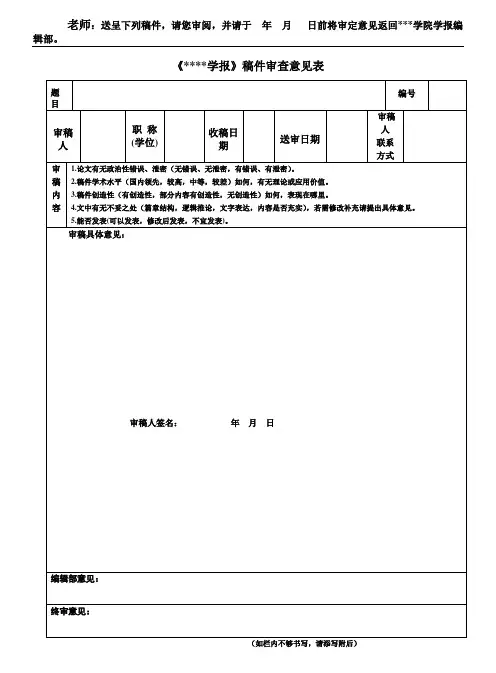
审稿意见模板
- 格式:doc
- 大小:34.00 KB
- 文档页数:4
论文审稿Ms. Ref. No.: JSV-D-06-01203
Title: Fault diagnosis research based on time-frequency analysis method in rotor systems
Journal of Sound and Vibration
Dear student ××××,
We have now received comments on your manuscript from the reviewers (reports included
below). Please revise your manuscript according to the referee's suggestions and detail all the
changes which you have made. I hope you will be prepared to undertake this, and I will then be
pleased to reconsider the manuscript for publication. Please note that due to the extensive
revisions necessay on your manuscript, it will need to be sent out for re-review.
If you do decide to revise the paper, we need to receive your new manuscript within the next
six months. You are asked to submit the following items along with the manuscript:
(1) A point-by-point reply that we can send to each reviewer;
(2) A separate list of the revisions made to the manuscript.
It is important that you address all the issues raised by the referees, either by revision or
reasoned rebuttal, before we make a decision on publication.
When submitting your revised manuscript, please ensure that you upload the source files (e.g.
Word). Uploading only a PDF file at this stage will create delays should your manuscript be
finally accepted for publication. If your revised submission does not include the source files,
we will contact you to request them.
To submit a revision, please go to /jsv/ and login as an Author.
Your username is: ********
Your password is: **************
On your Main Menu page is a folder entitled "Submissions Needing Revision". You will find
your submission record there.
Yours sincerely,
Richard Berryman
Editorial Office (Australasia)
Journal of Sound and Vibration
Reviewers' comments:
Reviewer #1: Comments on JSV-D-06-01203
Title: Fault diagnosis research based on time-frequency method in rotor systems
By: ××, ××and ××××××
_______________________________________
The paper presents an application of reassigned wavelet scalogram for rotor system fault
diagnosis. It is a topic of interest to the researchers in the related areas but the paper needs
very significant improvement before acceptance for publication. My detailed comments are as
follows:
1. The wavelet method (reassigned wavelet scalogram) used in the paper works very well for
the underlying fault diagnosis problem. On the other hand, this wavelet method is a
well-established method, and the present research is a direct application of this method
without new contribution in methodological research.
2. For the above reason, the presentation should be focused on the results. Unfortunately, the
presentation is far from acceptable for publication. The material was not properly organized
and it is strongly suggested that the authors check carefully the English writing and use standard terminologies in the technical area.
3. The title of the paper should be more specific since numerous studies have been done on
the fault diagnosis of rotor systems using wavelets and time-frequency methods. Also, remove
the word "research".
4. On Section 1:
· This section listed many references that are mainly related to rotor dynamics and are not
directly related to rotor system diagnosis. If the authors would like to keep these references,
some discussions on the relevance of these refs to the present research are needed.
· Review on the directly relevant refs will be more helpful for the reader. Also, time-frequency
and wavelets are mainly for non-stationary and transient analysis. The author may discuss in
more detail what types of transients and non-stationary components would appear in rotor
system vibration.
· A few sentences on the organization of the paper will be helpful.
5. On Section 2:
· Since the major method used in the application is reassigned wavelet scalogram, it is not
needed to give the details of three other methods (only give a few words and give the refs).
Instead, the authors may discuss more on the relationship between traditional wavelet
scalogram and the reassigned wavelet scalogram, and explain why the latter is better than the
former.
· Eq (2): the right-hand-side is wrong and "2" is missed.
· The description after Eq (2) is not clear. See Cohen's book for details about the cross-terms.
6. On Sections 3 and 4:
The description needs to be improved. The material in Section 3 should be organized in
several paragraphs.
7. On Section 5:
· The authors did a good experiment and some of the phenomena presented in the
time-frequency planes are also very interesting. However, the observations should be